
Frederic Remington (1861 to 1909) was an American illustrator, painter and sculptor from the far north of New York State. He pictured the American West of the late 1800s, with its cowboys, its cavalry soldiers and the Native peoples of the Plains and the Southwest.
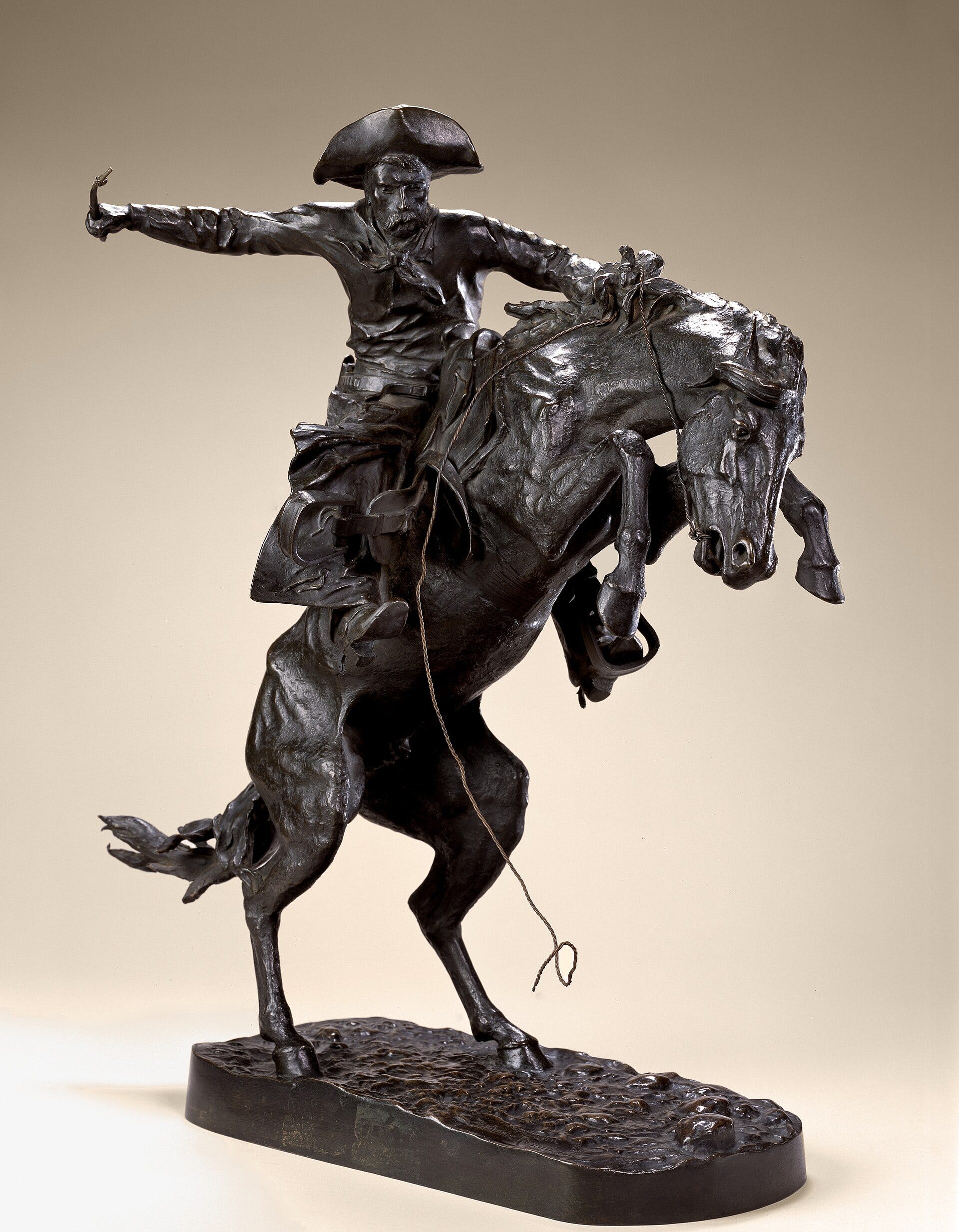
*For about twenty years, Remington's drawings filled the illustrated magazines of New York. His first bronze, The Broncho Buster, a cowboy on a bucking horse, made him famous as a sculptor too.*
Yet many of the Western battles that Remington made famous were invented in a studio near New York City, and he never saw Geronimo, the Apache leader whose trail he followed in 1886. Late in life, he burned more than a hundred of his own pictures.
Cool Stories About Art is a newsletter to learn art the fun way.
Join 200,000+ readers and get:
10 new art stories / month
The entire archive of content (140+ articles)
Comment, ask questions, and chat with other readers
Frederic Remington was born on October 4, 1861, in Canton, a small town in New York State near the Canadian border. His father, Seth Remington, owned a newspaper and had been a cavalry officer in the Civil War.
When Frederic was about eleven, the family moved to Ogdensburg, a port on the St. Lawrence River. At fifteen, the boy summed himself up in a letter: "I don't amount to anything in particular."
In 1878 Frederic entered the art school of Yale University, in New Haven, Connecticut, where he also played on the football team. His father's death in February 1880 ended his studies there.
In the summer of 1881, at nineteen, he traveled to Montana, a territory of the West that was not yet a state. He hoped to buy a ranch there, but he could not afford one.
Remington came home with sketches of cowboys, one of them drawn on wrapping paper. In February 1882, Harper's Weekly, a New York magazine full of pictures, printed that sketch. But an artist employed by the magazine had redrawn it and signed it, and a new title moved the scene to Arizona.
Why did the artist who showed Americans their Wild West end up burning so many of his own pictures?
In the rest of the story
How a steel magnate's order for "a life-and-death struggle" became a battle that never happened.
Why Remington's account of the Wounded Knee Massacre troubled the army's own general.
What Theodore Roosevelt's soldiers gave their colonel when they came home from Cuba.
How a refusal from New York's leading artists changed the way Remington painted.