
Futurism was an art movement launched in Italy in 1909. It asked painters, sculptors, architects and even musicians to show speed, machines, crowds and noise, and to break with museums. Its founder, a poet, announced it in the Paris daily Le Figaro, claiming that a racing car was more beautiful than the Victory of Samothrace, an ancient Greek statue.
Cool Stories About Art is a newsletter to learn art the fun way.
Join 200,000+ readers and get:
10 new art stories / month
The entire archive of content (140+ articles)
Comment, ask questions, and chat with other readers
Speed, Noise and a War They Asked For
The Futurist program came down to one demand: show things in motion. A body, a crowd or a machine was to be taken apart into planes and lines, so that the picture carried its speed. In 1910 five painters of the group signed two manifestos of their own, and the idea soon spread beyond painting, to sculpture, architecture, typography and even machines built to make noise.
The program also had a politics. When war broke out in 1914, the Futurists welcomed it, and in 1915 some of them volunteered to fight. The war cost the movement several of its artists. After the war, part of the group allied itself with Mussolini and his Fascist party.
The twelve works were made between 1910 and 1930, in Italy and abroad. Each is by an artist who signed a Futurist manifesto or openly worked in the Futurist manner, and each puts one demand of the program into practice, whether motion, noise, the city as a machine, war or the view from a plane. Together they also show what the program produced.
12. Luigi Russolo, Intonarumori (1913)
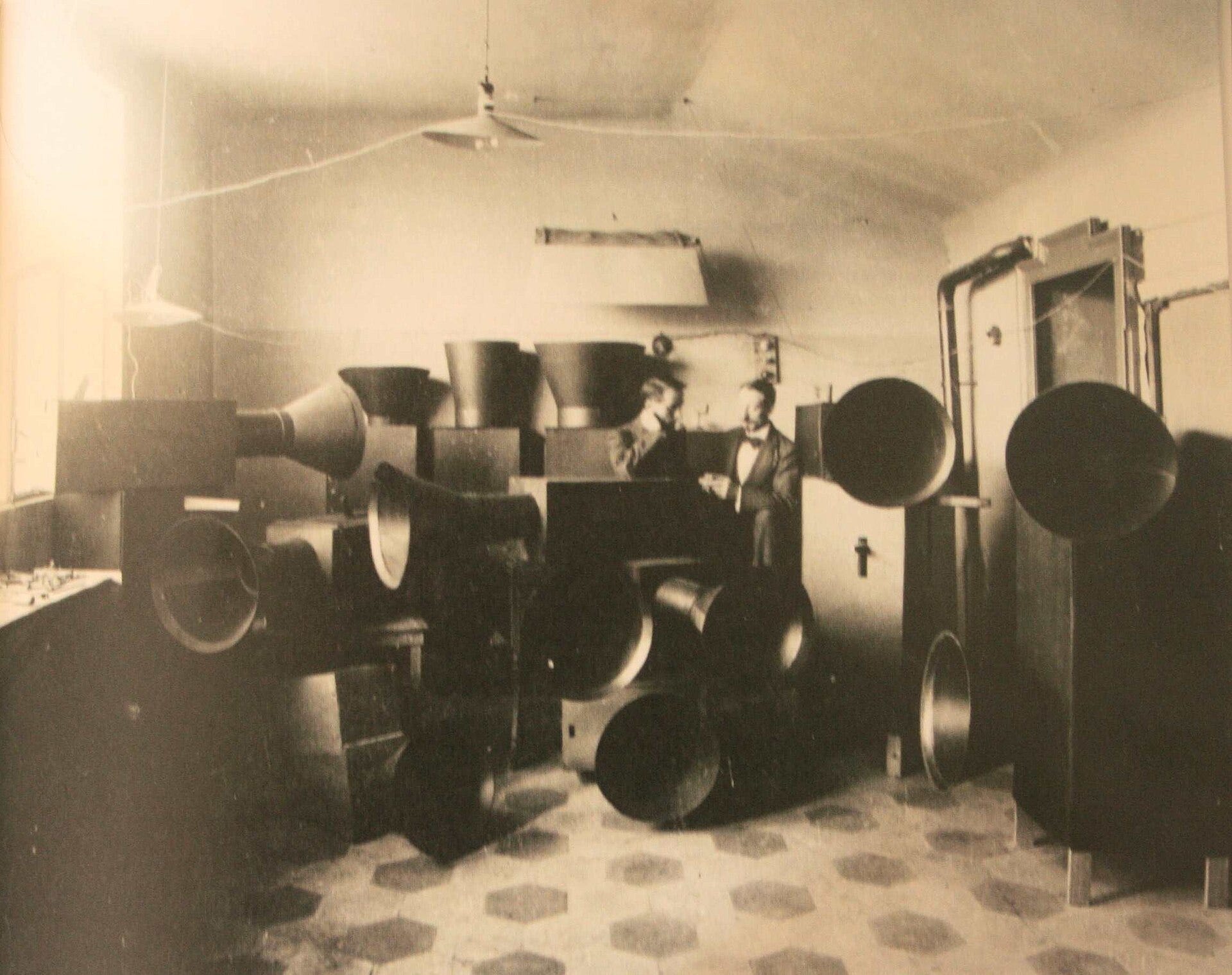
A row of wooden boxes stands in a studio in Milan, each one topped with a large metal horn, like the horn of an old gramophone. Two men in suits stand among them. One is Luigi Russolo, a painter of the Futurist group, and the other is his friend Ugo Piatti. The boxes are instruments, and the two men built them to play noise.
The idea came first, in 1913. Russolo set it out in a long letter to the composer Francesco Balilla Pratella, published under the title The Art of Noises. His aim was to bring the racket of the modern city into the concert hall.
The boxes were his way of doing it. Russolo and Piatti called them intonarumori, which means noise intoners. Inside each one were metal plates, gears and strings, and a player made it sound by turning a crank.
Their first concert took place at the Teatro Dal Verme, a theater in Milan, on April 21, 1914. That morning the police tried to ban the concert. It went ahead in the evening anyway, with eighteen instruments and with Filippo Tommaso Marinetti, the poet who had founded the movement, taking part.
Four pieces were played, and two of the titles told the audience what to expect: The Awakening of a City and Meeting of Cars and Airplanes. In the hall, the heckling turned into a riot, and fights broke out outside the theater.
None of those instruments survives. Most of them were destroyed in Paris during the Second World War, and the others were lost. In 1977, for an exhibition in Venice, Pietro Verardo, a former deputy director of the city's conservatory, built new ones from the early designs.
At a Glance
Artist: Luigi Russolo (1885 to 1947), with Ugo Piatti
Made: 1913 to 1914
Medium: Wooden boxes with metal horns, cranks and levers
Size: Not published
Where to see it: No original survives, only replicas built from the early designs
11. C. R. W. Nevinson, La Mitrailleuse (1915)
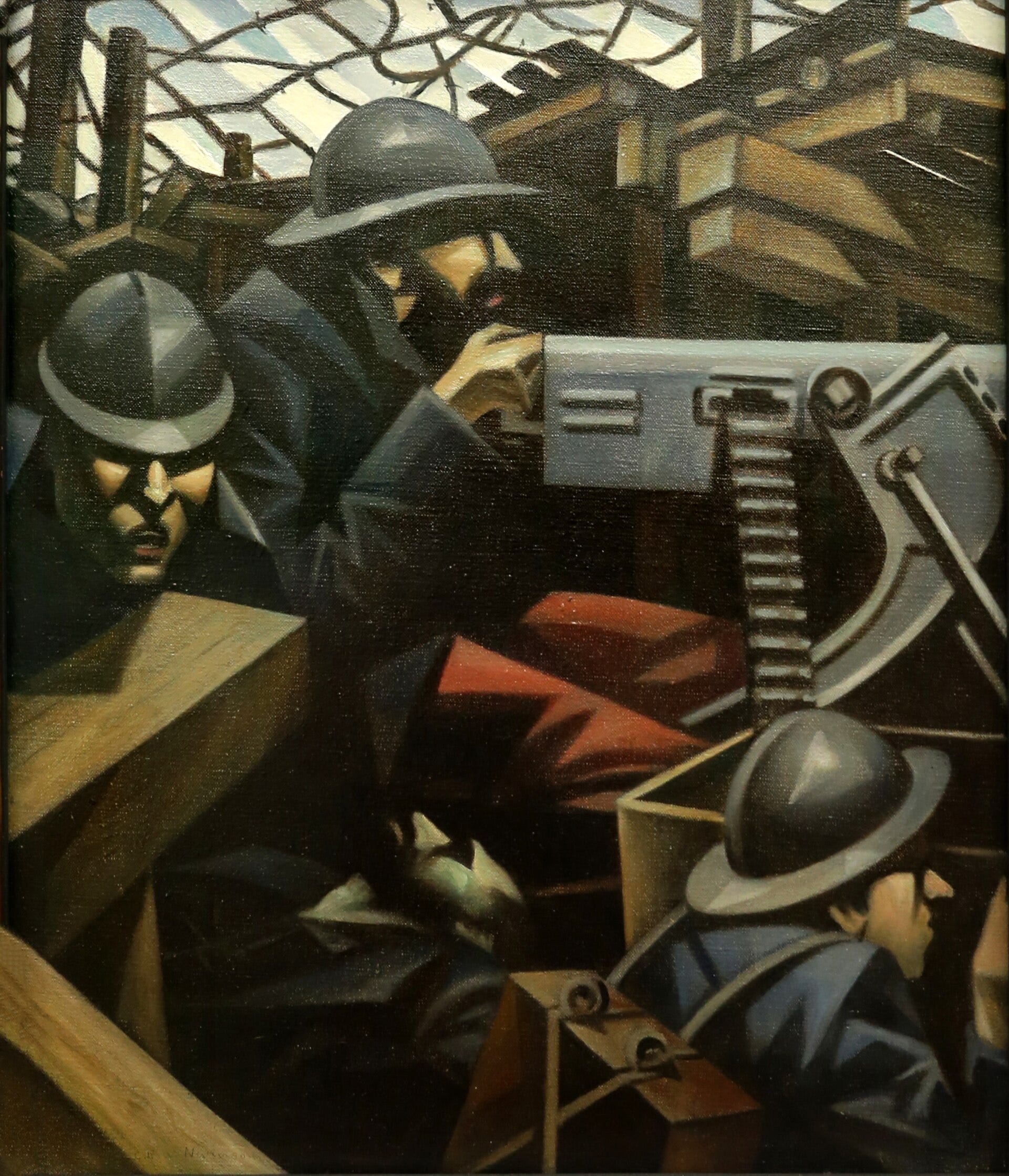
French soldiers crouch behind a machine gun in a trench, and their faces and backs are cut into flat planes with sharp edges. A young Londoner who called himself a Futurist painted them in 1915. In March 1916 the canvas hung in a London exhibition, and a critic summed up in four words what had become of the men at the gun.