
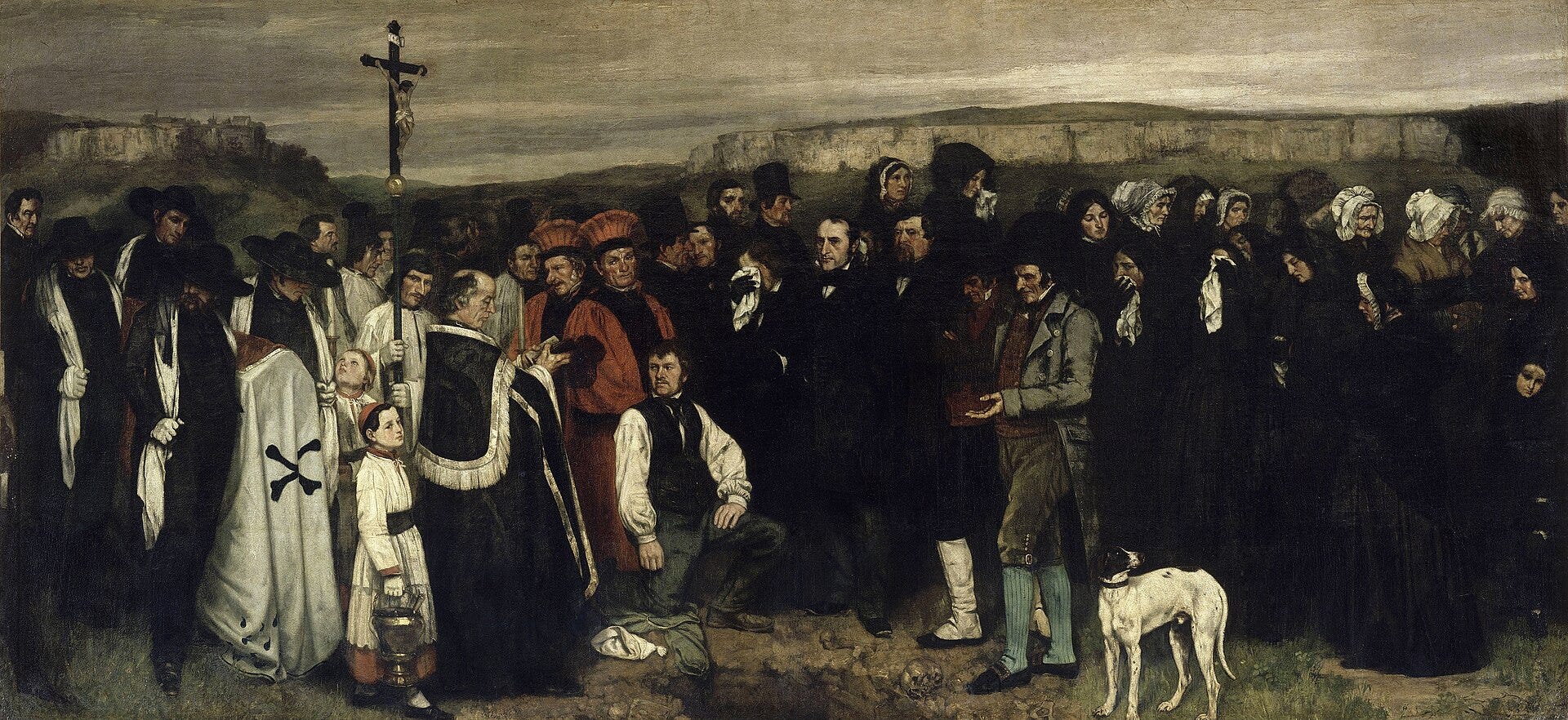
Genres of painting are the categories painters sorted their pictures into by subject: history painting (scenes from the Bible, myth and history), portrait, scenes of everyday life, landscape and still life, with cityscape as a branch of landscape. The old French Academy ranked them from history at the top to still life at the bottom, and Gustave Courbet's A Burial at Ornans, painted in 1849 and 1850 and now in the Musée d'Orsay, is the picture where that ranking is easiest to see, because it breaks it.
The ranking measured how much a subject asked of the painter. Fruit and flowers sat near the bottom, a face a little higher, and the top went to the painter who could stage great deeds with many figures.
Cool Stories About Art is a newsletter to learn art the fun way.
Join 200,000+ readers and get:
10 new art stories / month
The entire archive of content (1,000+ articles)
Comment, ask questions, and chat with other readers
The ranking is usually quoted as a tidy ladder of five rungs, credited to André Félibien and dated 1667. The text says less than that. In the preface to the Academy's lectures, Félibien writes that a painter of landscapes stands above one who paints only fruit, flowers or shells, and that a painter of living animals is worth more than one who shows only lifeless things.
Portraits get a colder line: a painter who makes only portraits has not yet reached the highest perfection of the art. At the top he puts the painter of human figures, whom he calls an imitator of God. None of those lines mentions scenes of everyday life, the very pictures that today carry the word genre.
So how did the farmers and card players get onto a ladder that never named them? Two painters show it from opposite ends. In 1728 Jean Siméon Chardin was received into the Academy for a painting of a stingray, as a master of the lowest rung, and in 1850 Gustave Courbet hung a village funeral at a size traditionally kept for biblical and mythological scenes.
What You'll Discover
What the 1667 ranking actually says.
Why one word names two things.
Who entered the Academy at the bottom.
How a village funeral broke the rule.