
George Stubbs (1724 to 1806) was an English painter from Liverpool who spent most of his life in London. He had almost no training in art and learned anatomy, the science of how bodies are built, largely by himself, with help from a surgeon.
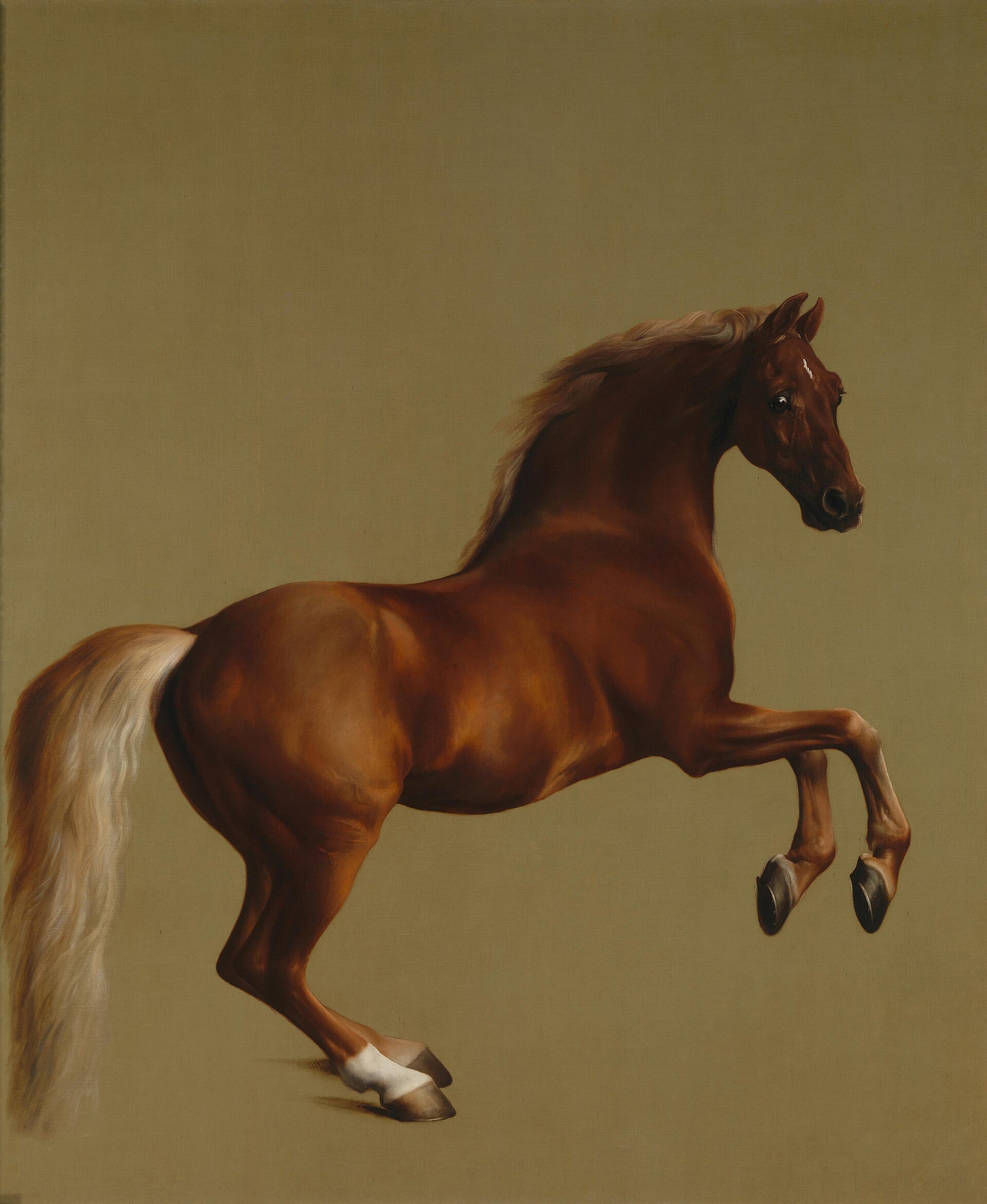
Stubbs is famous for Whistlejacket, a life-size portrait of a rearing racehorse, and for The Anatomy of the Horse, a book of his own engravings published in 1766.
In his time, pictures of animals ranked far below scenes from the Bible and from history. So although no painter knew the horse better, the label of horse painter followed Stubbs all his life.
Cool Stories About Art is a newsletter to learn art the fun way.
Join 200,000+ readers and get:
10 new art stories / month
The entire archive of content (140+ articles)
Comment, ask questions, and chat with other readers
George Stubbs was born in August 1724 in Liverpool, a busy port in the northwest of England. His father was a currier, a craftsman who finished leather for saddles and harnesses.
George worked in his father's workshop until about sixteen, then announced that he wanted to paint. His father agreed, as long as the boy found a proper teacher.
The teacher was Hamlet Winstanley, a local painter who was copying pictures at Knowsley Hall, the Earl of Derby's country house near Liverpool. When George chose a picture to copy, Winstanley refused, saying he wanted to copy that one himself.
After a few weeks, George walked out, declaring that from then on he would "look into nature for himself." He never had another painting teacher.
A missing teacher was not George Stubbs's only obstacle. In eighteenth-century England, paintings were ranked by what they showed. Scenes from the Bible, ancient myths and history came first, because they called for imagination and taught a lesson.
Animals came near the bottom, because painting them was seen as merely copying nature. The Royal Academy, the official society of British artists, founded in London in 1768, taught its students the same order.
Stubbs hoped for a higher rank. He wanted his study of anatomy to count as science, and he longed to paint great subjects.
Could the son of a leather worker, with almost no training, ever be seen as more than a horse painter?
In the rest of the story, you'll find out:
why Stubbs spent eighteen months with dead horses in a lonely farmhouse
how Stubbs painted a kangaroo without ever seeing one alive
why the Royal Academy took back the title it had just given him
what library workers in Massachusetts found in two forgotten folders in 1957