George Tooker: The Complete Story
George Tooker, 1920 to 2011, was an American painter of modern unease. Working in slow, old fashioned egg tempera, he turned subways, waiting rooms and offices into images of loneliness and quiet fear that still feel like now.
While other Americans threw paint at huge canvases, Tooker painted small, still and chilling. Here is the man who made bureaucracy look like a nightmare.
The painter of modern dread
Tooker found his subject in the city crowd. His people stand close together yet utterly alone, faces blank, eyes wary.
He painted the feeling of mid century America: the office, the queue, the sense of being processed. It reads as eerily current in the age of surveillance.
The Subway, and the feeling of being watched
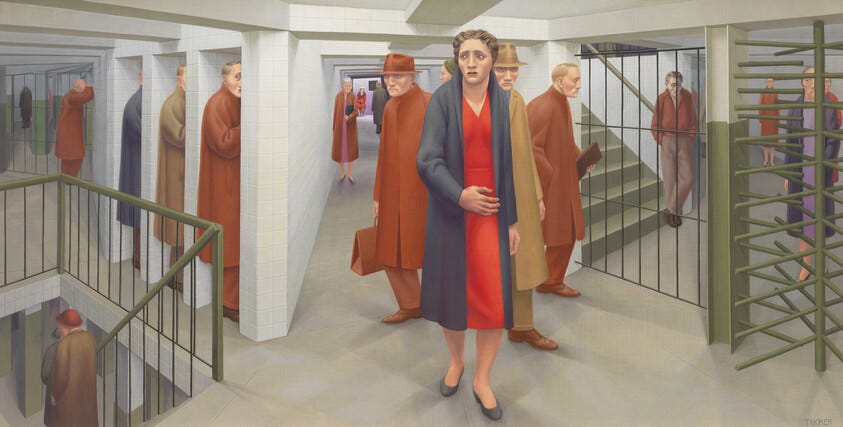
His best known work, The Subway of 1950, shows a woman in a tiled underground maze, hemmed in by barriers and watching strangers. It hangs at the Whitney Museum in New York.
Six years later he painted Government Bureau, a hall of identical clerks behind frosted glass, each citizen reduced to a number. The Met owns it.
Egg tempera in the age of the drip
In the 1950s, American art meant the wild splashes of abstract expressionism. Tooker went the opposite way, reviving egg tempera, a painstaking medieval medium.
He built each panel slowly, in tiny strokes, finishing only a few works a year. The result is a cold, clear realism that makes the strangeness feel solid and real.
The private man behind the panels
Tooker was part of a close circle with the painters Paul Cadmus and Jared French. He was gay at a time when that carried real danger, and his art keeps a guarded, watchful distance.
Later in life he moved to Vermont, became a devout Catholic, and turned to gentler religious portrait and figure works. He received the National Medal of Arts in 2007.
Three panels to start with
First, The Subway of 1950, the image that defined him and the anxious city.
Second, Government Bureau of 1956, a quiet horror story about paperwork and power.
Third, The Waiting Room, where numbered stalls turn ordinary people into cases.
The myth of the surrealist
Critics often called Tooker a Surrealist. He rejected the label.
He said he was not painting dreams but real life, only stripped down until the feeling showed. The unease is not fantasy. It is the everyday, seen clearly.
Where his America hangs
The Whitney Museum of American Art holds The Subway. The Metropolitan Museum of Art owns Government Bureau.
A slow hand, a long shadow
Tooker finished only a few paintings a year, building each one in thin layers of egg tempera. Across a long life he made only a few hundred works.
That patience paid off. His vision of the lonely crowd shaped how later artists pictured the office, the queue and the watched city. He received the National Medal of Arts in 2007.
George Tooker, things people ask
When was George Tooker born? In 1920 in Brooklyn, New York. He died in 2011 in Vermont.
What is he famous for? Magic realist scenes of city loneliness, above all The Subway.
What medium did he use? Egg tempera, a slow medieval technique, not oil.
Was he a Surrealist? He rejected the label. He said he painted real feeling, not dreams.
Where can I see his work? The Whitney and the Met in New York.
If Tooker pulled you in, you will love these too:
Six women, one monster, what Picasso did to the women who loved him
The darker truth about Gauguin, the part of the Tahiti story that never makes the wall label
Vermeer, Woman Holding a Balance, what is actually on those scales