
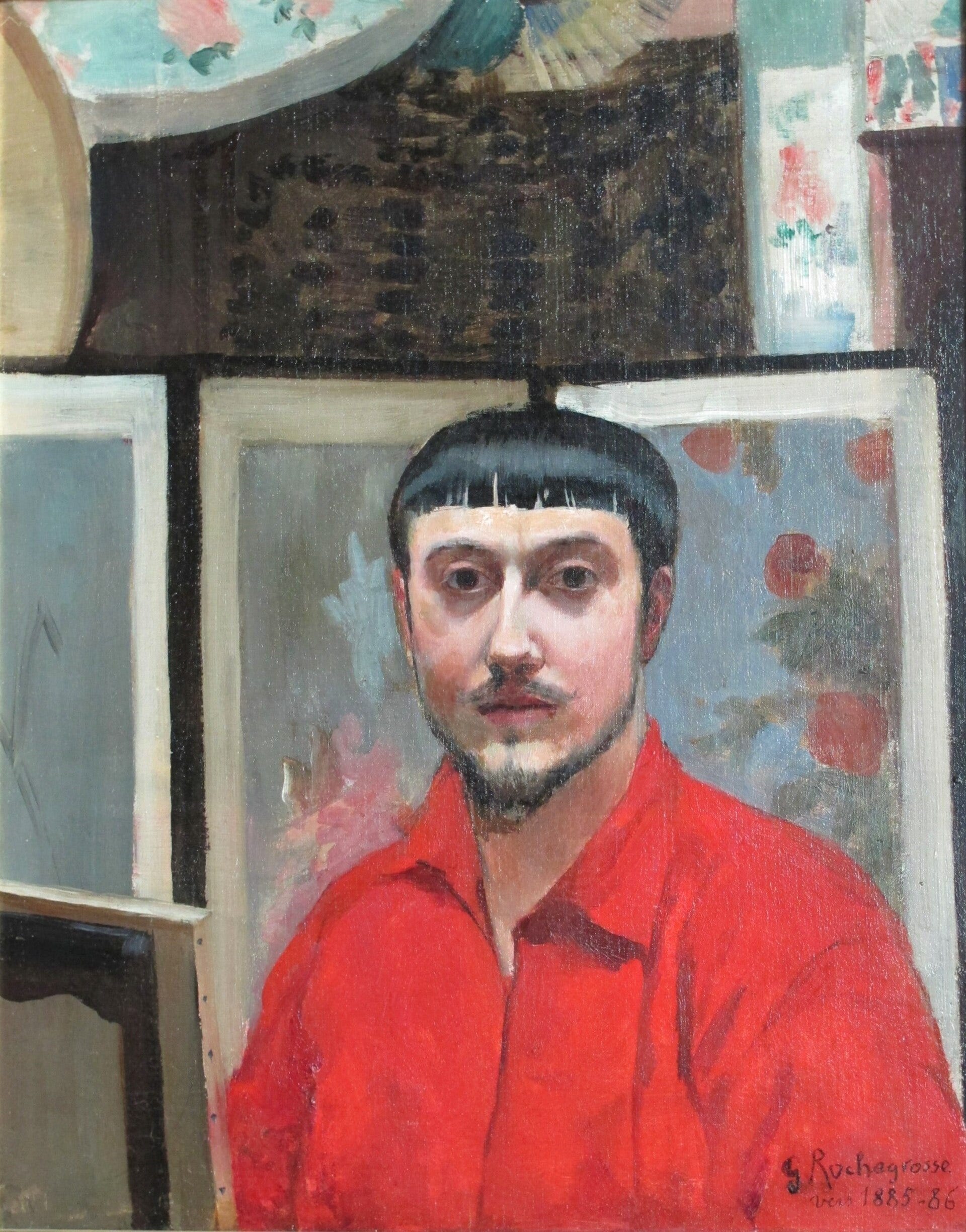
Georges Rochegrosse (1859 to 1938) was a French painter of violent moments from history and legend, on huge canvases. His most famous picture, The Knight of the Flowers, from an opera by the German composer Richard Wagner, hangs at the Musée d'Orsay in Paris.
Cool Stories About Art is a newsletter to learn art the fun way.
Join 200,000+ readers and get:
10 new art stories / month
The entire archive of content (140+ articles)
Comment, ask questions, and chat with other readers
For forty years, Georges Rochegrosse painted worlds at the moment they fall apart, from the last day of Troy, the city of Greek legend, to a royal ball in Paris where the dancers caught fire.
Yet late in 1923, one of his designs was given to the Flaubert museum at Croisset, near Rouen, in the pavilion that is all that remains of the house of Gustave Flaubert, the French novelist who wrote Madame Bovary. The design is a veil. Marie, the painter's wife, embroidered it in cloth and thread, after a watercolor by her husband.
The veil comes from one of Flaubert's novels. In the book, it belongs to a goddess, and anyone who touches it must die.
Georges Rochegrosse was born on August 2, 1859, in Versailles, the town outside Paris built around the palace of the French kings. His father died in 1874, when Georges was 14.
The next year, Georges's mother married Théodore de Banville, one of the leading French poets of his time. Banville adopted the boy, and Georges grew up in a house where writers came to visit.
Gustave Flaubert was one of those writers. Georges met him as a young teenager, and the meeting left him with a sense of mission. Years later, the painter drew the pictures for new editions of three of Flaubert's books.
Georges trained as a painter in Paris, in a private art school, then at the École des Beaux-Arts, the state school of fine arts.
Rochegrosse made his name at the Salon, the great yearly art exhibition of Paris, where a single picture could make a young painter famous.
In 1882, at 22, he showed Vitellius Dragged through the Streets of Rome. Vitellius was a Roman emperor overthrown in the year 69, after only a few months in power.
The canvas shows a mob forcing Vitellius down a flight of stone steps, a dagger at his throat. The picture won a medal, and Rochegrosse kept returning to the same kind of scene: a famous person or a whole city at the moment everything collapses.
Why would a painter of falling empires need a real version of a veil that existed only in a novel, and why did he give it to the museum in Flaubert's pavilion?
In the rest of the story
Who saved the king of France when the royal ball caught fire.
Which moment of Troy's last day won him a top prize at 23.
Which magician's garden became the setting of his most famous painting.
What one burning dancer jumped into to save his life.