
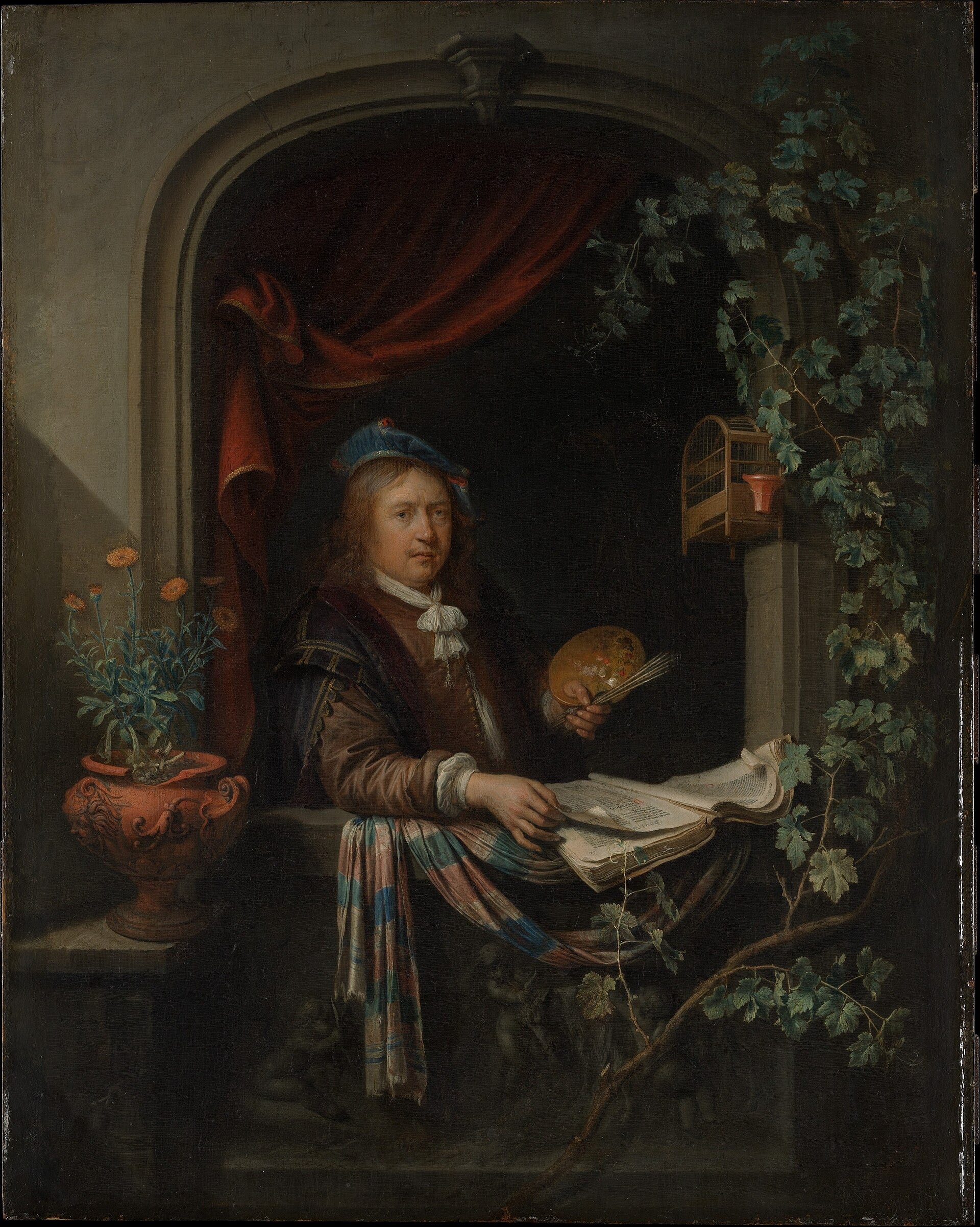
Gerrit Dou (1613 to 1675) was a Dutch painter from Leiden, the first pupil of Rembrandt and one of the best-paid artists of his time. He painted small scenes in minute detail, such as The Night School and The Young Mother.
Cool Stories About Art is a newsletter to learn art the fun way.
Join 200,000+ readers and get:
10 new art stories / month
The entire archive of content (140+ articles)
Comment, ask questions, and chat with other readers
Dou worked so slowly that the people who came to him for a portrait lost patience and gave up. Yet a queen and a king owned his pictures, and one of his panels, no bigger than a hand, could cost as much as half a house.
Gerrit Dou was born on April 7, 1613, in Leiden, a university city of the Dutch Republic, the country known today as the Netherlands. His father was a glazier, a craftsman who made and fitted glass windows.
As a boy, Gerrit worked on windows too, and he climbed so recklessly to fit and repair them that his father feared an accident. The glazier chose a safer trade for his son. On February 14, 1628, he sent Gerrit, then fourteen, to learn painting from a neighbor who lived about 110 yards away.
The neighbor was Rembrandt, a painter of about twenty-one who would become the most famous artist of the Dutch Republic. Gerrit was his first pupil. Rembrandt painted figures that step out of deep shadow into a patch of light, in thick paint that shows every stroke of the brush.
For about three years, the pupil painted like his master and borrowed his subjects, among them the hermit, a religious man who lives alone to pray. In 1631, Rembrandt left Leiden for Amsterdam, the largest city of the Dutch Republic. Dou, about eighteen, stayed behind and began to work on his own.
Left to himself, Dou gave up the thick strokes. His wooden panels grew small, some of them barely a foot tall, and their surfaces became as smooth as enamel, the glassy coating used on jewelry.
A surface that smooth took a great deal of time. Dou made his own paints and his own brushes. To paint from life, he looked at his model through a frame crossed with silk threads, which divided what he saw into small squares.
One day, a German painter named Joachim von Sandrart visited the studio with a friend. The panel Dou was working on included a broom, and its stick was painted with such care that the two visitors praised his patience. Dou answered that he still needed three more days to finish it.
Why would anyone pay a fortune to a painter who needed three more days for a broomstick?
In the rest of the story
Who paid Dou a yearly fee just to see his paintings first.
How long a woman had to sit while Dou painted one of her hands.
What the king of England offered Dou after receiving one of his paintings.
What a visitor had to do before looking at a painting by Dou.