
A ghost ship is the one sea story nobody can disprove, because the ship never comes back to be examined. Sailors passed it from crew to crew for centuries, and painters had to give a shape to something the tellers had only described in words. Some of these ships were real, and one was painted years before anyone knew what she would become.
Cool Stories About Art is a newsletter to learn art the fun way.
Join 200,000+ readers and get:
10 new art stories / month
The entire archive of content (140+ articles)
Comment, ask questions, and chat with other readers
Why Artists Painted Ships That Never Come Home
The most famous ghost ship, the Flying Dutchman, never existed. Sailors told of a captain who swore he would round the Cape of Good Hope in a storm and was condemned to keep trying forever. Sighting his ship was said to announce disaster.
That legend set artists a hard problem, because they had to show a ship that is there and not there. Fog solved it for some of them, and paint that shines in the dark solved it for another. Wagner's opera of 1843, in which only a faithful love can save the captain, sent several of them back to the story.
Every work chosen here turns on a ship that never makes port in the usual way, because it is cursed, emptied of its crew or carrying the dead. In one of them the ship survives only in the title. Ordinary shipwrecks were left out, since a wreck ends and a ghost ship goes on sailing.
12. Unknown Marseille artist, Amazon Entering Marseilles (1861)
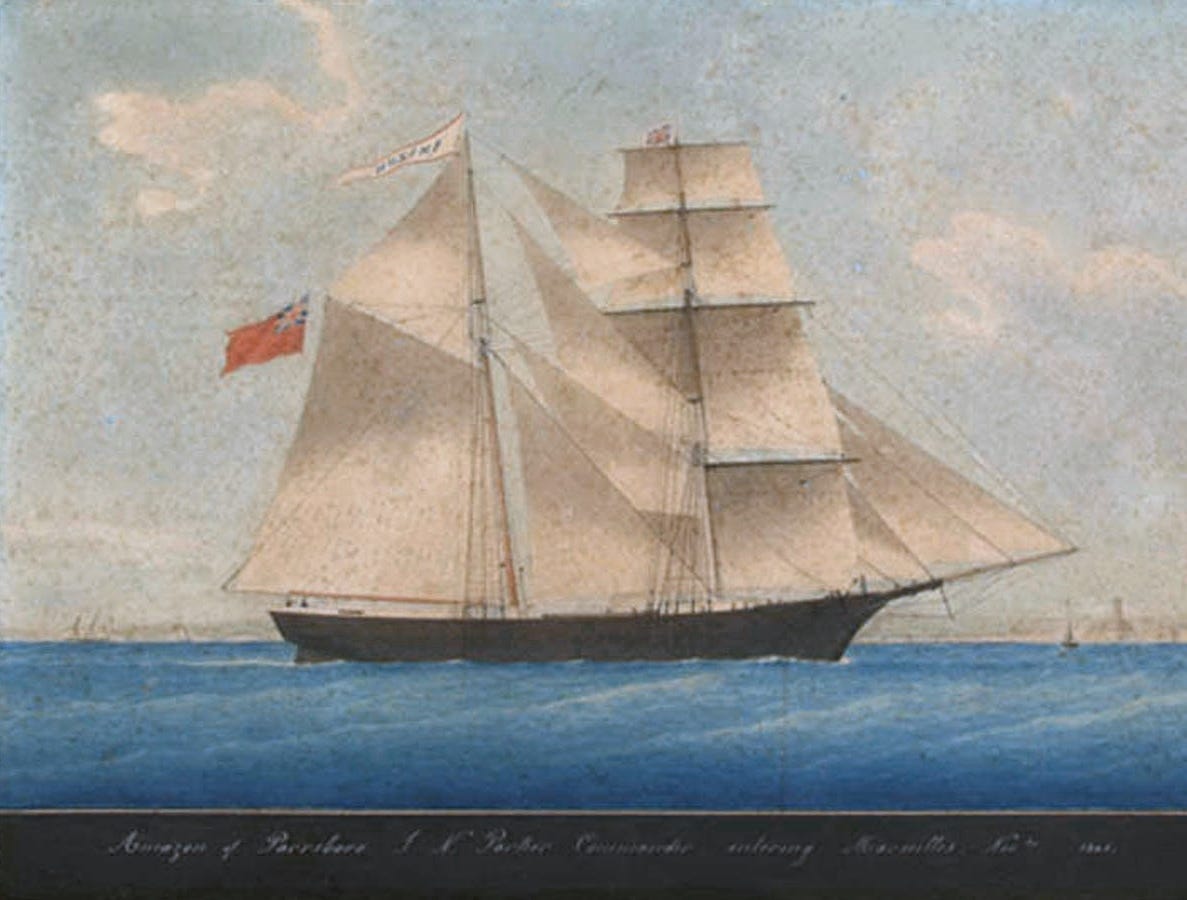
The brigantine in this harbor portrait could be any merchant ship of the 1860s. She is drawn side-on, both masts under full sail, in the plain manner of the portraits that harbor painters made for visiting captains. A line of lettering runs along the bottom: "Amazon of Parrsboro. J.N. Parker, Commander, entering Marseilles, Nov'b'r 1861."
Nobody knows for certain who painted it. Paul Begg, a historian and the author of a book about the ship, has suggested Honoré Pellegrin, a ship painter working in Marseille, while presenting the attribution as unconfirmed.
What the lettering does give is the ship's age. The Amazon was brand new, launched earlier that year at Spencers Island, a shipbuilding village in Nova Scotia. Later she was renamed, and her new name was Mary Celeste.
It was as the Mary Celeste that she was sighted on December 4, 1872, drifting in the Atlantic near the Azores, by the crew of a British brig, the Dei Gratia. When they boarded her, nobody was there. The captain, Benjamin Briggs, his wife, their two-year-old daughter and the whole crew had gone, along with the ship's boat and the navigation instruments.
Everything else was in place. The cargo, some 1,700 barrels of alcohol, was intact, and there was still food and water aboard. The last entry in the log, dated November 24, showed no sign of trouble. The boarding party reported that the crew seemed to have left in a great hurry, and no one has ever proved why they left.
The mystery grew with each retelling. In 1884 a young British doctor, Arthur Conan Doyle, published J. Habakuk Jephson's Statement, a tale half true and half invented, which gave him his first literary success three years before Sherlock Holmes.
The portrait in Marseille was painted before any of this. To me that is what makes it the most unsettling ghost ship of all. Eleven years before she was found empty, the same hull enters port with every sail drawing, and her commander's name is lettered beneath her.
At a Glance
Artist: Unknown, possibly Honoré Pellegrin (1800 to about 1870), a Marseille ship painter
Painted: 1861
Medium: Not published (a painted ship portrait)
Size: Not published
Where to see it: Location of the original not published
11. Dorothy Cross, Ghost Ship (1999)

At night in Scotsman's Bay, off Dún Laoghaire, the harbor town on the southern edge of Dublin Bay, an old lightship lit up in February 1999. She had been painted from end to end with phosphorescent paint. At intervals the glow faded to nothing, and then it came back. She had no engine, and she was not going anywhere.