
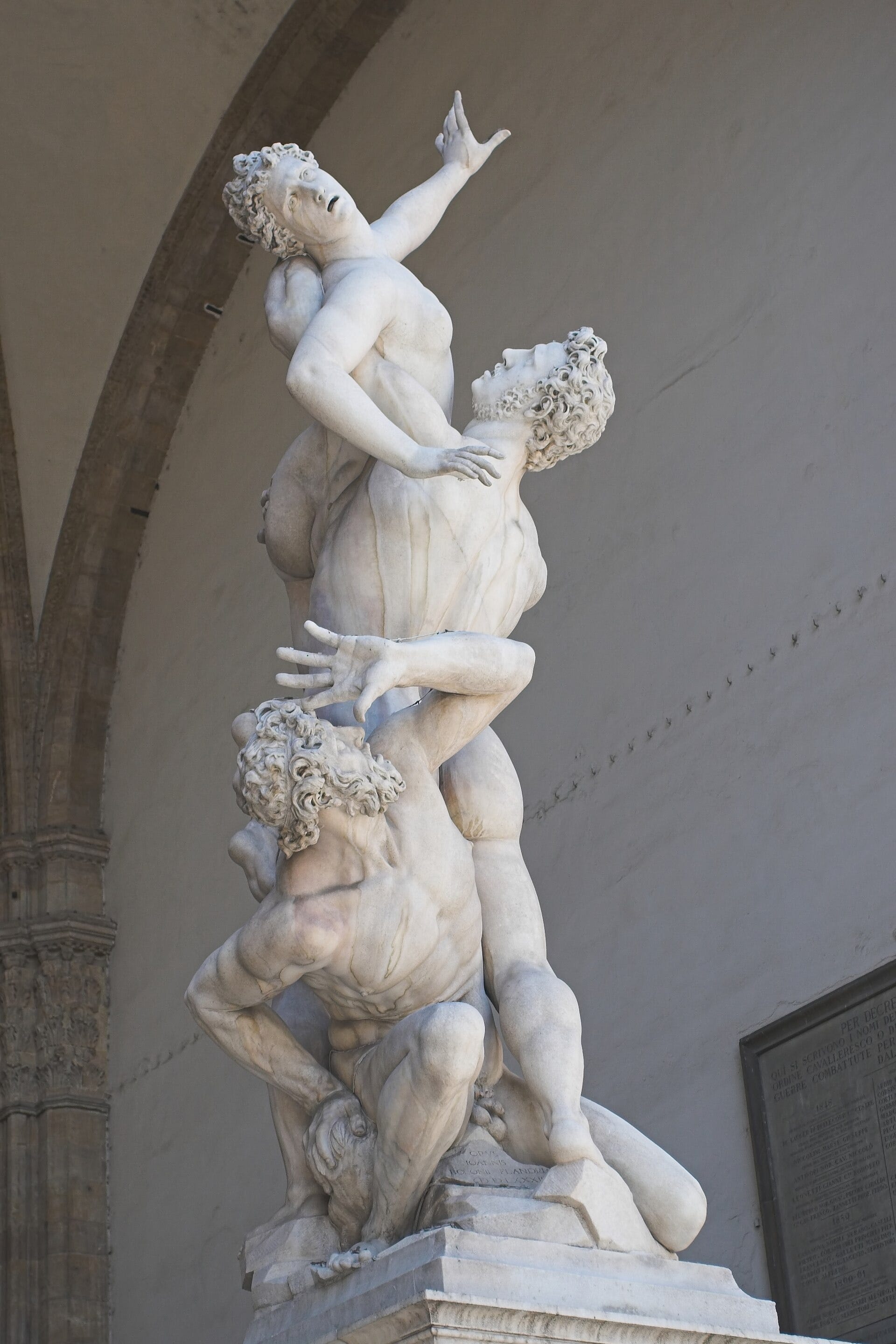
Giambologna (1529 to 1608) was a sculptor from Flanders, in today's northern France and Belgium, who worked in Florence, Italy. He made the bronze Flying Mercury, the messenger of the gods poised on one foot, and the marble Abduction of a Sabine Woman.
Cool Stories About Art is a newsletter to learn art the fun way.
Join 200,000+ readers and get:
10 new art stories / month
The entire archive of content (140+ articles)
Comment, ask questions, and chat with other readers
Giambologna came to Italy as a young man to study, then headed home to Flanders. He never got there. He stayed in Florence for the rest of his life, and his statues traveled for him: the rulers of Florence sent his bronzes as gifts to the emperor and to princes across Europe.
Giambologna was born Jean de Boulogne in Douai, a Flemish town that is French today. In Italy, his name became Giovanni Bologna, the Italian form of Jean de Boulogne, shortened to Giambologna. The name has nothing to do with the city of Bologna.
Young Jean learned to carve with Jacques du Broeucq, a Flemish sculptor and architect. Du Broeucq worked in the style of the Italian Renaissance, which imitated the statues of ancient Greece and Rome.
Around 1550, Jean went to Rome, the pope's city, to copy the ancient statues and the works of Michelangelo, the sculptor of the David and the most famous artist alive. More than a century later, Filippo Baldinucci, a Florentine writer of artists' lives, told a story about Jean's years in Rome that no one can prove.
In Baldinucci's story, Jean brought Michelangelo, then in his seventies, a small model in wax or clay, the kind a sculptor makes before carving a statue. Jean had finished every detail with care.
Michelangelo took the model, ruined it at once and modeled it again. Then the old master told the young man: "Now, first go learn how to sketch, and then how to finish."
For a sculptor, to sketch meant to find the pose and the movement of the whole body in a rough model. Smoothing the surface came last.
Around 1553, Jean started back to Flanders. On the way north, he stopped in Florence, a city ruled by the Medici, a family of bankers who had become dukes. Bernardo Vecchietti, a Florentine banker who advised the Medici on money, took the young man into his house.
Florence already had famous sculptors of its own. In 1554, soon after Jean's arrival, Benvenuto Cellini, a Florentine sculptor, showed his bronze Perseus, the Greek hero who killed the monster Medusa, on the main square of the city.
Why did the young man from Douai, who had only stopped in Florence on his way home, never take the road north again?
In the rest of the story
Why Giambologna's most famous marble had no story while he carved it.
What the Flying Mercury is really standing on.
How a ruler of Florence went fishing from inside a giant.
Who Giambologna invited to share his tomb.