
Giotto di Bondone was a Florentine painter, born around 1267, who died in Florence on 8 January 1337. He taught Western painting to show people with weight and feeling, and his masterpiece is the Scrovegni Chapel in Padua. A spacecraft carries his name: in 1986 the probe Giotto flew within 596 kilometers of Halley's Comet, which he was said to have painted.
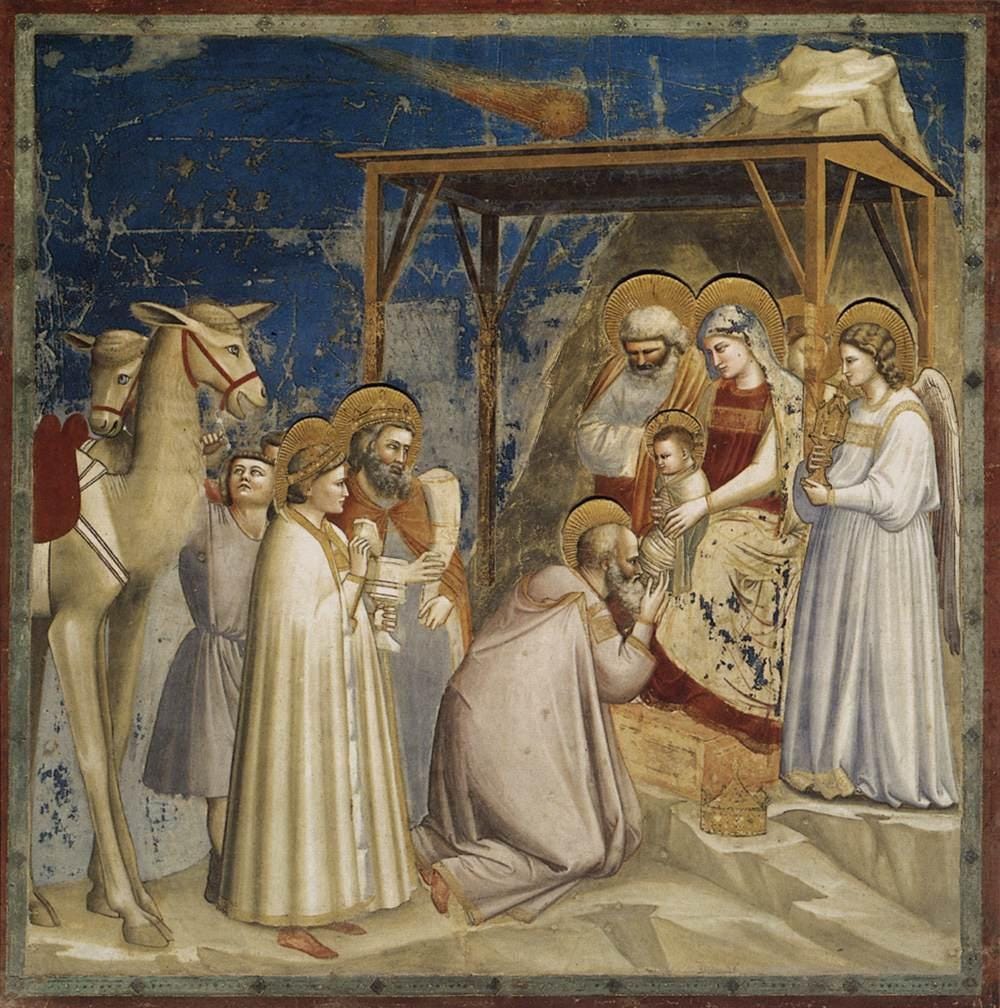
The comet is in the Adoration of the Magi, a fresco on a wall of the Scrovegni Chapel. Where painters had long hung a tidy star over the stable, Giotto painted a ball of fire with a long tail.
Cool Stories About Art is a newsletter to learn art the fun way.
Join 200,000+ readers and get:
10 new art stories / month
The entire archive of content (1,000+ articles)
Comment, ask questions, and chat with other readers
When the European Space Agency named its probe after him, it was repeating an old story. Giotto saw Halley's Comet in 1301, the story goes, and a few years later he put it over the manger. The probe reached the real comet in March 1986, and a grain of dust nearly ended the mission seconds before its closest approach.
The story has a problem. Halley's came closest to Earth in 1301 before it reached its brightest, and calculations never make it a dazzling sight.
A study published in 2026 in the Journal of the British Astronomical Association favors another comet, one that hung in the sky for only six days around Christmas 1304, while the chapel was being painted. Its author admits that significant questions remain for every candidate.
So the best-known fact about Giotto is also the shakiest. What is certain hangs in Padua: a comet with a head and a tail, painted by a man who seems to have looked at the sky instead of copying a formula.
What You'll Discover
The circle, the fly, the sheep.
What a banker bought in Padua.
Who really painted Assisi.
What Dante wrote while he lived.
The tower he never saw finished.