
Giuseppe Arcimboldo was an Italian painter, born in Milan in 1526 or 1527. He spent about twenty-five years working for the Habsburgs, the family of emperors that ruled much of central Europe.
Arcimboldo is famous for portraits whose faces are built from fruit, vegetables and flowers, like Vertumnus and The Four Seasons. He died in Milan in 1593.
Writers of his time called these portraits jokes. Yet Emperor Maximilian II dressed up as one of them at a court party, and his son Rudolf II gave the painter the title of count palatine.
Cool Stories About Art is a newsletter to learn art the fun way.
Join 200,000+ readers and get:
10 new art stories / month
The entire archive of content (140+ articles)
Comment, ask questions, and chat with other readers
Giuseppe Arcimboldo grew up in Milan, a city in northern Italy, where his father worked as a painter for the cathedral. As a young man, Giuseppe drew the designs for the cathedral's stained-glass windows.
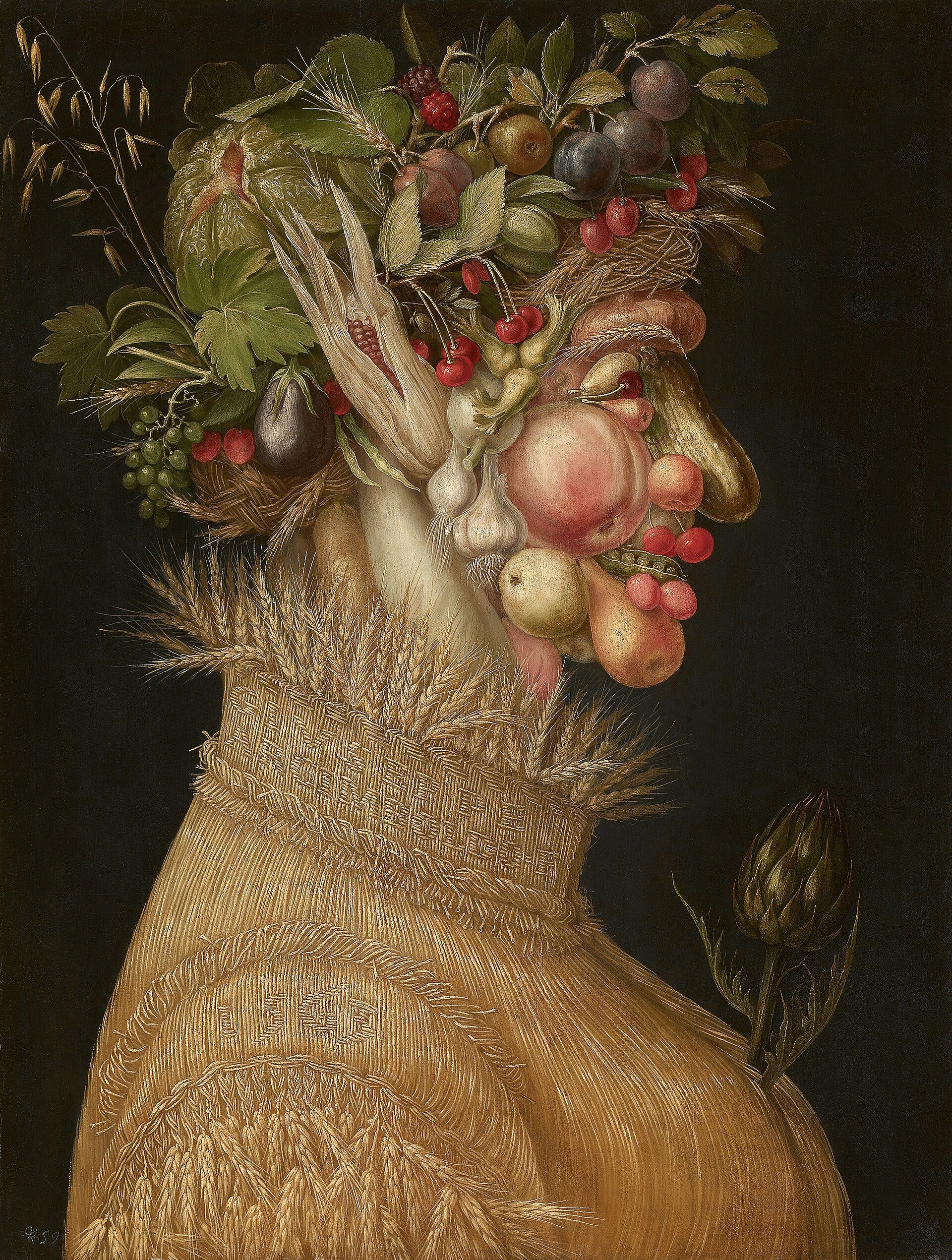
In 1562, Arcimboldo moved to Vienna, today the capital of Austria, to paint portraits for the Habsburgs. A year later, he painted Summer, the head of fruit at the top of this story.
In Summer, the man's nose is a cucumber, his lips are cherries, and his teeth are peas in an open pod. Where Arcimboldo found the idea of a face built from food is not known. Summer is one of the oldest of his heads that carry a date.
Summer belonged to a set of four Seasons. In 1566, Arcimboldo painted a second set, the four Elements, heads built from animals or from flames. On New Year's Day 1569, after years of work, he presented both sets together to Emperor Maximilian II.
Maximilian II was the Holy Roman Emperor, a title that went back to the Middle Ages and made him the highest ruler in central Europe.
Italian writers of the time had a word for pictures like Summer. They called them scherzi, Italian for "jokes."
A court painter owed his salary and his place to the emperor. Handing the emperor a set of jokes could look like a risk.
Was Arcimboldo laughing at the emperors who paid him, or paying them a compliment?
In the rest of the story
Why an emperor let his painter build his face from fruit and vegetables.
Why an emperor dressed up as one of his painter's jokes.
How an emperor's portrait was carried off to Sweden as war loot.
Why Salvador Dalí and the Surrealists admired a painter dead for centuries.