Gothic and Medieval Paintings: 12 Famous Works
For a thousand years, from the fall of Rome to the dawn of the Renaissance, Europe painted for God.
Medieval and Gothic art glows with gold, saints and strange devils, flat and jewel bright, made to open a window onto heaven rather than copy the world.
Here are twelve of the most famous medieval and Gothic paintings, all now in the public domain. I have gathered the works that carried Europe from stiff golden icons to the first faces that truly seem alive.
If you have read this far
Three that changed how I look at a picture:
The Arnolfini Portrait, detail by detail, the mirror, the dog, and the question everyone asks
The Ambassadors, detail by detail, the object at the bottom that only works from one side
Luncheon of the Boating Party, detail by detail, who everybody at that table actually was
1. The Book of Kells (about 800)
Before there were paintings on walls, monks painted inside books, and none is more famous than this one. The Book of Kells is a copy of the four gospels made by Irish monks around the year 800, every page swarming with spirals, knots and tiny beasts hidden in the letters.
One initial page holds detail so fine that a medieval writer swore it must have been drawn by angels. It survived Viking raids, a theft, and a thousand years of damp, missing only a few stolen golden covers.
It survives in a Dublin library, where a single page is turned each day so the light cannot fade it, one of the great treasures of the illuminated manuscript.
2. Cimabue, Santa Trinita Madonna (about 1290)
At the very end of the Middle Ages one Florentine broke the golden mold, just a little. Cimabue painted the Virgin enthroned on a vast gold throne carried by angels, still stiff and holy in the old Byzantine way, but with the first hint of real weight and space.
Legend says he found a shepherd boy scratching sheep onto a rock and took him in, and that boy was Giotto, who would outshine him. Dante wrote that Cimabue thought he ruled painting until Giotto arrived and eclipsed him.
The great gold panel hangs in the Uffizi today, but by the time Cimabue died his pupil Giotto had already eclipsed him and taken his crown.
3. Giotto, The Lamentation (about 1305)
In a small chapel in Padua, Giotto did something nobody had done for a thousand years, and made holy figures look like real, grieving people.
His fresco of the dead Christ shows Mary cradling her son while angels wheel overhead, howling with grief, their faces twisted in real pain.
The mourners have weight and backs and bodies, and they turn away from us into the scene as if we were intruding on a private sorrow. Even the sky is a plain deep blue, not gold, the first step toward painting the real world.
He covered the whole chapel in about two years, and every great Florentine painter who followed, up to Michelangelo, went to Padua to learn from it.
4. Duccio, Maesta (1311)
When Duccio finished this giant altarpiece in 1311, the whole city of Siena shut its shops and carried it to the cathedral in a candlelit parade with trumpets.
The Maesta shows the Virgin enthroned in majesty, ringed by a crowd of saints and angels on a field of gold, with dozens of small gospel scenes painted on the back.
It was the greatest tempera panel of the age, and Siena treated it as a civic miracle. Centuries later it was sawn apart and scattered, and single panels now sit in museums around the world.
The main panels survive in Siena, but pieces sawn from the back are now scattered in London, New York and Washington.
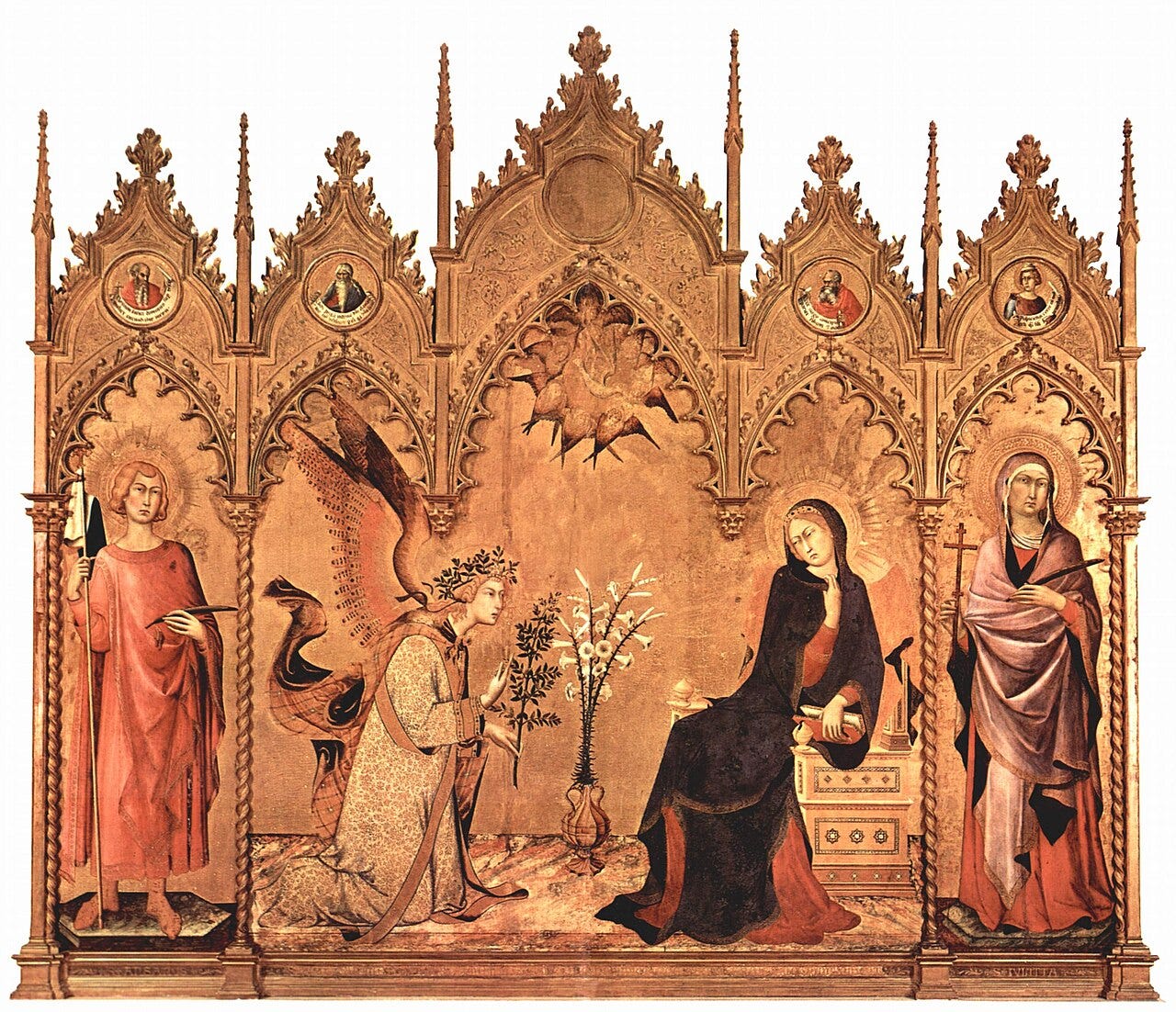
5. Simone Martini, The Annunciation (1333)
The angel Gabriel has just landed, his plaid cloak still swirling, and the Virgin shrinks back in fear on a blaze of pure gold Simone Martini, Duccio's greatest pupil, painted the moment God's message arrives as sheer elegance, all curving line and precious surface.
The words of the greeting run in raised gold letters straight from the angel's mouth toward Mary. There is no room, no floor, no world at all, only figures floating on gold like a dream.
It is the high point of the graceful Sienese style, and Simone carried it all the way to the papal court at Avignon.
6. Gentile da Fabriano, Adoration of the Magi (1423)
By 1423 the golden style had one last, glittering flowering, and this is it. Gentile da Fabriano painted the three kings arriving to worship the newborn Christ in a parade of silk, gold, horses, hunting dogs and exotic servants winding down from the hills.
Every surface drips with real gold and rich detail, the most expensive kind of picture money could buy. It is the great showpiece of the style called International Gothic, courtly and lavish across all of Europe.
Painted the very decade the young Masaccio was inventing perspective a few streets away, it is the medieval world at its most splendid, and nearly its last.
7. The Wilton Diptych (about 1395)
A small painted hinge of two panels folds shut like a book, made for a king to carry and pray to in private. On one side the English King Richard the Second kneels, presented by three saints, and on the other the Virgin stands in a meadow of angels who all wear the king's own badge of a white deer.
The blue of the Virgin's robe is ground from lapis lazuli, then costlier than gold itself. Nobody knows for certain who painted it, French, English or Italian, which only deepens the mystery.
It is the finest surviving English panel of its age, small enough to hold in two hands.
8. Limbourg Brothers, Tres Riches Heures (about 1416)
The most beautiful calendar ever made was painted by three Dutch brothers for a French duke who collected books like jewels. Each month of the Tres Riches Heures shows peasants and nobles at work and play beneath a blue sky and a golden band of stars, castles rising in the distance in impossible detail.
The February page holds the earliest snow scene in Western art, with peasants warming themselves by a fire, skirts lifted to the flames. All three brothers and their patron died in the same year, 1416, probably of plague, leaving the book unfinished.
It was completed decades later and now rests in a French chateau, too fragile to display.
9. Jan van Eyck, The Ghent Altarpiece (1432)
When van Eyck unfolded this vast altarpiece in 1432, oil paint arrived in Europe fully formed, and nothing looked flat again. The Ghent Altarpiece has twelve panels that open to reveal a jeweled world of saints, singing angels and a mystic lamb bleeding into a golden cup, every hair and gem painted with terrifying precision.
It is the single most stolen artwork in history, taken or looted at least a dozen times, most famously by the Nazis, who hid it in an Austrian salt mine.
I unpack more of van Eyck's hidden tricks in the full piece on the Arnolfini Portrait One lower panel was cut out by a thief in 1934 and has never been found.
10. Rogier van der Weyden, The Descent from the Cross (about 1435)
No painting of the fifteenth century was copied more often than this one. Ten life size figures crowd against a shallow gold box like actors on a narrow stage, lowering the dead Christ while his mother faints in an echo of his pose below.
Van der Weyden built the whole picture from grief, every face wet with real tears painted drop by drop. The bodies curve in matching arcs, Christ and Mary falling together, a design so exact it burns into memory.
Spanish kings hung it in their palaces, and legend says it survived a shipwreck on the voyage to Spain. The colors are still so fresh it could have been finished last week.
11. Andrei Rublev, The Trinity (about 1425)
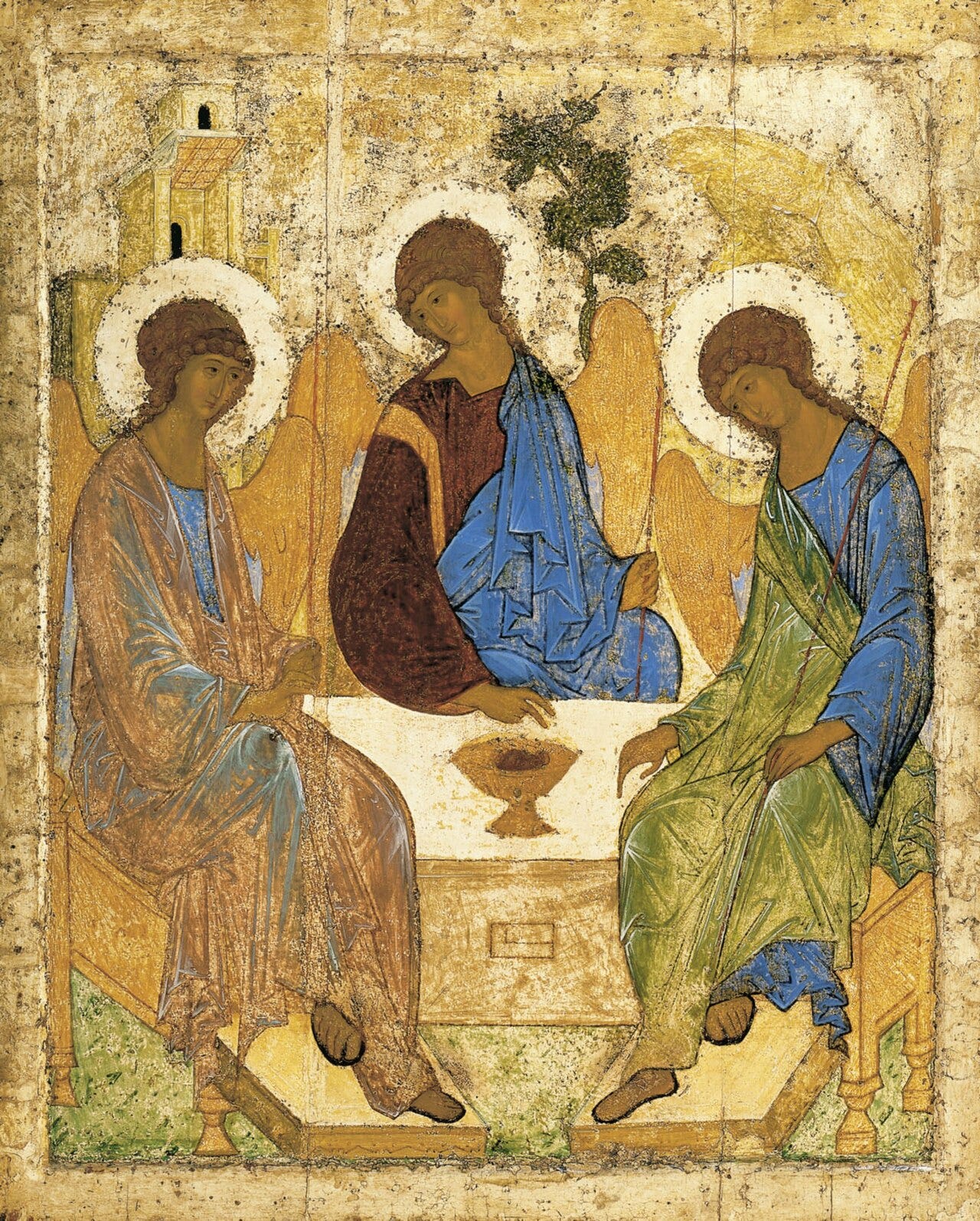
Three angels sit quietly around a table, so alike and so gentle that the whole picture seems to hold its breath in silence. Rublev, a Russian monk, painted the three visitors to Abraham as the Holy Trinity itself, bound in a circle of soft color and impossible calm.
It is the summit of the Russian icon, an image meant not to be looked at but prayed through, a window into the divine. For centuries it hung black with candle soot and overpaint until it was cleaned in 1904 and its colors blazed out again.
It is now so revered that Russia argued for years over whether it was too holy and fragile to leave its monastery.
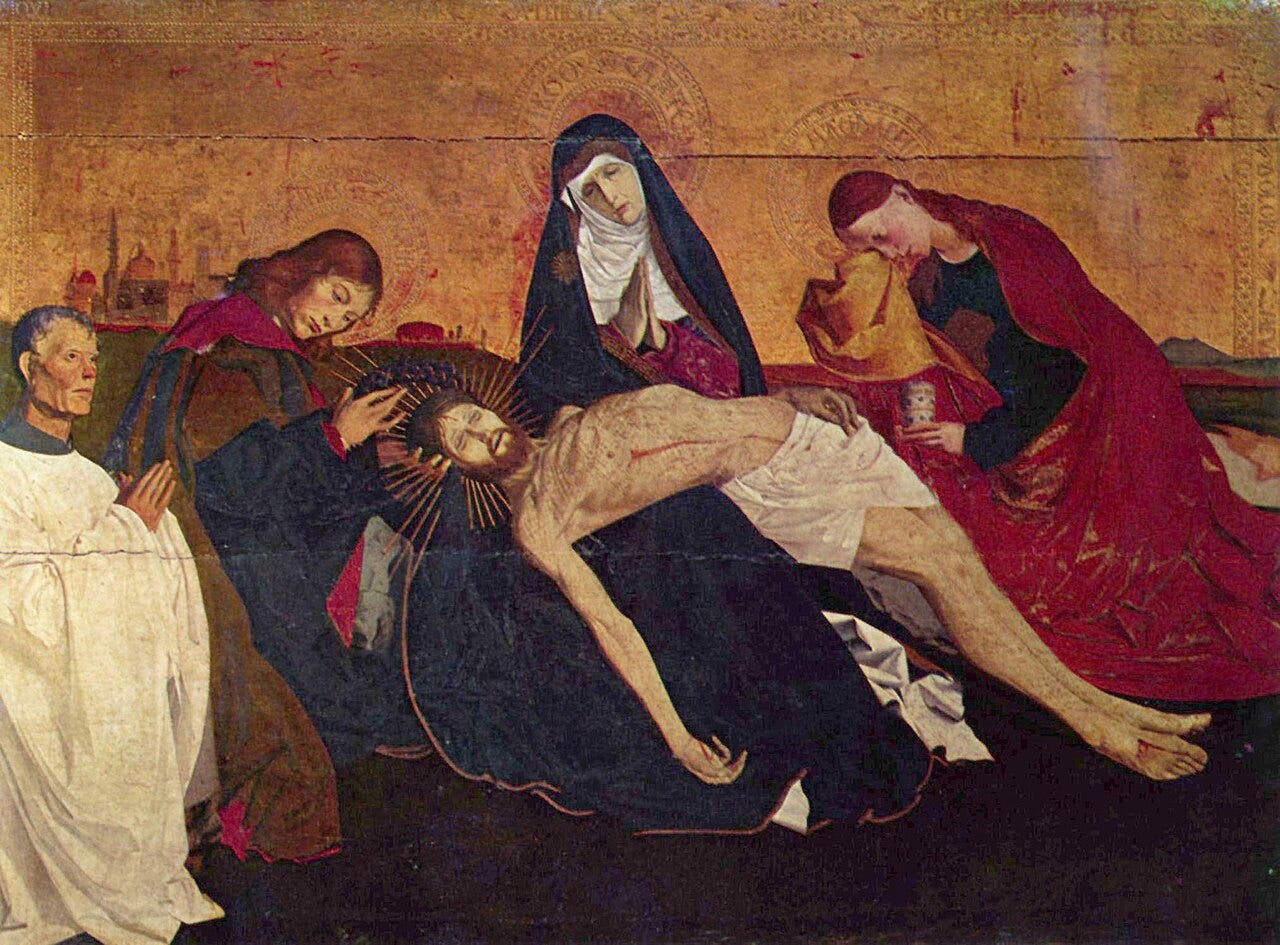
12. Enguerrand Quarton, The Avignon Pieta (about 1455)
Against a flat sheet of gold, the Virgin holds her dead son across her knees while three mourners bend around them in a curve of pure sorrow.
This French panel, long thought to be by an unknown hand, was one of the most powerful images the Middle Ages produced, stark and still and almost modern in its grief.
The gold ground and the tiny kneeling donor in white belong to the old medieval world, while the raw emotion points straight toward what came next. It hung forgotten in a village church near Avignon for centuries.
The Louvre holds it now, credited at last to a painter named Enguerrand Quarton, one of the very few French medieval artists we can still name.
Medieval art, questions people ask
What is Gothic painting? Art from about 1200 to 1400, full of gold, tall thin figures and rich detail, made mostly for churches and prayer.
Why is so much medieval art gold? Gold stood for the light of heaven, turning a panel into a glowing window onto the divine rather than a view of the real world.
Who was the most important medieval painter? Giotto, who first made holy figures look like real, solid people, is usually given the title.
What is an illuminated manuscript? A handwritten book decorated with painted pictures, gold and patterns, the main form of medieval painting for centuries.
How is medieval art different from Renaissance art? Medieval art is flat, golden and symbolic; Renaissance art adds perspective, real space and lifelike bodies.
If these golden panels pulled you in, you will love these too:
Was Monet really the first Impressionist, the painting that may have got there first
The secret behind Monet Magpie, one bird in the snow, and why it matters
Lady with an Ermine, detail by detail, why she is holding that animal
The window and the mirror
For a thousand years painters aimed past the world entirely, building a door to another one, all gold and silence and holy fire. Then, slowly, in a chapel in Padua and a workshop in Bruges, the door began to turn into a mirror, and the faces on the panels started to look like ours.
The gold has never quite lost its pull. Stand in front of one of these panels, and you feel a whole lost world still trying to reach you through the light.