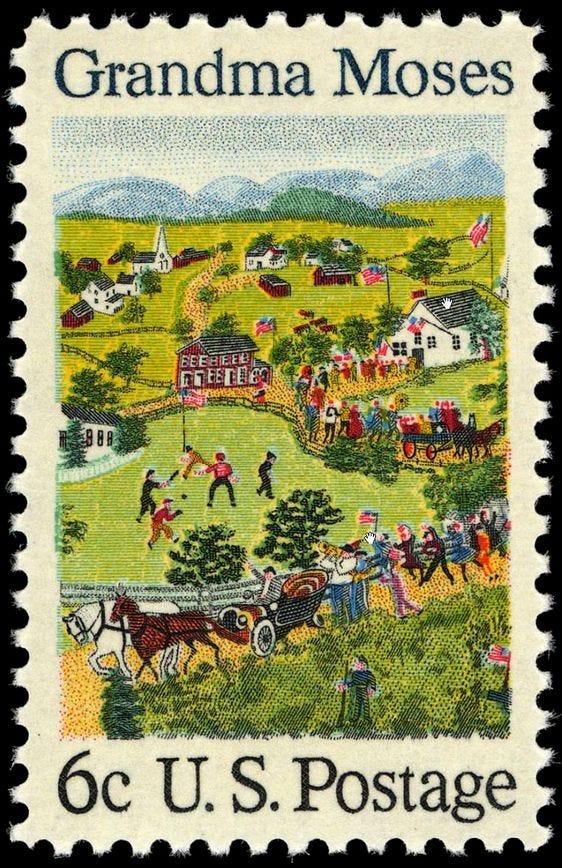
Grandma Moses: The Complete Story
Grandma Moses (1860-1961) was Anna Mary Robertson Moses, the New York farm wife who took up painting seriously in her late seventies when arthritis ended her embroidery, and became, by her death at 101, the most famous folk artist in American history.
The late start is the legend. The sharpness behind it is the better story.
Grandma Moses at a glance
1860. Born Anna Mary Robertson on a farm in upstate New York, one of ten children.
1887. Married Thomas Moses and farmed in Virginia’s Shenandoah Valley for nearly two decades.
1938. A collector named Louis Caldor spotted her paintings in a Hoosick Falls drugstore window.
1949. Received an award from President Truman, who sat down and played the piano for her.
1961. Died at 101, having painted more than 1,500 pictures, most of them after turning 80.
Seventy-eight years before the first act
Born in 1860 in rural New York, she spent a lifetime farming in Virginia and then back home in Eagle Bridge, raising five surviving children and stitching embroidered pictures on the side.
When arthritis made the needle impossible in her late seventies, her sister suggested paint. She switched tools and kept the same eye: memory, season by season.
The drugstore window
In 1938 a travelling collector named Louis Caldor spotted her paintings in a drugstore window in Hoosick Falls, priced at a few dollars, and bought the lot. Two years later, at 80, she had her first New York show, What a Farm Wife Painted. The press met her, fell for her entirely, and America had a new grandmother.
More incredible painter stories
If Grandma Moses pulled you in, you will love these too:
Sugaring off
Over two decades she produced some 1,500 paintings of the year turning: maple sugaring, hay rides, checkerboard fields, first snows, all seen from slightly above, all busy with small figures doing real work. Time put her on its cover in 1953; LIFE marked her hundredth birthday in 1960, the year the governor of New York declared Grandma Moses Day.
Yarn pictures first
Before paint there was thread. For years she embroidered farm scenes in worsted yarn and gave them away.
In her seventies, arthritis made the needle painful. Her sister suggested paint would be easier on the hands.
The compositions did not change. Only the tool did.
Painting live on television
In 1955 Edward R. Murrow put her on live television and asked her to paint on camera.
She was in her mid nineties and entirely unbothered, chatting while the picture grew.
The broadcast introduced her to millions who had only known the Christmas cards.
Grandma Moses Day
For her hundredth birthday in 1960, Governor Nelson Rockefeller proclaimed Grandma Moses Day in New York State.
Life magazine put her on the cover.
She celebrated, then went back to work. She painted through her final year.
The myth to retire
The sweet, simple grandmother was a public role she played gladly, and shrewdly. Moses negotiated her own prices, licensed her images for cards and fabrics, ran her output like the farmer she was, and composed those crowded scenes with real structural skill. Naive is the label; nothing about the career was.
Where to see Grandma Moses
The Bennington Museum in Vermont, just over the state line from her farm, holds the largest public collection. The Smithsonian American Art Museum keeps her in the national story, and Sugaring Off, her best-known scene, set her record when it sold for 1.36 million dollars in 2006.
The Grandma Moses questions that keep coming up
When did Grandma Moses start painting? Seriously in her late seventies, after arthritis ended her embroidery.
How many paintings did she make? Around 1,500, most of them after her eightieth birthday.
How much are her paintings worth? Sugaring Off sold for 1.36 million dollars in 2006, her auction record.
Where can I see her work? The Bennington Museum in Vermont and the Smithsonian American Art Museum.
Did Grandma Moses make art before she was old? Yes, embroidered yarn pictures of farm life. When arthritis made needlework painful in her seventies, her sister suggested paint.
Did she appear on television? Yes, live with Edward R. Murrow in 1955, painting on camera in her mid nineties and stealing the show.
More secrets to unlock
Three dollars to every mailbox
In 1969 the United States put her Fourth of July on a postage stamp. The woman who sold her first paintings for three dollars in a drugstore window ended up in every mailbox in America.