
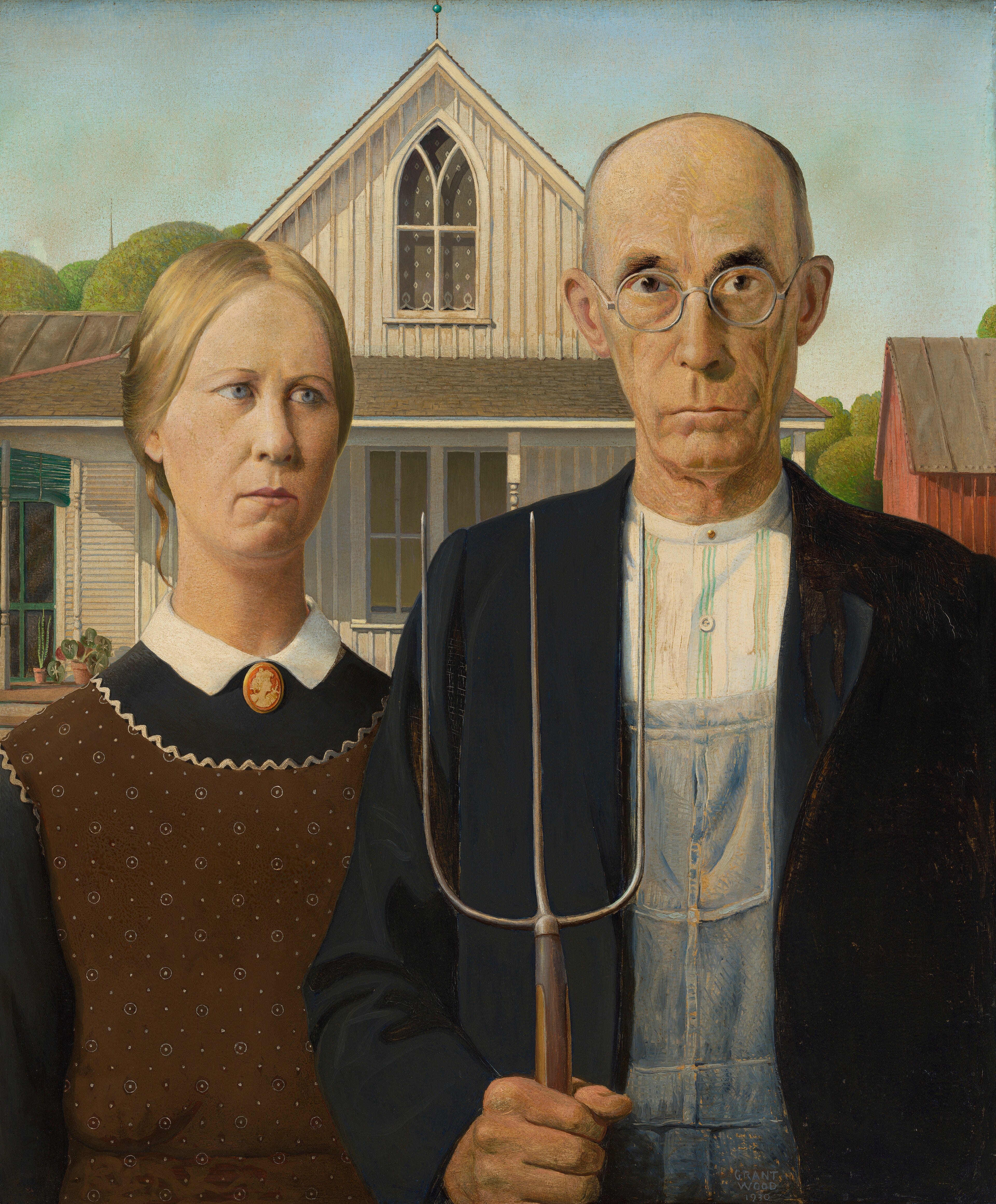
Grant Wood was an American painter, born in Iowa in 1891, who died in 1942. With Thomas Hart Benton and John Steuart Curry he is counted among the leading painters of Regionalism, but one picture made him famous: American Gothic, painted in 1930, the stern man with a pitchfork beside a woman in an apron. His models were his sister and his dentist.
Americans have been arguing about those two faces ever since. Is the joke on the Midwest, or is it a tribute?
Cool Stories About Art is a newsletter to learn art the fun way.
Join 200,000+ readers and get:
10 new art stories / month
The entire archive of content (1,000+ articles)
Comment, ask questions, and chat with other readers
It began with a house. In August 1930 a young local painter drove Wood around Eldon, Iowa, and he noticed a small white farmhouse with a pointed Gothic window under its roof. The next day he sketched it from the front yard. He wanted to paint, he said, "the kind of people I fancied should live in that house."
He entered the finished picture in the annual exhibition of the Art Institute of Chicago, where it won a bronze medal and 300 dollars, and the museum bought it. Back home, Iowans read it as an insult. Newspapers printed it as an Iowa farmer and his wife, readers wrote to the museum to complain, and one farm wife reportedly threatened to bite off Wood's ear.
He spent the rest of his life explaining, and the explanation is stranger than the scandal. Wood never went back to Eldon after that visit, and he had to ask for a photograph of the house to finish the picture.
The couple everyone has parodied since was not a couple at all. In 1941 Wood wrote it down: "The prim lady with him is his grown-up daughter." The father was a dentist, and the daughter was Wood's sister.
What You'll Discover
What Munich showed him.
Who stood in front of the house.
Why Iowa took offense.
Why Wood never picked a side.
Who he truly meant to mock.
What fame made him do.