Greek Myths in Painting: 12 Great Retellings
Greek myth has driven Western painting for centuries, from Titian's Diana surprised at her bath to Bruegel's tiny drowning Icarus, Rubens' chained Prometheus and Turner's blinded Cyclops.
Most of these scenes trace back to one book, Ovid's Metamorphoses, the painter's favorite source of gods behaving badly.

Myth gave painters everything the church could not: naked bodies, violence, sex, monsters and transformation, all with a respectable classical label.
The same handful of stories comes back again and again, each age retelling them in its own accent. I have picked twelve that do something surprising with a tale you may think you already know.
How to read a mythological painting:
The tell. A bull that is too calm, a hunter with antlers starting, an eagle at a liver. The clue to the myth is usually one odd detail.
The source. Nine times out of ten it is Ovid, so the theme is change, a body turning into a beast, a tree or a flower.
The excuse. Myth let painters show what was otherwise forbidden, which is why the gods are so often undressed.
The moment. Good painters freeze the story one beat before disaster, when it could still go another way.
If you like knowing what nobody tells you
Three that changed how I look at a picture:
Luncheon of the Boating Party, detail by detail, who everybody at that table actually was
Was Monet really the first Impressionist, the painting that may have got there first
The secret behind Monet Magpie, one bird in the snow, and why it matters
1. Pieter Bruegel the Elder, Landscape with the Fall of Icarus (about 1560)
A farmer plows, a shepherd stares at the sky, a ship sails on, and almost nobody notices the pair of pale legs disappearing into the sea in the corner.
That is Icarus, who flew too near the sun, drowning while the world simply carries on. It is one of the great hidden figures in art, the kind of buried detail I chase in the secrets hidden in famous paintings.
The point is the indifference. Bruegel makes the tragedy tiny and the ordinary huge, and the poet W H Auden built a famous poem around exactly that cruelty, the way suffering happens in a corner while everyone eats lunch.
There is even a twist about the picture itself. Scholars now think the version we know may be an old copy after a lost Bruegel, which means the most famous Bruegel of all might not be quite a Bruegel.
2. Titian, Diana and Actaeon (1556 to 1559)
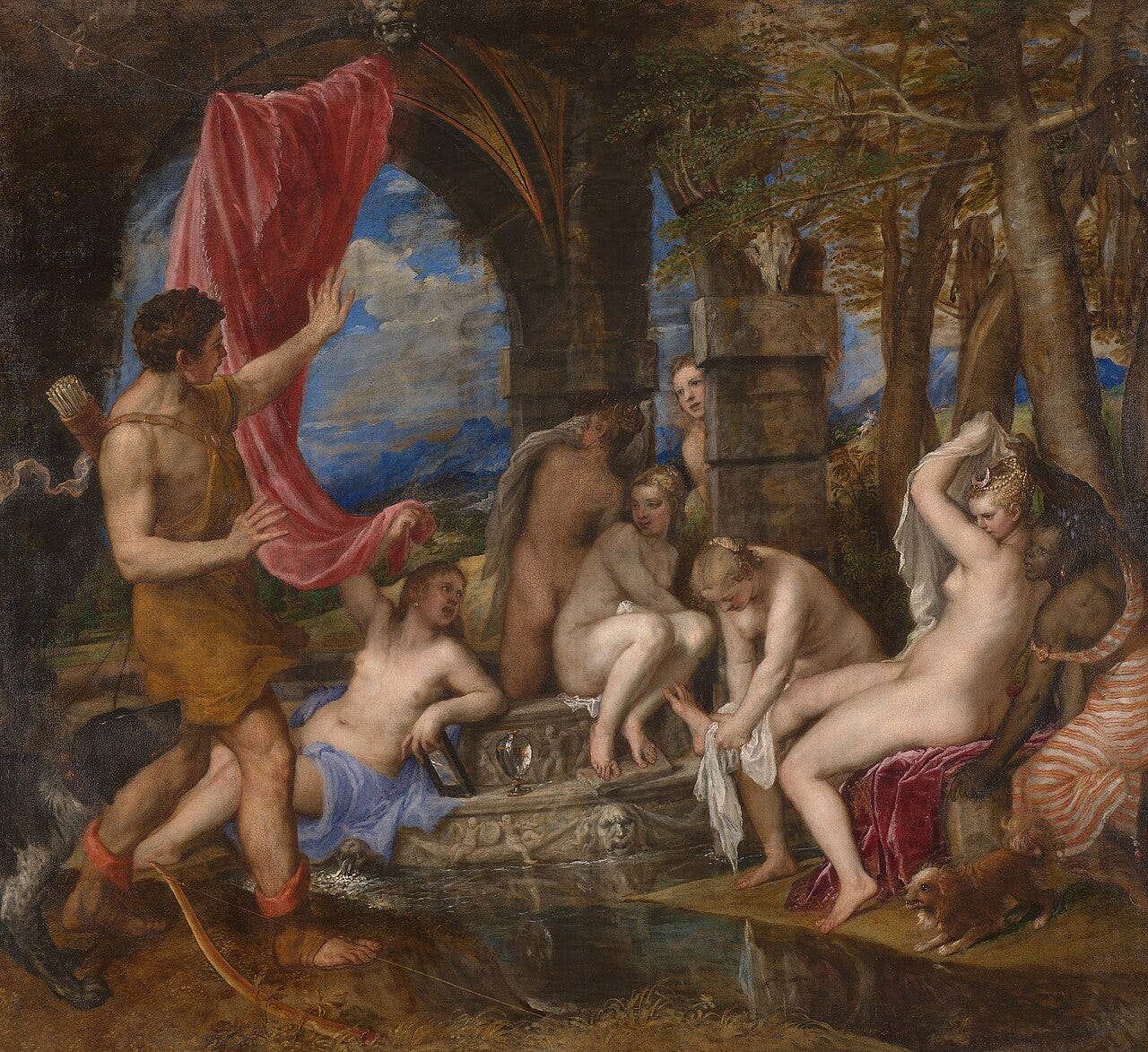
The hunter Actaeon pushes through a curtain and freezes. He has blundered onto the goddess Diana and her nymphs bathing, and the look on her face tells you he is already dead. She will turn him into a stag, and his own hounds will tear him apart.
Titian loads the scene with omens. A stag skull sits on a pillar, a dog tenses, and everything points to the horror a heartbeat away, all painted in his loose, glowing late style.
This was one of six mythologies Titian made for King Philip the Second of Spain, works he called poesie, painted poems. In 2009 two British galleries jointly bought this one to keep it from leaving the country, for fifty million pounds.
3. Peter Paul Rubens, Prometheus Bound (1611 to 1618)
A huge man is chained to a rock, twisted in agony, while an eagle drives its beak and talons into his side. This is Prometheus, punished for stealing fire from the gods and giving it to humankind.
The cruelty is eternal. Each day the eagle eats his liver, each night it grows back, and Rubens paints the muscles and the terror at full, terrible scale.
He did not paint the bird. The eagle, so real you can feel the grip, was done by the animal specialist Frans Snyders, one of many Rubens collaborations where the master shared the canvas.
4. Rembrandt, The Abduction of Europa (1632)
A white bull wades into the sea with a frightened young woman on its back, her friends left shrieking on the shore. The bull is Zeus in disguise, carrying off the princess Europa, and only she seems to sense that her ride is a god.
It is a rare seascape for Rembrandt. He was young and showing off, catching the wet light on the water and the panic in the little group on the bank.
The continent is named for her. By tradition Europa gives Europe its name, which makes this small, quiet abduction a kind of origin story for a whole part of the world.
5. Guido Reni, Atalanta and Hippomenes (about 1620)
Two nearly nude runners cross in mid stride against a black sky, one bending to snatch something bright from the ground. Atalanta could outrun any man, and refused to marry one who could not beat her, so the losers were killed.
Hippomenes cheated with beauty. He dropped three golden apples from the goddess of love, and each time Atalanta stooped to grab one she lost a step, and finally the race.
Reni turns it into pure choreography. He painted more than one version, and this one, now in Naples, sets the two pale bodies in a great X against a black night, a footrace painted as a dance.
6. Nicolas Poussin, Echo and Narcissus (about 1630)
A beautiful youth lies dying by a pool, still gazing at his own reflection, while a pale nymph wastes away behind him. Narcissus fell in love with his own image and could not leave it, and Echo, who loved him, faded until only her voice remained.
Poussin paints the exact moment of change. A flower, the narcissus, is already sprouting by the boy's head, the plant he becomes when he dies.
It is a myth about self obsession, and it has never felt more current. The word narcissism comes straight from this cold, still, beautiful scene.
7. Gustave Moreau, Oedipus and the Sphinx (1864)
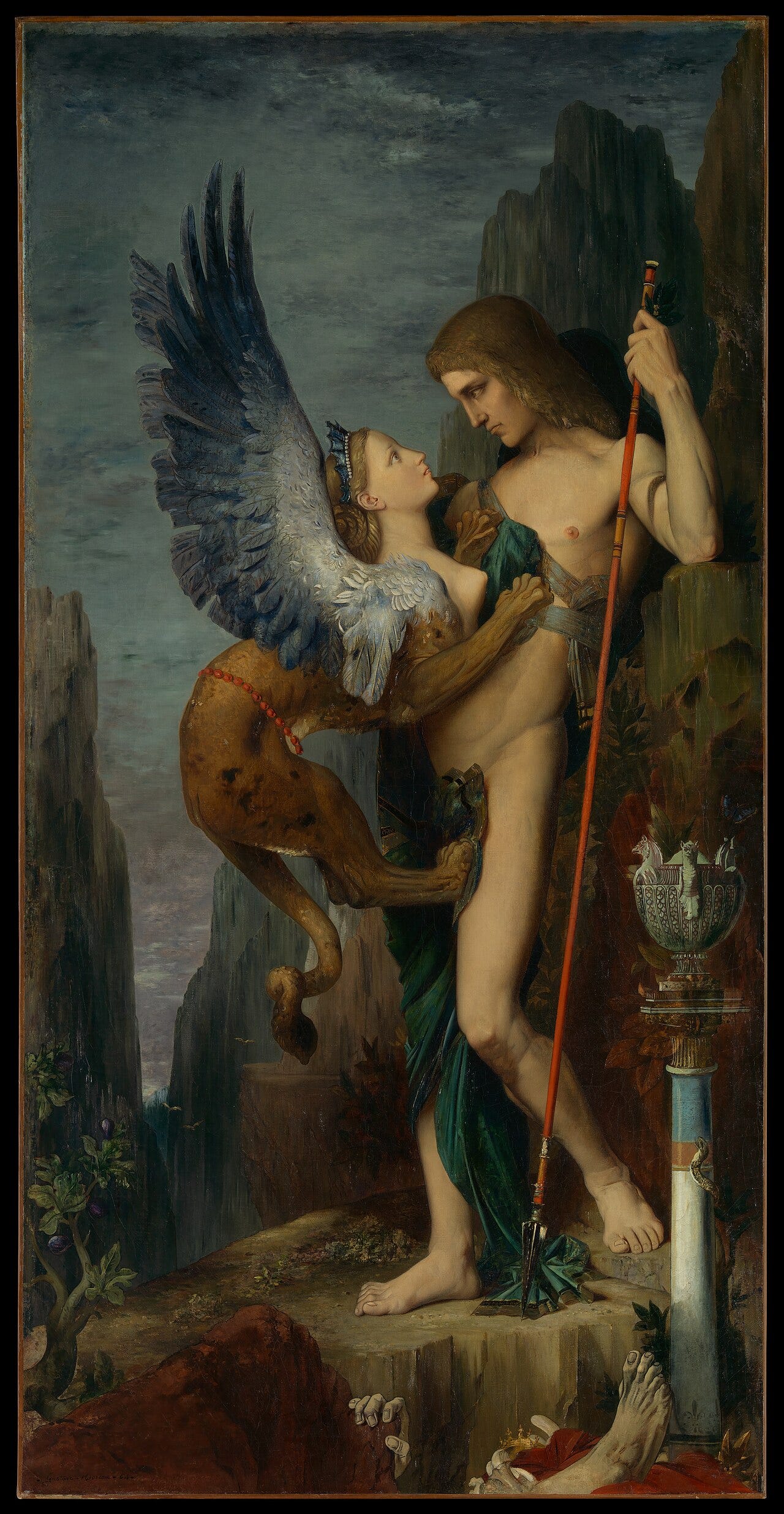
A winged monster with a woman's face and a lion's body clings to a young man's chest, staring him down, dead bodies piled below. This is the Sphinx, who kills everyone who fails her riddle, meeting Oedipus, the one man who will answer it.
Moreau painted it at the jewel like Symbolist edge of the century.
The riddle is the famous one. What walks on four legs, then two, then three, and the answer, man, is the whole of a human life in a sentence.
It made Moreau's name. The picture was the sensation of the Paris Salon of 1864, strange, still and loaded with dread, a world away from the slick myth paintings around it.
8. Jean Auguste Dominique Ingres, Jupiter and Thetis (1811)
A tiny sea nymph reaches up to touch the beard of an enormous, blank faced god enthroned in the clouds. Thetis is begging Zeus to help her son Achilles in the Trojan War, and the size difference says everything about who holds the power.
Ingres bends anatomy on purpose. Thetis has an impossibly long, boneless arm and neck, distorted to make her pleading feel soft and desperate against the god's stone stillness.
Critics hated it at first. The strange proportions looked like mistakes to them, and only later did people see that the wrongness was the whole point.
9. Frederic Leighton, The Return of Persephone (1891)
A young woman is lifted up out of a dark cleft in the earth toward a mother reaching down in a blaze of light. Persephone, stolen away to the underworld, is being carried back to Demeter by the messenger god.
The myth explains the seasons. Persephone must return below for part of each year, and while she is gone her grieving mother lets the world go cold, which is winter.
Leighton stages it as pure uplift, a single rising line from darkness into daylight. He painted it as president of the Royal Academy, and he was later made a lord, the only British artist ever raised to the peerage.
10. J M W Turner, Ulysses Deriding Polyphemus (1829)
A great ship pulls away in a burst of gold and rose light while a huge, dim shape rages on the cliff above. Ulysses has just blinded the one eyed giant Polyphemus and escaped his cave, and he cannot resist shouting his own name in triumph.
The taunt is his mistake. By naming himself, Ulysses lets the giant curse him to the god of the sea, which is why his voyage home drags on for another ten years.
Turner barely paints the story at all. The real subject is the light, a sunrise so fierce that the myth almost dissolves into pure color, and you can just make out the sun god's horses in the glow.
11. Peter Paul Rubens, The Judgement of Paris (about 1636)
Three goddesses stand undressed before a young shepherd who holds out a golden apple, trying to decide which of them is the fairest. The shepherd is Paris, and his choice is about to start the longest war in myth.
Each goddess offers a bribe. Paris picks Venus, who has promised him the most beautiful woman in the world, and that woman, Helen, is already married to a Greek king.
So this quiet beauty contest is a fuse. The theft of Helen that follows launches the ten year siege of Troy, and Rubens paints the calm instant just before the whole disaster lights.
12. Herbert Draper, Ulysses and the Sirens (1909)
Sirens haul themselves up over the side of a ship while the sailors row for their lives and the captain, roped to the mast, strains toward the singing. Ulysses had himself tied down so he could hear the deadly song and live to tell it.
Draper makes one big change. In Homer the sirens are bird women on a rocky shore, but here they are beautiful young women climbing aboard, the danger turned fully human.
It is the Odyssey as pure temptation. The whole picture pulls toward the sound we cannot hear, and only a length of rope keeps the hero from throwing himself into the sea.
Where to meet the gods
Titian, Diana and Actaeon: shared by the National Gallery, London and the National Galleries of Scotland.
Turner, Ulysses Deriding Polyphemus: the National Gallery, London.
Rubens, The Judgement of Paris: the National Gallery, London.
Moreau, Oedipus and the Sphinx: the Metropolitan Museum of Art, New York.
Leighton, The Return of Persephone: Leeds Art Gallery.
Follow the stories deeper
Myth is the engine room of Western art. These go further:
Lady with an Ermine, detail by detail, why she is holding that animal
The secret behind Hopper Soir Bleu, the clown picture that went wrong
Titian, Sacred and Profane Love, which of the two women is which
Questions people ask about mythology in art
Why did artists paint Greek myths so often? Myth let them show nudity, violence and passion under a respectable classical cover, and the stories were shared by every educated viewer in Europe.
What book are most mythological paintings based on? Ovid's Metamorphoses, a Roman poem retelling Greek myths, is by far the most painted source, full of gods turning people into animals and plants.
Are Roman and Greek gods the same in art? Mostly. Painters often use the Roman names, so Zeus becomes Jupiter, Aphrodite becomes Venus and Odysseus becomes Ulysses, but the stories are Greek.
What is the myth in Bruegel's Icarus? Icarus flew too close to the sun on wax wings, which melted, and he fell into the sea. Bruegel hides his fall in a corner while daily life goes on.
Which myth painting started the Trojan War? The Judgement of Paris, where Paris gives the golden apple to Venus in return for Helen, the act that leads to the war on Troy.
The oldest stories we keep repainting
Three thousand years on, we are still turning these tales into pictures. A shepherd chooses the wrong goddess and a city burns. A boy will not stop looking at his own reflection and gives his name to a disorder we all recognize.
A father's warning goes unheeded and a pair of legs vanishes into the sea while a plowman keeps his eyes on the furrow. The gods change names and the painters change styles, but the myths hold because they were never really about the gods.
They were always about us.