
Ancient Greek sculpture was made wherever Greeks lived, from Athens and the islands of the Aegean Sea to the cities they founded in Sicily and on the coast of today's Turkey. It flourished from about 650 BC until 30 BC, when Rome completed its conquest of the Greek world.
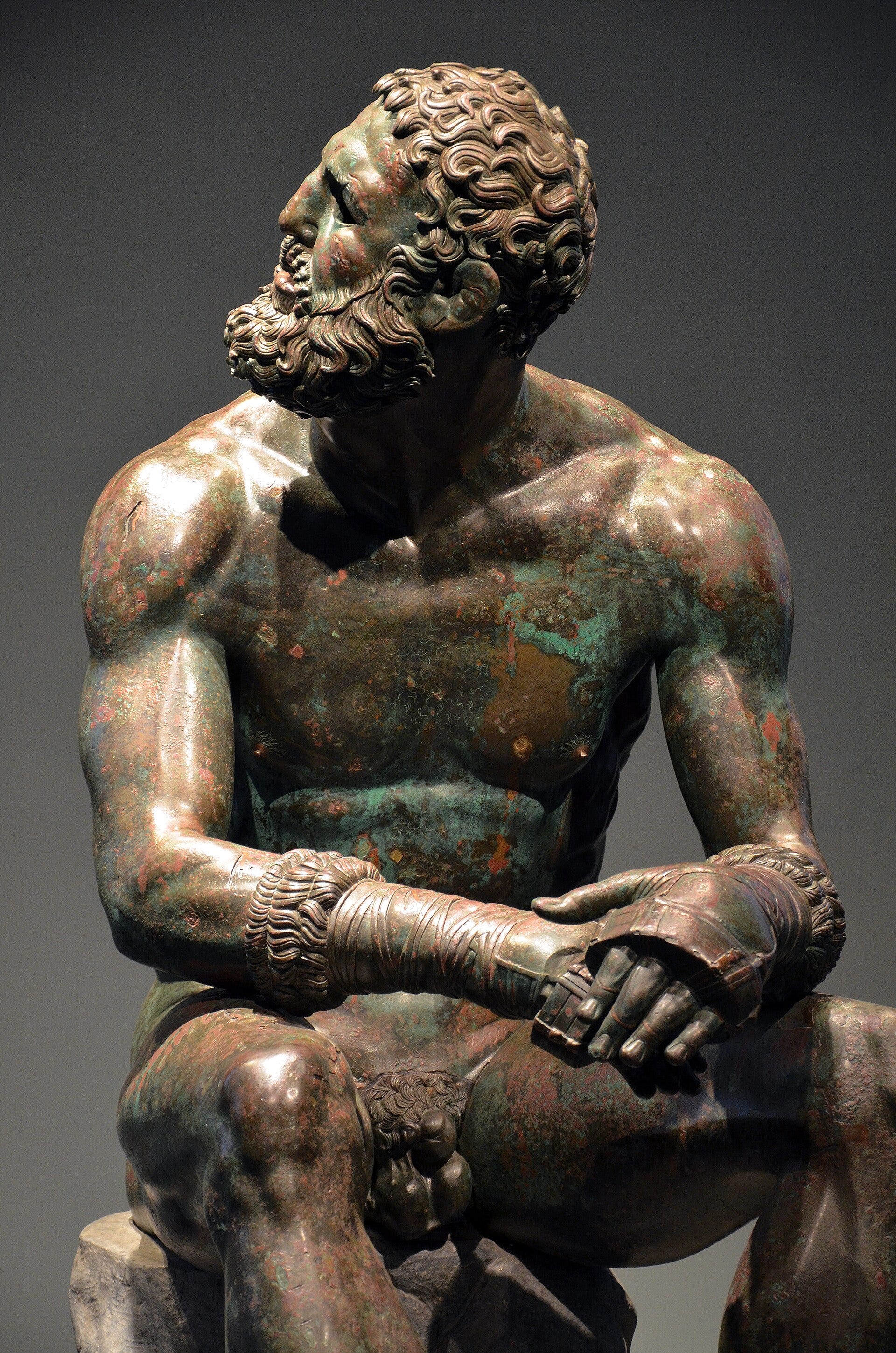
Greek marble statues look plain white today, yet the people who carved them painted the stone. They gave their metal figures glass eyes and wounds of inlaid copper, and some statues were buried on purpose soon after they were made.
What survives came back from pits, shipwrecks and a castle moat, often in pieces, and almost always without its paint.
Cool Stories About Art is a newsletter to learn art the fun way.
Join 200,000+ readers and get:
10 new art stories / month
The entire archive of content (140+ articles)
Comment, ask questions, and chat with other readers
What Greek Sculptors Were Trying to Do
Greek sculptors worked on one great subject, the human body. Gods, athletes and the dead were all shown as people, and generation after generation, the challenge was to make marble or cast metal look like someone alive.
The answers changed over time, and historians divide them into three periods. In the Archaic period, from about 650 to 480 BC, statues of young men, called kouroi, and of young women, called korai, stand straight and smile.
Classical figures, made from 480 to 323 BC, shift their weight and move. That end date marks the death of Alexander the Great, the Macedonian king who had conquered the Persian Empire. In the Hellenistic age that followed, sculptors also carved bodies asleep or worn out.
Most of that work is lost. Metal statues were melted down and reused, and many marbles survive only as Roman copies, like the Aphrodite of Knidos further on.
The other statues that follow come from all three periods, and most are Greek originals. For two of them, though, a sleeping satyr and a god carrying a child, scholars cannot agree whether the marble is Greek work or a later copy.
12. Aristion of Paros, Phrasikleia Kore (about 550 to 540 BC)
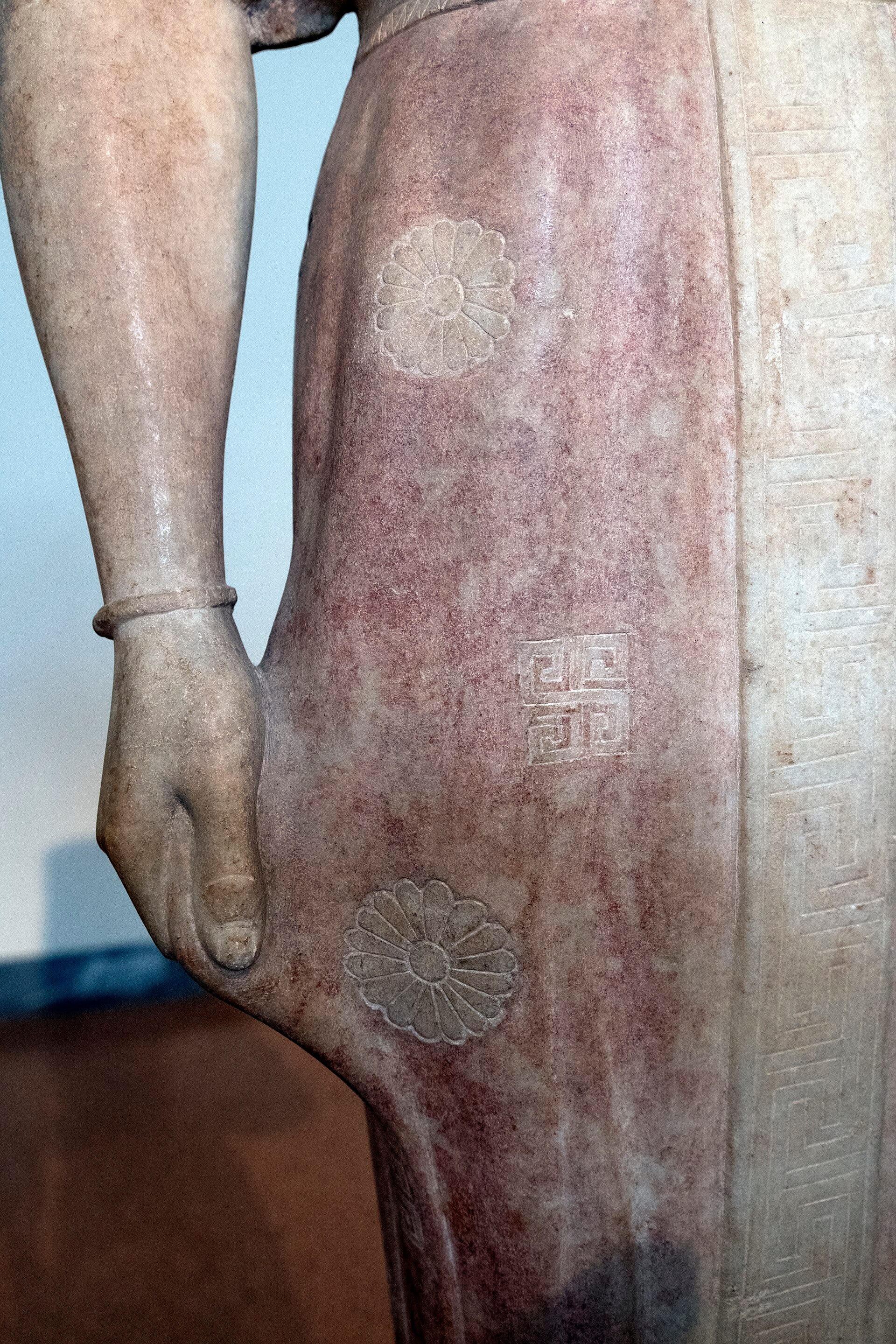
A closed flower is pressed against the chest of this young woman. Her long dress falls straight to her feet, a crown of buds sits on her braided hair, and a few patches of red still cling to the marble of her skirt.
Her name is Phrasikleia, and scholars knew it for more than two centuries before anyone saw her face. It was carved on a stone base, recorded in 1729, which had been reused in the walls of a country church in Attica, the region around Athens.
The same base carries the signature of the man who carved her, Aristion of Paros. He came from Paros, an island in the Aegean Sea known for its fine white marble.
Phrasikleia died before she could marry, and her statue stood over her grave. The inscription speaks in the voice of the dead girl: "Kore I shall forever be called, this name given to me by the gods instead of marriage."
The flower she holds is a lotus bud, and lotus flowers were linked to Hera, the goddess of marriage. The bud may therefore point to the wedding she never had.
The statue itself turned up only in the summer of 1972, and scholars matched it with the inscribed base. Archaeologists found it lying in a pit beside the figure of a young man, a kouros. The two had been laid there deliberately, soon after they were carved, and nobody knows why.
Two explanations have been proposed. Around 546 BC, Pisistratus came back from exile and took power in Athens, ruling alone as what the Greeks called a tyrant. Families opposed to him may have buried the monuments of their dead to keep them safe from his supporters.
The other explanation places the burial later, just before the Persian army sacked Athens in 480 BC.
Whatever the reason, the pit protected more than the stone. It kept traces of paint: red and yellow pigments made from iron oxides, and cinnabar, a bright red mineral, on the dress. Analysis also revealed gold leaf and a thin foil of lead and tin.
Those traces were enough for two German archaeologists, Vinzenz Brinkmann and Ulrike Koch-Brinkmann, to make a painted copy, begun in 2010, finished in 2019 and shown in New York in 2022. Their Phrasikleia wears a red dress covered with rosettes and stars.
At a Glance
Artist: Aristion of Paros (6th century BC, dates unknown)
Carved: About 550 to 540 BC
Medium: Parian marble with traces of paint
Size: Height: 176 cm (69 in)
Where to see it: National Archaeological Museum, Athens
About This Sculpture
Where was the Phrasikleia Kore found?
In Merenda, a village in eastern Attica that stands on the site of the ancient town of Myrrhinous.
Who was Aristion of Paros?
A sculptor from Paros, a Cycladic island known for its fine white marble, active in the middle of the 6th century BC. He is known through his signature on this base.
11. The Antikythera Youth (about 340 to 330 BC)
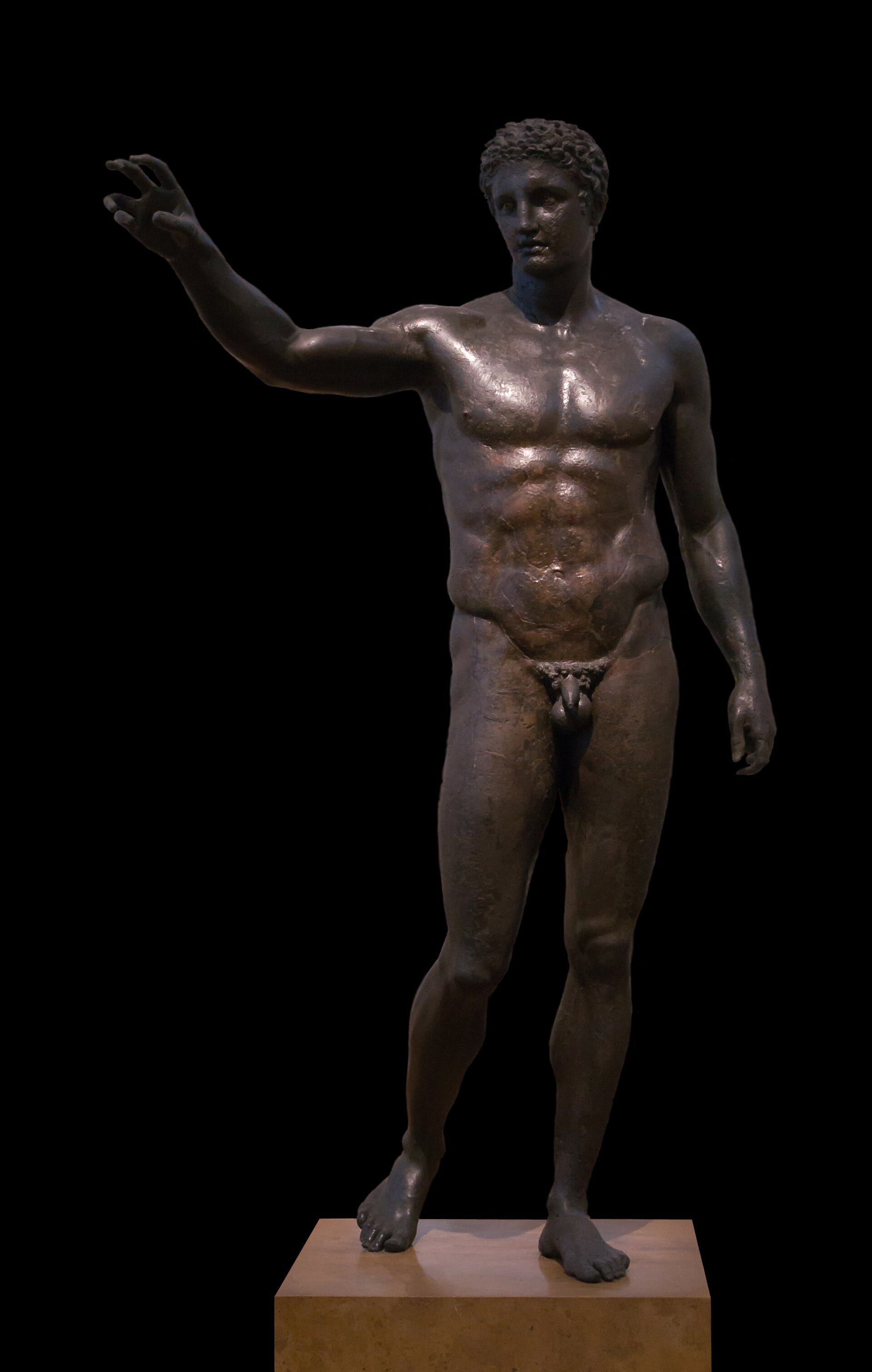
This naked young man in bronze lay for centuries on the seabed off a small Greek island, and the first man to see the wreck that held him came back up shaking, saying he had seen a heap of dead people. His right arm is raised, and his fingers curl around something that is no longer there.