Green Paintings: 12 Famous Works and the Color at the Center

The most famous green paintings run from Bruegel's peasant dance and Constable's hay cart to Rousseau's jungle tiger and Klimt's leaf covered park.

Green is the color painters have distrusted the most and reached for constantly anyway, and these twelve pictures show why.

Green sits between warm and cool on the color wheel, and for most of art history the paint itself was hard to trust. Pigments faded, turned brown, or in one well known case turned out to be laced with arsenic. I have picked twelve pictures where green carries the whole scene, and together they trace how a color painters kept fighting with still ended up everywhere.

Why green is the hardest color to trust:

  • The instability. Historic green pigments often faded or browned over time, so old paintings can look less green today than they did when they were finished.

  • The danger. Scheele's green, widely used after 1775, contained arsenic, a fact painters and buyers did not always know.

  • The distrust. Painters across centuries called green one of the hardest colors to mix well, since it turns muddy fast.

  • The range. Green has stood for farmland, wilderness, jealousy and hope, sometimes in the same picture.


Join 170,000 readers who get the secrets behind the paintings. Free.


Twelve pictures, one difficult color

1. Pieter Bruegel the Elder, The Magpie on the Gallows (1568)

Bruegel painting of dancing peasants and a magpie perched on a gallows
Pieter Bruegel the Elder, The Magpie on the Gallows, 1568, Hessisches Landesmuseum, Darmstadt

Bruegel painted this scene in 1568, a year before he died, showing peasants dancing beneath a gallows while a magpie looks on from a branch. In Flemish tradition a chattering magpie stood for gossip and slander, so the bird perched above an execution site reads as a warning, though nobody has settled exactly what the joke was aimed at.

The green sits in a flat middle band between brown foreground and pale sky, marking distance rather than describing any single field. Bruegel is said to have asked his wife to burn his more openly satirical drawings after his death, but to keep this particular painting for herself, a detail I trace further in my complete Bruegel profile.

2. Caspar David Friedrich, Chalk Cliffs on Rugen (about 1818)

Friedrich painting of three figures looking down white chalk cliffs toward the sea
Caspar David Friedrich, Chalk Cliffs on Rugen, about 1818, Kunst Museum Winterthur, Winterthur

Friedrich painted three figures looking down a set of white chalk cliffs toward the sea, likely inspired by a real trip to the island of Rugen with his wife and brother. Art historians read the three figures as standing for faith, love and hope, each given its own color, and green was assigned to hope.

For decades the painting was misattributed to another artist entirely after it surfaced at a Berlin auction in 1903, and it was only correctly identified as Friedrich's work in 1920. I cover his career in full in my Friedrich profile.

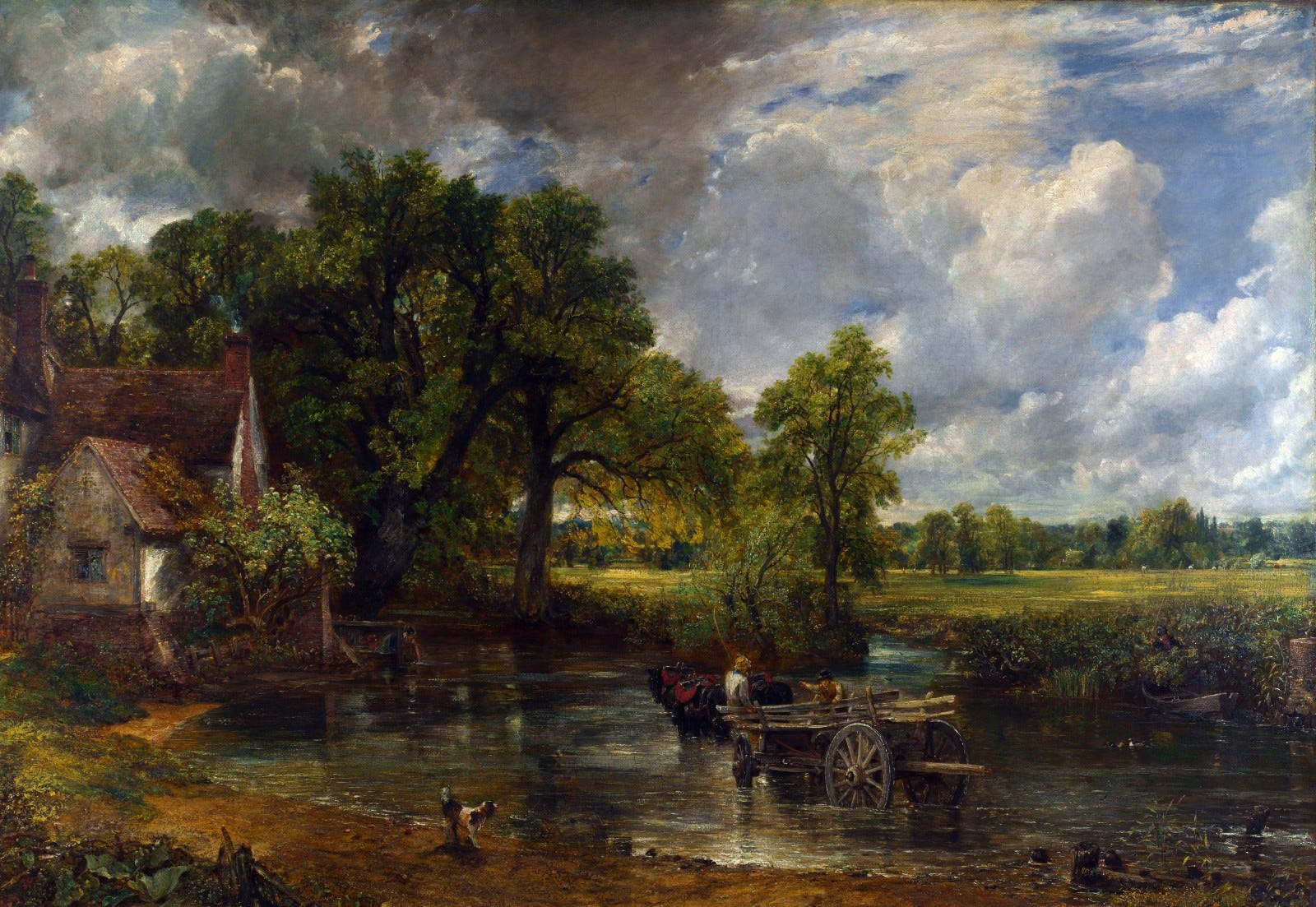
3. John Constable, The Hay Wain (1821)

Constable painting of a horse drawn cart crossing a river in the English countryside
John Constable, The Hay Wain, 1821, National Gallery, London

Constable painted this scene of a horse drawn cart crossing a shallow river on the Suffolk countryside he grew up in, finishing it in 1821. It found no buyer in England that year, then won a gold medal from King Charles X of France at the 1824 Paris Salon.

Green fills the meadow, the riverbank trees and the reflection in the water, set against warm brown thatch and gold hay. A cast of that French medal is set into the picture's own frame today. I go deeper into his story in my Constable profile.

4. Thomas Cole, The Oxbow (1836)

Cole painting of a river bend seen from a mountain after a thunderstorm
Thomas Cole, The Oxbow, 1836, Metropolitan Museum of Art, New York

Cole's full title for this work is View from Mount Holyoke, Northampton, Massachusetts, after a Thunderstorm, painted in 1836. The canvas splits in two: dark, storm lit wilderness on the left, sunlit farmland on the right, both rendered in green.

Logging scars on a distant hillside were later noticed to spell out a Hebrew word when the canvas is turned upside down, a detail art historians only identified long after the painting entered the Metropolitan Museum's collection.

5. George Inness, The Lackawanna Valley (1855)

Inness painting of a train roundhouse in a green valley with grazing sheep
George Inness, The Lackawanna Valley, 1855, National Gallery of Art, Washington

A railroad company paid Inness to paint this Pennsylvania valley in 1855 as advertising for its new line, roundhouse and all. Green pastureland fills the entire foreground, with grazing sheep placed right next to the tracks.

Inness resented the commission's demands, later saying the railroad wanted every visible detail included whether it improved the picture or not. The result still hangs at the National Gallery of Art in Washington.

6. Edouard Manet, The Balcony (1868 to 1869)

Manet painting of four figures on a balcony behind a green iron railing
Edouard Manet, The Balcony, 1868 to 1869, Musee d'Orsay, Paris

Manet showed four Parisians behind an iron balcony railing painted in a loud, saturated green, a color choice contemporary critics singled out by name as aggressive and in poor taste. The painting was shown at the 1869 Paris Salon to mixed reviews.

That green railing, not the figures behind it, is what still dominates the composition today. Berthe Morisot, seated at the left, went on to become one of the leading Impressionist painters herself.

7. Vincent van Gogh, Wheat Field with Cypresses (1889)

Van Gogh painting of a wheat field with a dark green cypress tree
Vincent van Gogh, Wheat Field with Cypresses, 1889, Metropolitan Museum of Art, New York

Van Gogh painted this field near Saint Remy directly from nature in 1889, then made two further studio versions from memory afterward. He described the result to his brother Theo as one of his best summer landscapes.

The dark cypress, built up in thick strokes of viridian and emerald green, anchors the whole composition against the gold wheat around it. This version hangs at the Metropolitan Museum of Art in New York.

8. Paul Gauguin, The Green Christ (1889)

Gauguin painting of a Breton woman seated before a green crucifix statue
Paul Gauguin, The Green Christ, 1889, Royal Museums of Fine Arts of Belgium, Brussels

Gauguin painted a Breton woman seated before a green tinted crucifix in 1889, a scene he titled The Green Christ. The calvary statue is not invented: it copies a real roadside cross that still stands beside a church at Nizon, near Pont Aven, though Gauguin moved it in the painting to a different stretch of coast entirely.

Green here works as a symbol rather than a description, applied to a religious object rather than to any landscape. The painting now hangs at the Royal Museums of Fine Arts of Belgium in Brussels.

9. Henri Rousseau, Tiger in a Tropical Storm (1891)

Rousseau painting of a tiger crouched in dense jungle foliage during a storm
Henri Rousseau, Tiger in a Tropical Storm, 1891, National Gallery, London

Rousseau, a self taught painter who never left France, built this jungle from dozens of distinct green tones layered against streaks of red. He used a pantograph, a mechanical tracing device, to enlarge the tiger's outline onto the canvas, which is part of why the animal appears to float rather than stand on solid ground.

Conservators have also found darkened patches above the grass that may cover an earlier, painted out figure. I trace his full, unusual career in my Rousseau profile.

10. Claude Monet, The Water Lily Pond (1899)

Monet painting of a Japanese footbridge over a lily pond
Claude Monet, The Water Lily Pond, 1899, National Gallery, London

Monet painted this Japanese style bridge over his lily pond at Giverny in 1899, one of only three canvases he made of the bridge that year after several years away from the subject. He later showed twelve related bridge paintings together in a single Paris exhibition in December 1900.

Green dominates through the lily pads and the reflected willows, laid on in thick, unblended strokes rather than smoothed together. The painting entered London's National Gallery in 1927.

11. Paul Cezanne, Mont Sainte Victoire (about 1902 to 1906)

Cezanne painting of a limestone mountain above a green valley in Provence
Paul Cezanne, Mont Sainte Victoire, about 1902 to 1906, Metropolitan Museum of Art, New York

Cezanne painted this limestone mountain near his home in Provence dozens of times over his career, and this version dates to his final years, about 1902 to 1906. He enlarged the canvas partway through the work, adding strips of fabric to extend the view further into the foreground.

Green structures the orchards and valley floor below the pale mountain, built from small, distinct geometric patches of color rather than blended tone. The canvas now hangs at the Metropolitan Museum of Art.

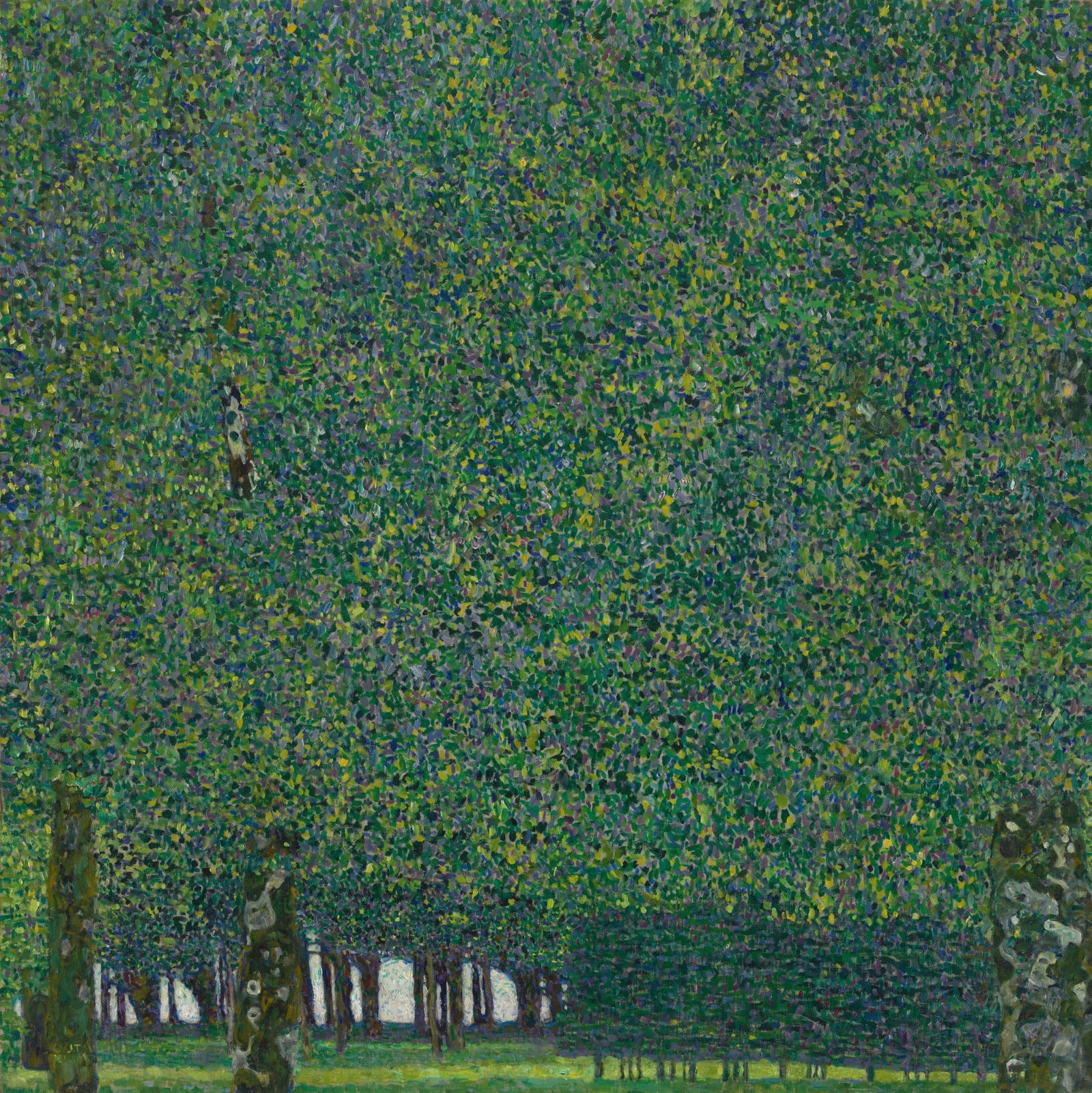
12. Gustav Klimt, The Park (1910)

Klimt painting of dense green tree foliage filling the canvas
Gustav Klimt, The Park, 1910, Museum of Modern Art, New York

Klimt painted this canopy of trees at Schloss Kammer on the Attersee, where he spent his summers, in 1910. He is said to have used a piece of cardboard with a square hole cut into it as a viewfinder, framing sections of foliage before transferring them to canvas.

Nearly the entire painting, apart from a narrow strip of tree trunks at the bottom edge, is a mosaic of green, blue and yellow dabs with no sky and no horizon. It has hung at the Museum of Modern Art in New York since 1957.


No lectures, no jargon. Just the paintings and the facts, free every week.


Where these greens hang today

  • Bruegel, The Magpie on the Gallows: Hessisches Landesmuseum, Darmstadt.

  • Friedrich, Chalk Cliffs on Rugen: Kunst Museum Winterthur, Winterthur.

  • Constable, The Hay Wain: National Gallery, London.

  • Cole, The Oxbow: Metropolitan Museum of Art, New York.

  • Inness, The Lackawanna Valley: National Gallery of Art, Washington.

  • Manet, The Balcony: Musee d'Orsay, Paris.

  • Van Gogh, Wheat Field with Cypresses: Metropolitan Museum of Art, New York.

  • Gauguin, The Green Christ: Royal Museums of Fine Arts of Belgium, Brussels.

  • Rousseau, Tiger in a Tropical Storm: National Gallery, London.

  • Monet, The Water Lily Pond: National Gallery, London.

  • Cezanne, Mont Sainte Victoire: Metropolitan Museum of Art, New York.

  • Klimt, The Park: Museum of Modern Art, New York.


Two new stories a week, twelve paintings decoded at a time. Start free.


Short answers, green paintings

  • Why is green considered hard to paint? Historic green pigments were unstable or toxic, and mixed greens turn muddy easily, so painters treated the color with more caution than most.

  • What is Scheele's green? A bright green pigment introduced in 1775 that contained arsenic, widely used in paint, wallpaper and dye before its danger was understood. I cover its full, strange history in this piece on the color green.

  • Why does green sometimes look different in old paintings today? Some historic pigments have faded or browned with age and light exposure, changing how green areas read compared to when the paint was fresh.

  • What is the most famous green painting? Constable's The Hay Wain and Rousseau's jungle scenes are usually the paintings people picture first when they think of green in art.

  • How does green work differently from other colors in painting? I break down how several colors function across specific paintings in Color in Art, including how green gowns, cangiante drapery and interior lighting each use color differently.

One color, never fully settled

Line these twelve up and the color barely holds still. It marks distance in Bruegel, hope in Friedrich, farmland in Constable and Inness, danger in a manufactured pigment, then jungle, religion and abstraction by the time Klimt gets to it.

Gauguin's green crucifix is the strangest case. It is a real roadside calvary that still stands today beside a church at Nizon, though Gauguin moved it in paint to a stretch of coast far from where it actually is.