
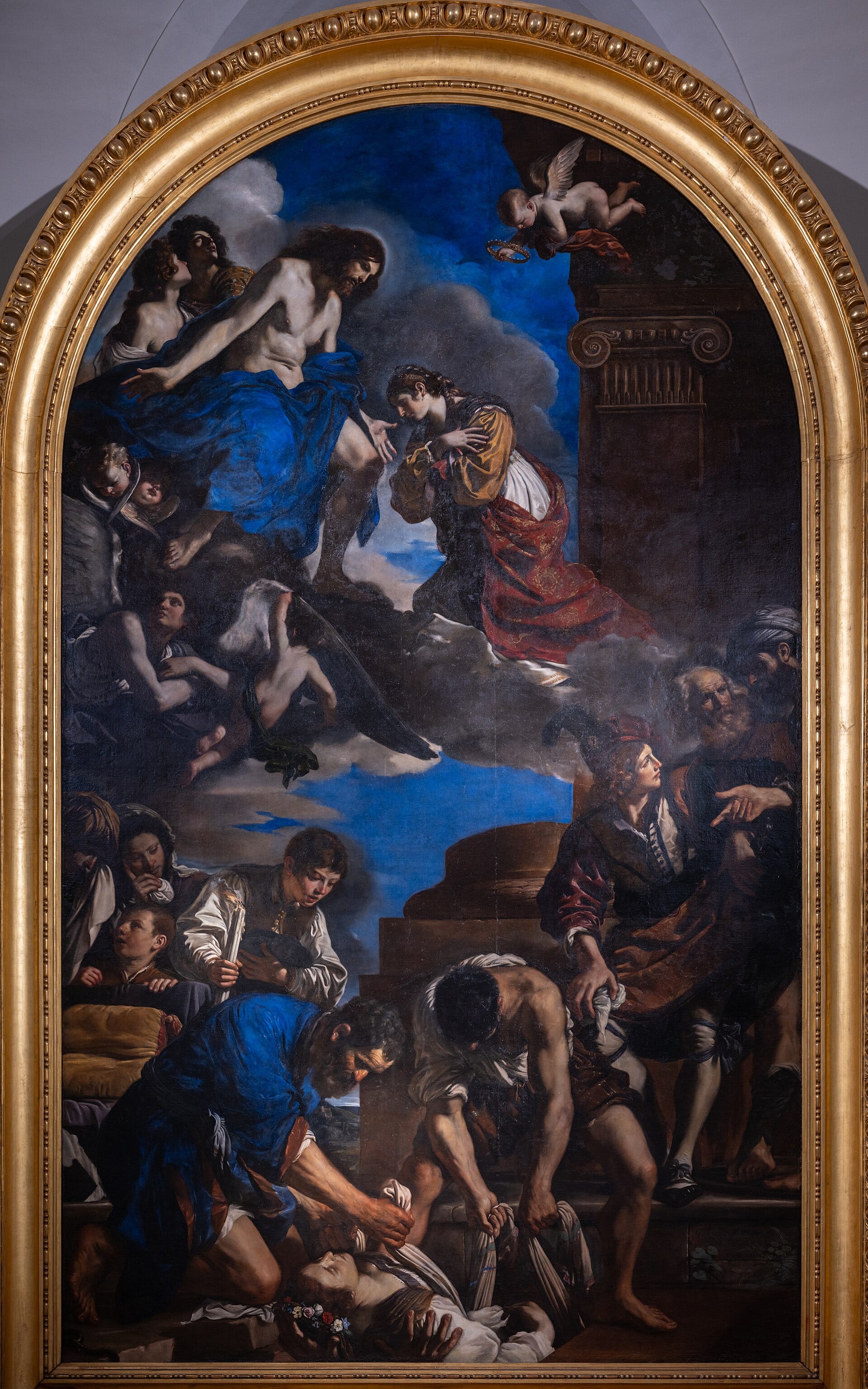
Guercino (1591 to 1666) was an Italian painter of the 1600s, born Giovanni Francesco Barbieri in Cento, a small town near Bologna. He is famous for Aurora, a ceiling painted in Rome, and The Burial of Saint Petronilla, an altarpiece made for Saint Peter's.
Cool Stories About Art is a newsletter to learn art the fun way.
Join 200,000+ readers and get:
10 new art stories / month
The entire archive of content (140+ articles)
Comment, ask questions, and chat with other readers
In 1621, a pope called the painter Guercino to Rome, and two years later Guercino was back in Cento. Then the queen mother of France invited him to Paris, and later the king did too. Both times Guercino said no.
Giovanni Francesco Barbieri was born in Cento in 1591, to poor parents. The town then belonged to the Papal States, the part of Italy ruled by the pope, like Bologna, the great city of the region.
The boy squinted all his life. According to a story told in Cento, a loud noise startled him awake as a baby, and his right eye stayed turned to one side. In Italian, Guercino means "the one who squints," and the nickname stuck.
As a teenager, Guercino climbed a ladder in a church of Cento to study a Virgin Mary by Ludovico Carracci, one of the leading painters of Bologna. He called the picture his "Carraccina," a pet name meaning his little Carracci.
Some ten years later, Ludovico Carracci had become the boy's admirer. On October 25, 1617, the older painter wrote to a friend that the young man was "a monster of nature," meaning a wonder, and a miracle who amazed anyone who saw his works.
On Carracci's advice, the archbishop of Bologna, Alessandro Ludovisi, had bought three of Guercino's Evangelists, paintings of the authors of the Gospels. He paid 25 scudi, the coins of the Papal States, for each one.
In February 1621, the archbishop became Pope Gregory XV. That May, Guercino arrived in Rome, at thirty.
The new pope wanted him to decorate the Loggia of Blessings, the hall behind the balcony where the pope blesses the crowd at Saint Peter's Basilica, the greatest church of the Catholic world. The job was worth about 22,000 scudi.
Why would a painter wanted by a pope and a queen refuse, for twenty years, to settle anywhere but his small town?
In the rest of the story
Which of Guercino's paintings made the trip to Paris without him.
What became of the painting Guercino made for the French queen mother.
What Guercino answered when his friends urged him to marry.
Who wrote the last line of Guercino's account book, the day he died.