
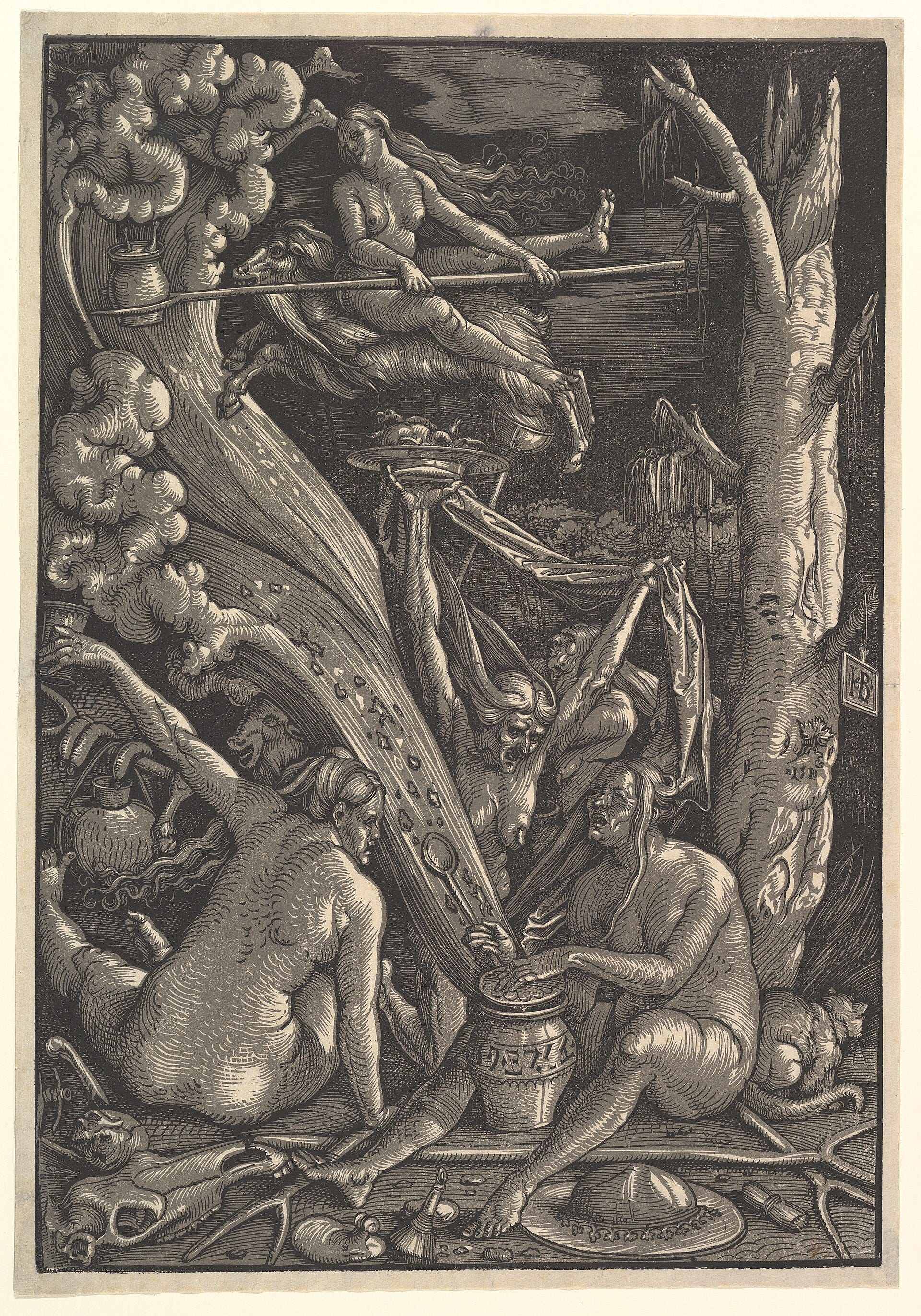
Hans Baldung Grien (1484 or 1485 to 1545) was a German painter and printmaker, trained by Albrecht Dürer. He is famous for his witches, like the print The Witches, and for his pictures of Death seizing young women, like Death and the Maiden.
Cool Stories About Art is a newsletter to learn art the fun way.
Join 200,000+ readers and get:
10 new art stories / month
The entire archive of content (140+ articles)
Comment, ask questions, and chat with other readers
In 1516, Hans Baldung set up a great altarpiece, a set of painted panels, on the high altar of the main church of Freiburg, in Germany. Soon after, he made a print that showed Martin Luther, the monk who defied the pope, as a saint. In 1529, his own city, Strasbourg, took Luther's side, and religious images came down from its churches.
Hans Baldung was born in 1484 or 1485, probably in Schwäbisch Gmünd, a small town in southwestern Germany. In the 1490s, his family moved to Strasbourg, then a German city on the Rhine, today in France.
Strasbourg was a free city, which answered only to the emperor. The Baldungs were a family of lawyers and doctors, and Hans chose a craft instead.
In 1503, at about eighteen, Hans entered the workshop of Albrecht Dürer, the most famous German painter and printmaker of his time, in the rich merchant city of Nuremberg.
Two other apprentices of Dürer were also named Hans. The newcomer became "Grien," green in the German of the time, perhaps to tell the three apart, perhaps because he liked to dress in green. He kept the nickname all his life, and on some works he added a G, for Grien, to his initials, HB.
While Dürer traveled in Italy, the young painter finished orders for the workshop. In those same years, he painted his first two altarpieces under his own name, for the city of Halle, in eastern Germany.
In April 1509, Hans Baldung became a citizen of Strasbourg. By 1510, he had married Margarethe Herlin, the daughter of a Strasbourg citizen, and opened his own workshop in the city.
Baldung's first large orders in Strasbourg were altarpieces, for churches and monasteries. In 1510, he also signed with his initials a print made to be sold to anyone, The Witches.
What would a painter of altarpieces do, in a city about to take the pictures out of its churches?
In the rest of the story
Whose face looks out from behind the cross on the Freiburg altarpiece.
What Albrecht Dürer did with his former pupil's prints in 1521.
How Baldung made his living once Strasbourg's churches stopped ordering altarpieces.
Which family emblem hangs in a stable, in Baldung's late print about witchcraft.