
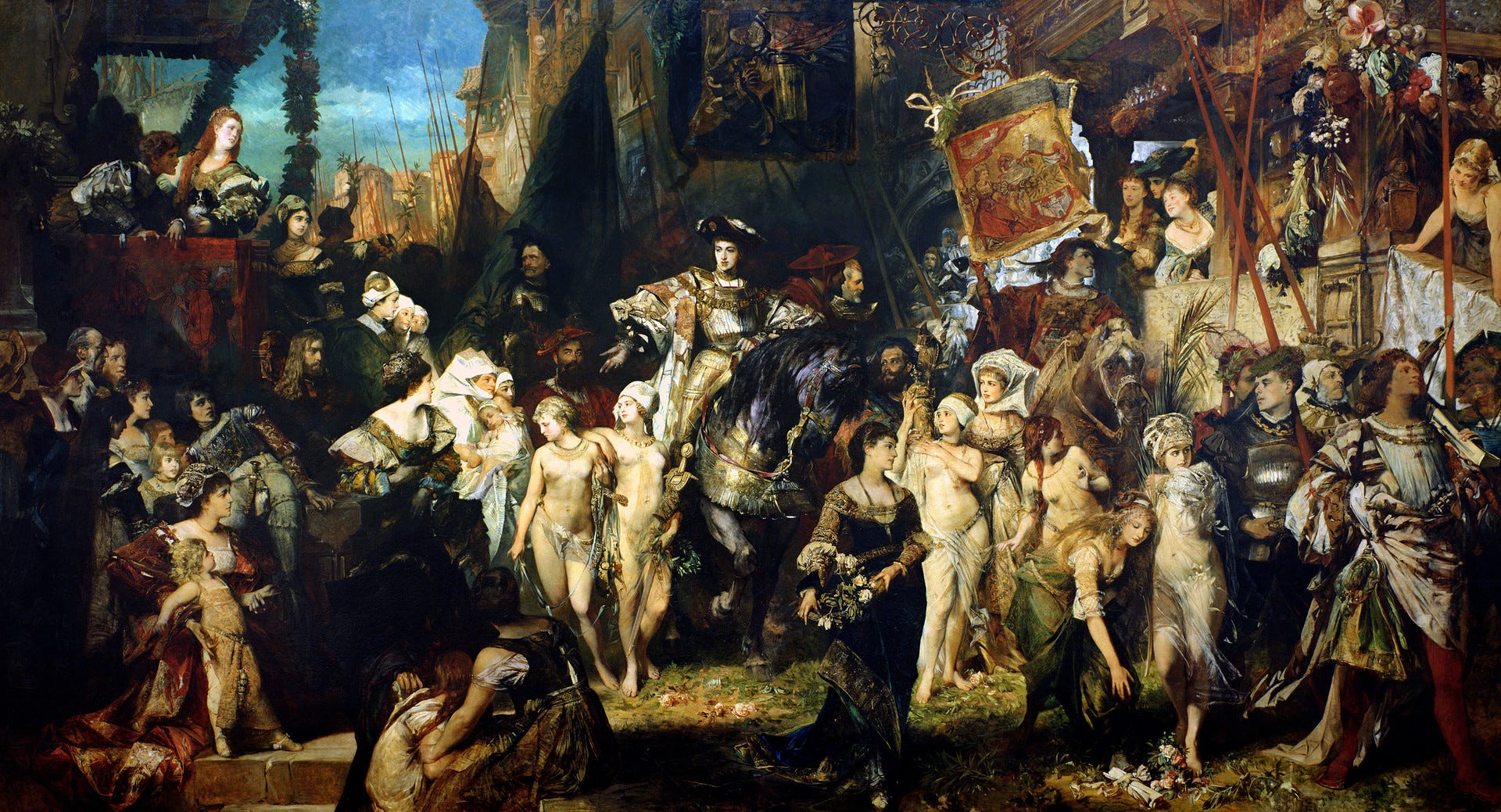
Hans Makart (1840 to 1884) was an Austrian painter, the most famous artist in Vienna in the 1870s. He painted giant scenes of history and legend, like The Entry of Charles V into Antwerp, now at the Hamburger Kunsthalle in Germany.
Cool Stories About Art is a newsletter to learn art the fun way.
Join 200,000+ readers and get:
10 new art stories / month
The entire archive of content (140+ articles)
Comment, ask questions, and chat with other readers
In 1879, Hans Makart designed the costumes and floats of a parade of 14,000 people for the emperor's silver wedding, and rode at its head on a white horse. Five years later, he was dead at forty-four, and others had to finish his two greatest works for the emperor.
Hans Makart was born on May 28, 1840, in Salzburg, a city of Austria at the foot of the Alps. His father, Johann, was in charge of the rooms of Mirabell Palace, the palace of the archbishops who once ruled Salzburg, and painted in his spare time.
In 1848, a year of revolutions and wars across Europe, Johann Makart left for Italy. He died there the next year, in the town of Imola, and Hans grew up without a father.
In 1858, at eighteen, Hans entered the Academy of Fine Arts in Vienna, the official school that trained the painters of the empire. His teachers judged that he had no talent, and he soon left.
Makart tried again in Munich, the capital of Bavaria and the great art city of southern Germany. From 1860 to 1865, he trained with Karl von Piloty, Munich's most famous history painter. History painting, the most respected kind, meant huge scenes from the past, the Bible and myths.
In 1868, at an exhibition in Munich, Makart showed The Plague in Florence, a history painting in three panels, and it made him famous across Europe.
Franz Joseph, the emperor of Austria, bought Makart's painting of Shakespeare's Juliet lying dead. Vienna was then building the Ringstrasse, a boulevard of museums and palaces on the site of its old walls, and its new buildings needed a painter. In 1869, Franz Joseph called Makart to Vienna.
Twelve years later, the court gave Makart the two greatest commissions of his life. One was the staircase of the emperor's new art museum. The other was the bedroom of the emperor's wife, Empress Elisabeth, known as Sisi.
Who would take over the walls that Makart left unpainted?
In the rest of the story
What shops as far away as London sold under Makart's name.
Whose faces visitors in Vienna recognized in Makart's biggest canvas.
Which painter of the past Makart dressed up as for the parade.
Which young admirer would one day become far more famous than Makart.