
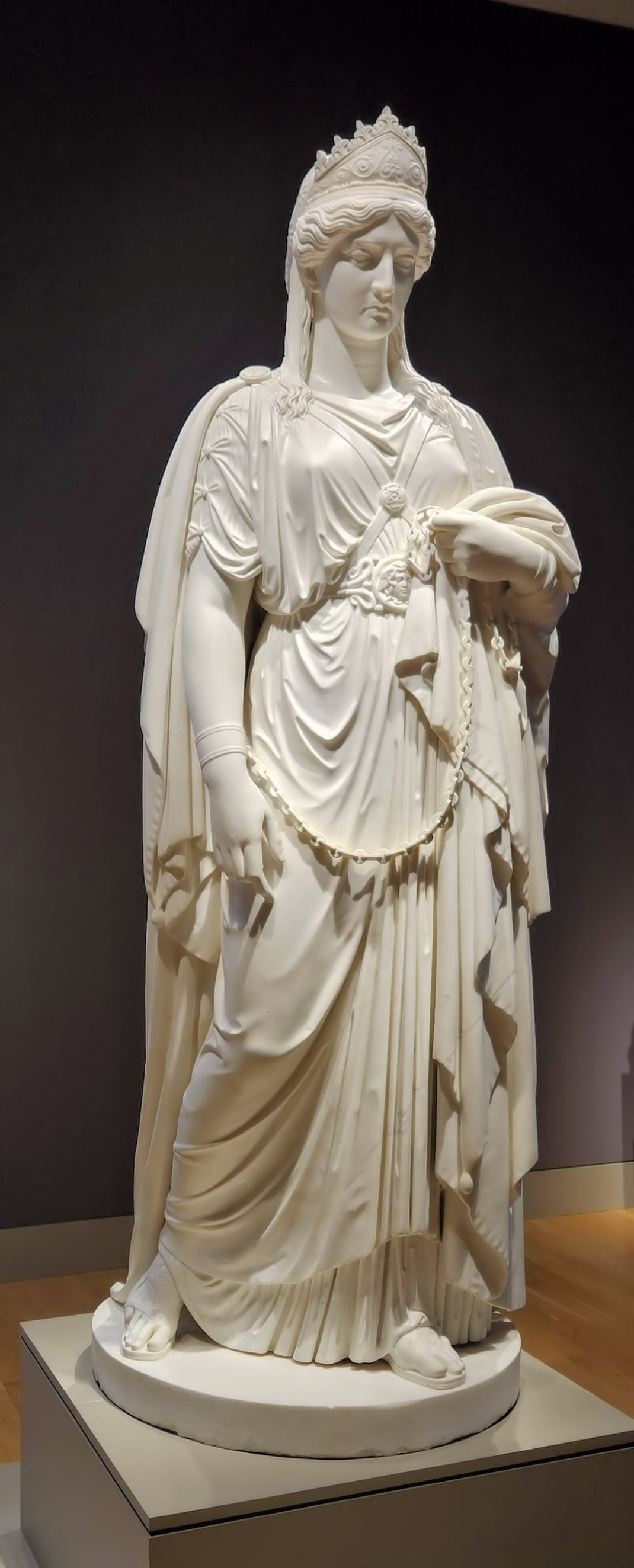
Harriet Hosmer (1830 to 1908) was an American sculptor who spent most of her career in Rome. She made statues in white marble, like Zenobia in Chains, a captive queen of the ancient world, now at the Huntington museum in San Marino, California.
Cool Stories About Art is a newsletter to learn art the fun way.
Join 200,000+ readers and get:
10 new art stories / month
The entire archive of content (140+ articles)
Comment, ask questions, and chat with other readers
Harriet Hosmer sold her marble statues to rich Americans and to the heir to the British throne. Then, in 1863, two London magazines printed that her greatest statue had really been made by an Italian workman.
Harriet Hosmer was born on October 9, 1830, in Watertown, Massachusetts, next to Boston. Tuberculosis, a lung disease, killed her mother, then her two brothers and her sister.
Her father, a doctor, wanted his last child to grow up strong. He raised Hosmer outdoors, with a horse, a pistol and a small boat.
At about nineteen, Hosmer decided to become a sculptor. She took lessons in Boston in shaping figures in clay, and her father built her a studio at home.
To shape a human body, Hosmer needed anatomy, the study of bones and muscles. The medical schools around Boston refused to teach a woman.
In 1850, Wayman Crow, a rich merchant and the father of a school friend, found her a place at a medical college in his city, St. Louis, a thousand miles away. Hosmer attended the anatomy lectures of Dr. Joseph Nash McDowell.
Before going home, Hosmer took a steamboat up the Mississippi. During a stop in Iowa, she won a footrace to the top of a hill above the river. The hill is still called Mount Hosmer.
In November 1852, Harriet Hosmer sailed for Rome. Sculptors from Europe and America gathered there to study the ancient statues and to hire skilled marble carvers.
In Rome, every statue began in clay. The sculptor invented the figure in a small clay model. Assistants enlarged it to full size, and the sculptor worked on the big clay figure for months.
The finished clay was copied in plaster, dotted with small measuring marks. Then paid stonecutters copied the plaster in marble, carrying each mark into the block, one point at a time.
Nobody asked whether a famous man had carved his own marble. But when London magazines claimed that a workman had really made her marble queen, how could Harriet Hosmer prove the statue was hers, if hired carvers had cut the stone?
In the rest of the story
How a small marble fairy paid her bills in Rome for years.
Why her sculpture teacher in Rome said his studio held two impostors.
The comic poem she wrote to mock the male sculptors of Rome.
What machine she chased for decades, though physics says it cannot work.