
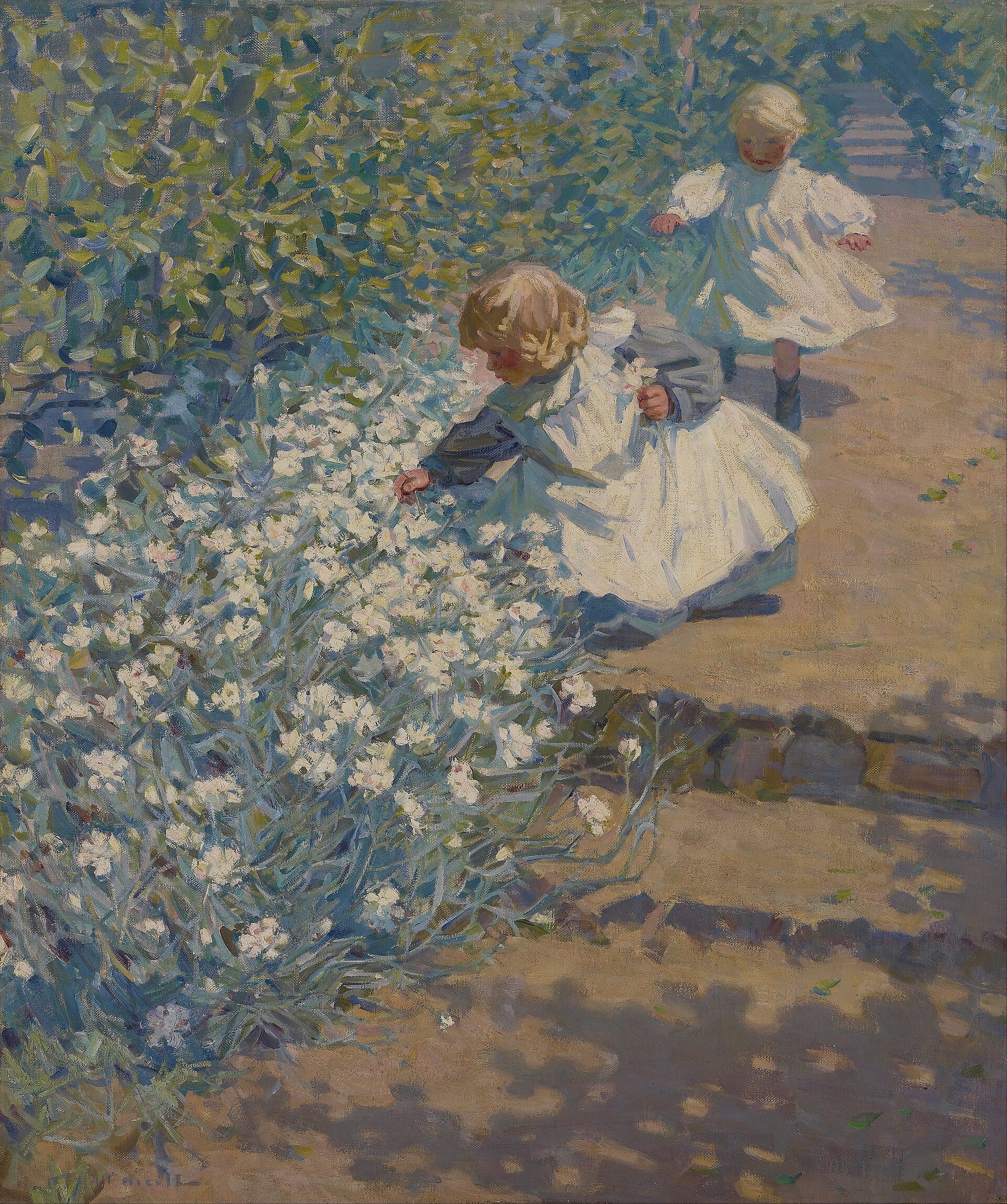
Helen McNicoll (1879 to 1915) was a Canadian painter in the Impressionist style. She painted children, gardens and beaches in bright sunlight, as in Picking Flowers, now at the Art Gallery of Ontario in Toronto.
Cool Stories About Art is a newsletter to learn art the fun way.
Join 200,000+ readers and get:
10 new art stories / month
The entire archive of content (140+ articles)
Comment, ask questions, and chat with other readers
In 1913, the Royal Society of British Artists, a society of professional painters in London, elected her, one of only eight artists it chose that year. In 1914, the Royal Canadian Academy of Arts, Canada's official society of artists, made her an associate, its first rank of membership.
She died the next year, at thirty-five. Within a few decades, a painter praised on both sides of the Atlantic had almost dropped out of sight in Canada.
Helen McNicoll was born in Toronto on December 14, 1879, the eldest child of two immigrants from Britain. While she was still small, the family moved to Montreal. Her father, David McNicoll, rose there to become a vice-president of the Canadian Pacific Railway, the company that had built the railway line across Canada from one ocean to the other.
The McNicolls lived in Westmount, a wealthy part of Montreal, in a large house they called Braeleigh. At about two, Helen caught scarlet fever, a serious childhood illness, which left her with severe hearing loss. She learned to read lips, private tutors taught her at home, and at crowded gatherings she relied on her family and friends.
Around 1899, she began to study drawing at the Art Association of Montreal, the city's art society and art school, which later became the Montreal Museum of Fine Arts. Students there drew from plaster casts of ancient statues, and her drawings won her a scholarship.
Her teacher, William Brymner, was a painter who had studied in Paris. Brymner urged his students to paint outdoors and to look at the Impressionists, the French painters who, from the 1870s, caught the light of a single moment in quick strokes of bright color.
In 1902, McNicoll crossed the Atlantic to study at the Slade School of Fine Art in London, an art school that admitted women on the same terms as men. She left two years later with first-class honors. From then on she painted in England and France, and sent her pictures home to be shown in Canada.
What made Canada forget, so soon, a painter it had just honored?
In the rest of the story
The cutting remark an old painter made about her picture before a London vote.
Where she was when war broke out in 1914, and who got her out.
Which new group of painters appeared in 1920, five years after her death.
What was hidden under the frame of a painting cataloged in her style.