
In painting, hell is where the dead are punished after judgment, and no sacred text describes it in detail. Painters built it from borrowed sources: the Last Judgment of the Gospels, the Divine Comedy, in which the Florentine poet Dante walks down through its circles, and Buddhist sutras that match each sin to its torment.
The works here run from the twelfth century to the twentieth, across Europe and Japan, and each painter uses different signs to show a soul is lost.
Cool Stories About Art is a newsletter to learn art the fun way.
Join 200,000+ readers and get:
10 new art stories / month
The entire archive of content (140+ articles)
Comment, ask questions, and chat with other readers
How These Were Chosen
A work made the list when it shows a place of punishment after death, with at least one of three things in view: a soul being carried there, judged for it, or tormented in it. A museum or library documents each one.
The list keeps one work per artist. Several are on paper or parchment, and one is a Japanese handscroll. Patinir's boat carries a soul, Rogier's archangel weighs the dead, and most of the others show the torment itself.
12. Winchester Psalter, The Hellmouth (about 1150)
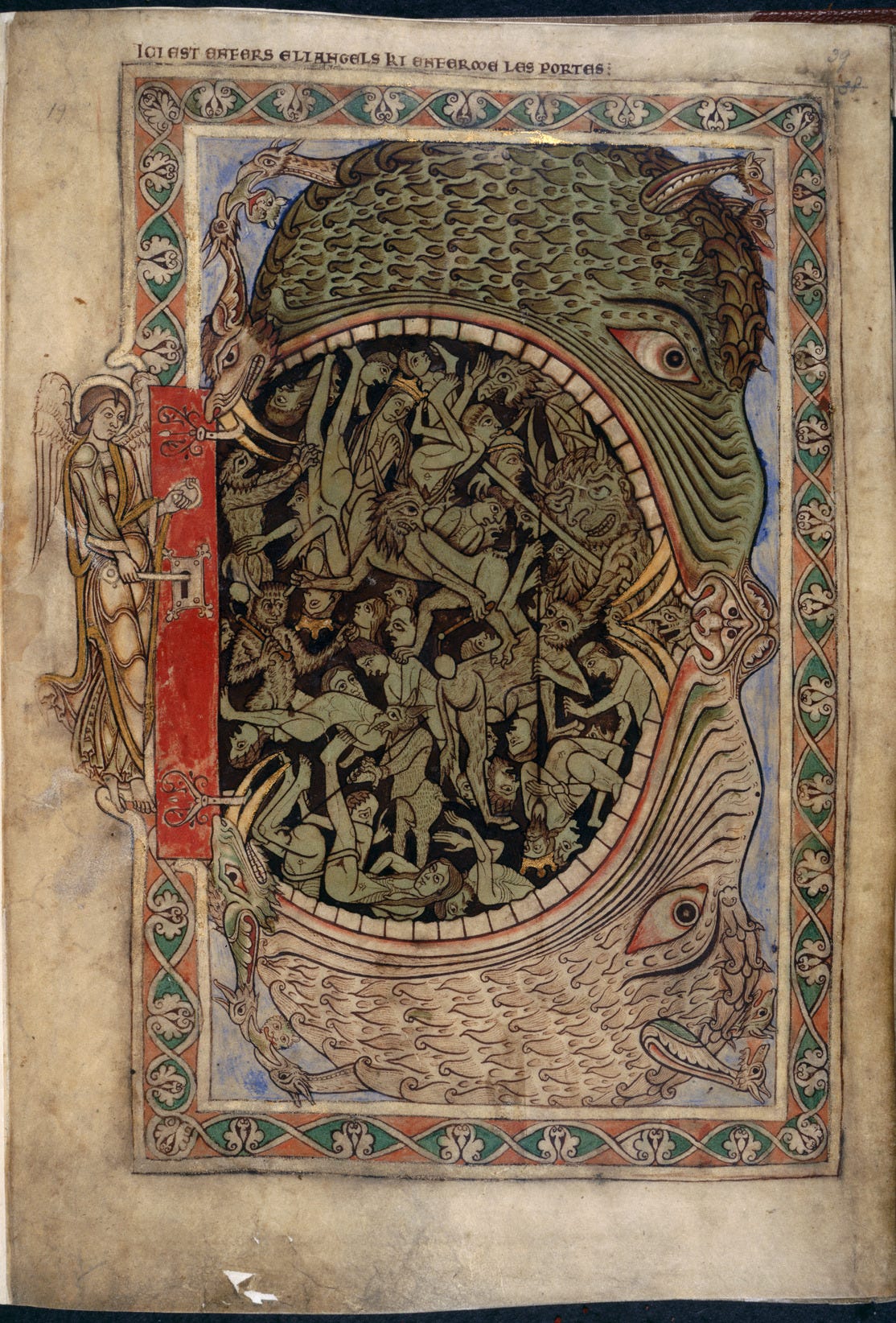
On a page of the Winchester Psalter, an angel turns a large key and shuts a pair of red doors. Behind them, naked people are packed together while demons set to work on them.
The doors hang in the open mouths of two beasts, whose jaws meet at the center of the page to form a single maw.
The illuminator, the painter of the manuscript, gave the two creatures hairy hides and bloodshot eyes. From the folds of each neck grow two smaller dragon heads. Their long fangs hook into the edges of the red doors and serve as hinges.
The book itself is a psalter, a volume of psalms, painted in England around 1150. It was probably made for Henry of Blois, the bishop of Winchester and a brother of King Stephen of England.
A caption runs with the picture, in Anglo-Norman French, the language of England's ruling class after the Norman Conquest: "Ici est enfers et li angels ki enferme les porteis." Here is Hell and the angel who closes the doors.
That caption fits a page about sinners being shut in. Yet the page was once cataloged as the Harrowing of Hell, Christ's descent to free the dead held there. It is now taken as part of the Last Judgment, with the angel locking the doors on the damned.
The crowd inside still wears the marks of its rank. Kings and queens wear golden crowns, and monks show their tonsures, the shaved patch on top of the head.
Lay people are packed in beside them, and rank protects no one. One demon has turned a king upside down and spears him with a pitchfork.
At a Glance
Artist: Unknown illuminator, Winchester, England
Made: About 1150 (mid 12th century)
Medium: Full page miniature, in a psalter written in Latin and Anglo-Norman
Size: Page about 32 × 22 cm (12.6 × 8.8 in)
Where to see it: British Library, London, Cotton MS Nero C IV, folio 39r (rarely on display, digitized online)
About This Manuscript Page
What is the Winchester Psalter?
A psalter is a prayer book of psalms, and this one opens with dozens of full page pictures before the psalms begin. After the Ashburnham House fire of 1731, its folded sheets were found as single leaves, so the original order of the pages is still uncertain.
Where does the mouth of hell in medieval art come from?
The mouth of hell in medieval art comes partly from Old English texts. In the Exeter Book, a collection of Old English poems, the entrance to hell is compared to the open mouth of a whale. The Vercelli Homilies, a set of Old English sermons, describe it as the throat of a dragon.
11. Hell Scroll (Jigoku zōshi), the Hell of Excrement (12th century)
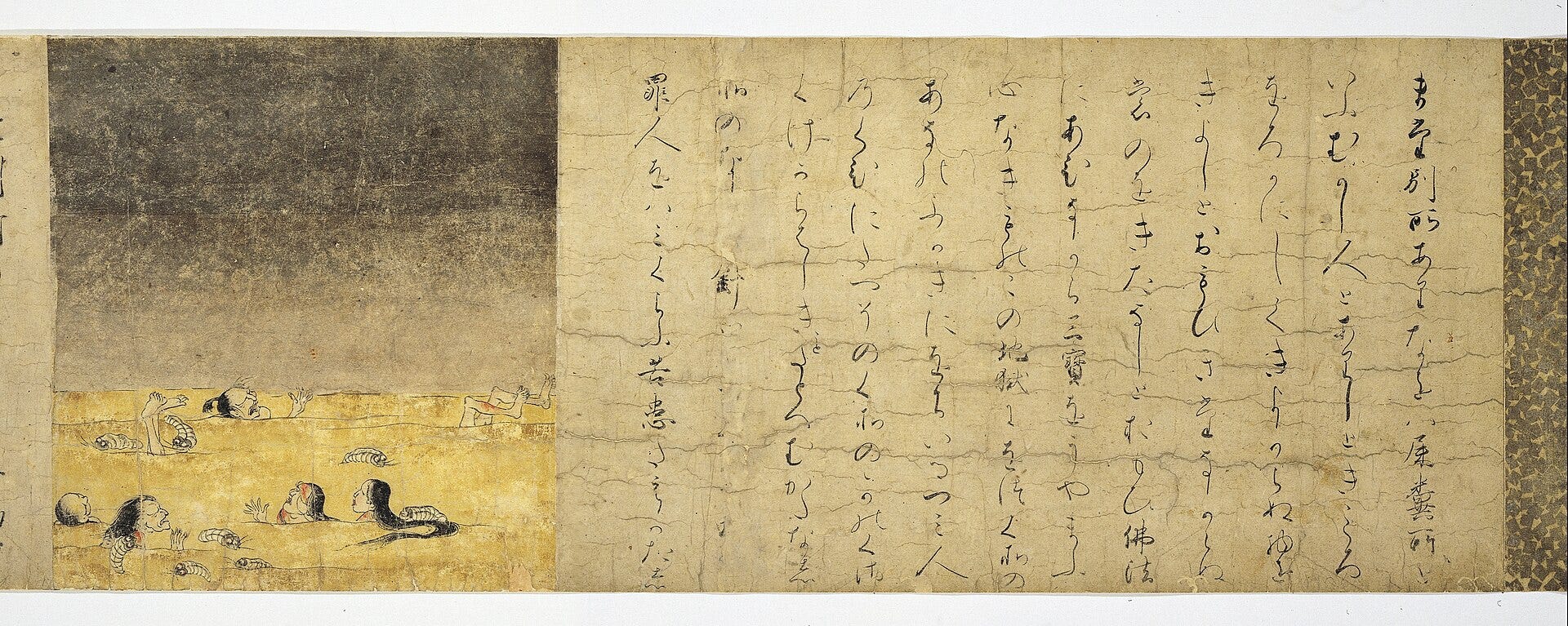
In the Japanese Hell Scroll, worms with needle-shaped mouths live inside a pit of excrement and gnaw at the people sunk in it. Only the sinners' heads show above the surface.
The scene opens this handscroll, painted in Japan in the 12th century. The text beside it names the fault: these are people who met the Buddhist teaching, took the impure for the pure and failed to honor the Three Jewels, the Buddha, his teaching and the community of monks.
Every torment in the painting, down to the worms, comes from a single Buddhist text, written far from Japan.