
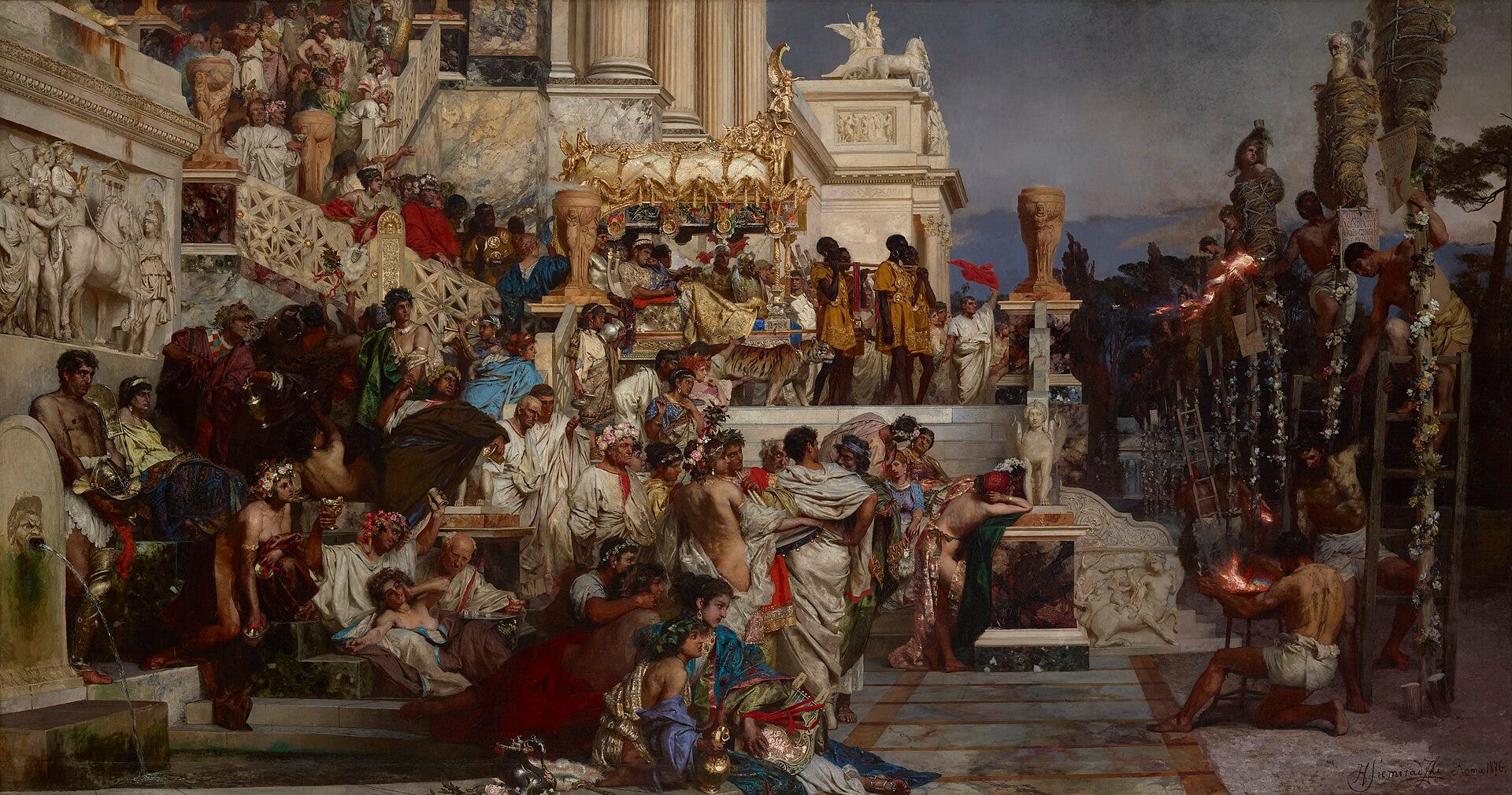
Henryk Siemiradzki (1843 to 1902) was a Polish painter, born in the Russian Empire, who painted huge scenes of ancient Rome. His Nero's Torches shows Christians tied to poles, about to be burned alive to light up a party given by the Roman emperor Nero.
Cool Stories About Art is a newsletter to learn art the fun way.
Join 200,000+ readers and get:
10 new art stories / month
The entire archive of content (140+ articles)
Comment, ask questions, and chat with other readers
In 1877, the Imperial Academy of Arts in St. Petersburg, the official art school of the Russian Empire, rewarded Siemiradzki for Nero's Torches with one of its highest honors, the title of professor. Two years later, the painter gave that same canvas, for free, to Kraków, the old capital of the kings of Poland, then ruled by Austria.
Henryk Siemiradzki was born in 1843 in a small town near Kharkiv, a big city in today's Ukraine. His father, Hipolit Siemiradzki, was a Polish nobleman and an officer in the army of the tsar, the emperor of Russia.
A Polish officer served the tsar because, since 1795, Poland had been divided among its three powerful neighbors, Russia, Prussia and Austria, and no longer existed as an independent state. The Siemiradzkis served the tsar loyally, and at home they lived as a Polish family.
In high school in Kharkiv, the boy took his first drawing lessons. Then, at his father's wish, he studied the natural sciences at the University of Kharkiv and wrote his thesis on the instinct of insects.
In 1864, his degree in hand, Siemiradzki left for St. Petersburg, the capital of the Russian Empire, to become a painter. At the Imperial Academy of Arts, the young Pole won medal after medal. In 1870, he entered the contest for the highest prize of all, the big gold medal, which paid for six years of travel abroad.
Why would Siemiradzki, a professor of the tsar's own Academy, give his most famous canvas to a Polish city outside the tsar's empire?
In the rest of the story
Who bought the first big picture Siemiradzki painted in Rome.
How a week of celebrations for a novelist brought Siemiradzki's painting to Kraków.
What Kraków's city council decided soon after hearing of the gift.
What a young Kraków painter said about Siemiradzki's second gift to the city.