
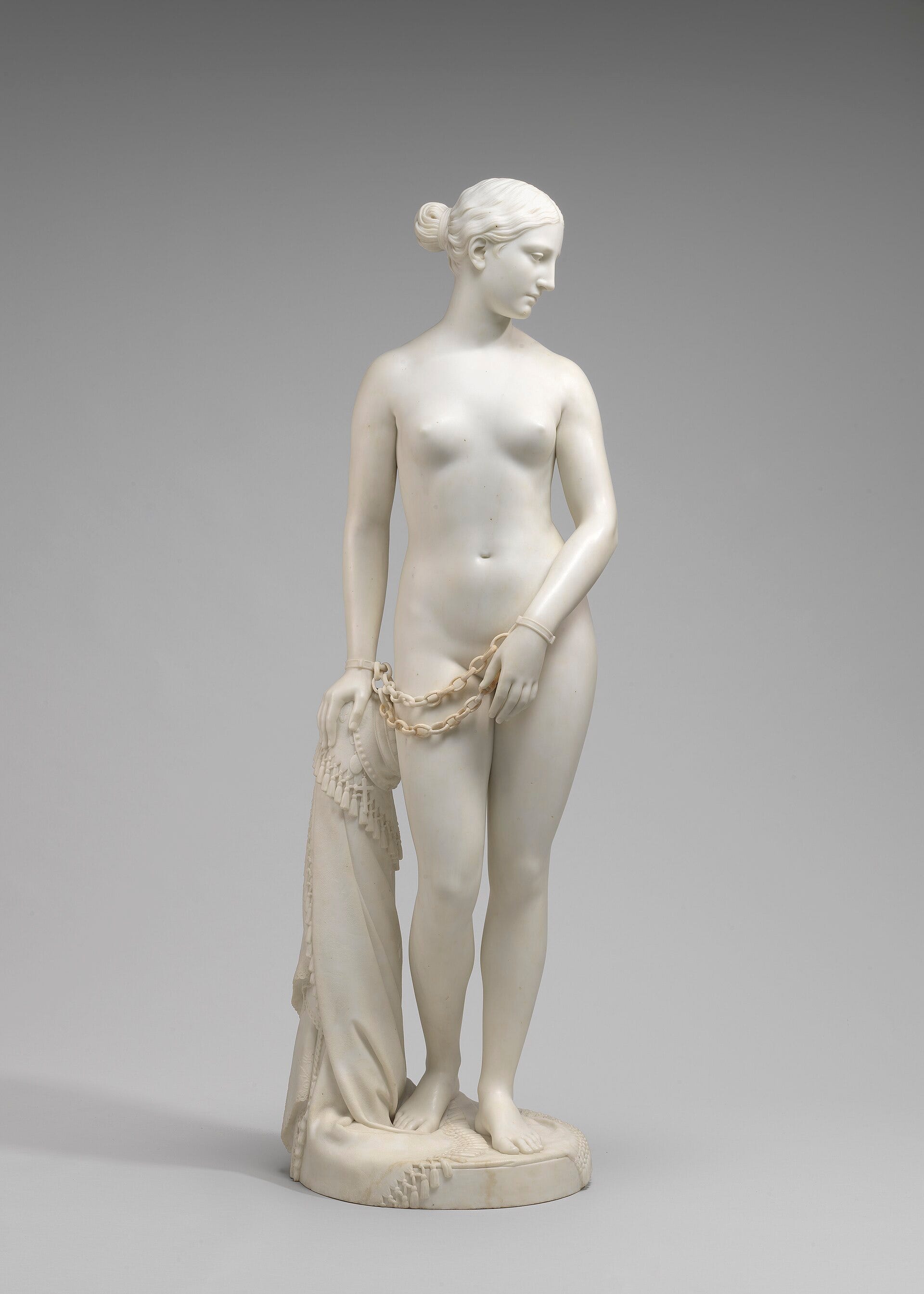
Hiram Powers (1805 to 1873) was an American sculptor who spent most of his life in Florence, Italy. His marble The Greek Slave, a chained woman for sale, was the most famous sculpture in America in the 1800s.
Cool Stories About Art is a newsletter to learn art the fun way.
Join 200,000+ readers and get:
10 new art stories / month
The entire archive of content (140+ articles)
Comment, ask questions, and chat with other readers
Hiram Powers said his statue showed a Greek woman captured in a war far from the United States. Many Americans looked at her and thought of their own country, where Black men, women and children were held in slavery. Abolitionists, the people who wanted slavery ended, adopted the statue. By his own account, her sculptor had never been one of them.
Hiram Powers was born in 1805 on a farm in Vermont, in the northeastern United States. When he was a boy, his family moved to Ohio, near the city of Cincinnati, and his father died soon after. At about seventeen, Hiram went to work in a Cincinnati factory that made clocks and organs, where he learned to build machines.
That skill got him hired by the Western Museum, a Cincinnati museum of curiosities, to make its wax figures and its mechanical displays. In 1828, Powers built there a show of Hell taken from Dante's Divine Comedy, the Italian poem about a journey through Hell.
About thirty wax devils and sufferers filled the show. Powers himself walked among the visitors dressed as a demon, in a dark robe, with a lobster claw for a nose.
The young showman also modeled portraits, and in 1834 a rich Cincinnati patron sent him to Washington to portray the country's leaders. President Andrew Jackson, then sixty-eight, told him, "Make me as I am," and Powers's bust of Jackson shows the president's missing teeth.
In 1837, Powers moved with his family to Florence, the Italian city where sculptors had worked since the Renaissance. He meant to stay a few years. He lived there until his death and never saw the United States again.
In Florence, on March 12, 1843, Powers finished the clay model of a life-size figure: a young woman standing with her wrists in chains. He named her The Greek Slave.
The statue's subject is a Greek woman taken captive by Ottoman soldiers during the Greek War of Independence, the revolt that began in 1821 against the Ottoman Empire, which then ruled Greece. She is for sale in Constantinople, the Ottoman capital, today's Istanbul.
How did a Greek captive in marble come to stand for slavery in the United States, and what did Powers himself write about slavery?
In the rest of the story
What a minister wrote that brought churchgoers to see the statue.
What a man who had escaped slavery did beside the statue in London.
What Powers wrote about slavery a few weeks before the Civil War began.
Which famous abolitionist kept a small porcelain copy of the statue at home.