
The Gospels never give Joseph a single line to speak, and between the night of the birth and the day the boy turns twelve, they say almost nothing about life in his house. Everything painters later showed of that house, the workbench, the sewing basket, a cat with its eyes on a bird, they had to invent, and they never agreed on where Joseph should stand.
Cool Stories About Art is a newsletter to learn art the fun way.
Join 200,000+ readers and get:
10 new art stories / month
The entire archive of content (140+ articles)
Comment, ask questions, and chat with other readers
Where Should Joseph Stand?
A Holy Family is a household rather than a single episode: Mary, Joseph and the child, sometimes joined by Mary's cousin Elizabeth and her small son. The Gospels give that household a birth, a flight abroad and a boy found in the Temple at twelve, and very little in between.
Painters had to fill that gap themselves. A family at home needed a room, furniture and tools on the wall, and every painter had to decide how close Joseph came, whether he stayed a pale figure at the back or took the child in his own hands.
A picture earns its place either by setting a way of showing the family that others followed, or because something happened to it, or inside it, that belongs to no other Holy Family.
12. John Everett Millais, Christ in the House of His Parents (1849 to 1850)
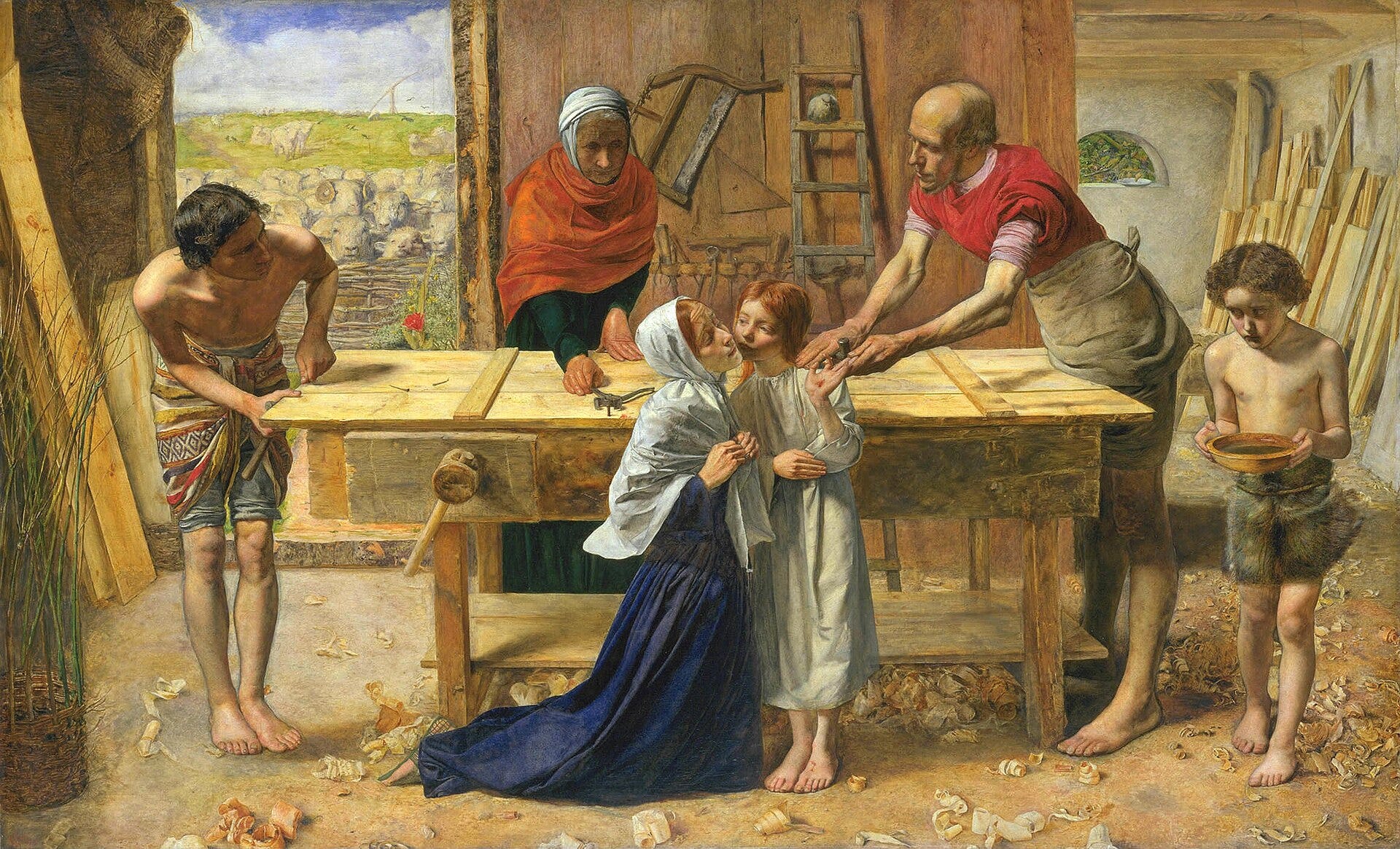
A single drop of blood has fallen from the boy's palm onto the top of his foot. He has cut his hand on a nail in the family workshop, his mother kneels beside him, and around the bench the adults have stopped work. The boy is Jesus, the workshop is Joseph's, and John Everett Millais, then twenty, painted them as Christ in the House of His Parents.
The way he painted them came from a promise made two years earlier. In 1848, Millais, William Holman Hunt and Dante Gabriel Rossetti had founded the Pre-Raphaelite Brotherhood, named after its program: to work as painters had before Raphael, from close observation of real things rather than from rules of ideal beauty.
For a carpenter's family, that promise meant a real carpenter's shop. At the end of December 1849, Millais began painting in one on Oxford Street, in London, and kept at it through the winter until he caught a cold there in January. On the floor of the picture, every curl of wood is painted one by one.
Those shavings were the first thing London noticed once the canvas hung at the Royal Academy's annual exhibition of 1850. Mary had a wrinkled brow, some of the figures had feet that were less than clean, and the holy house looked like a place where people worked. The Times found the result disgusting.
Charles Dickens went further. In his weekly magazine, Household Words, the novelist described the boy as "a hideous, wry-necked, blubbering, red-haired boy in a nightgown," and wrote that Mary would pass for a monster in the lowest gin-shop in England. Queen Victoria asked for the painting to be taken out of the exhibition and brought to her for inspection.
The uproar was about dirt, and it left the rest of the shop unread. Against the back wall stands a ladder studded with nails, like the ladders painters lean against the cross in scenes of the Deposition, when the body of Christ is taken down. A dove, the sign of the Holy Spirit, perches on it, and over the boy's head hangs a carpenter's triangle for the Trinity.
The people in the shop carry the same second meaning. The young John the Baptist brings a bowl of water to wash the wound, a first glimpse of the baptism to come, and Saint Anne, Mary's mother, reaches toward the nail with a pair of pincers. As for the drop of blood, it sits on the boy's foot, where the cross will one day leave its wound.
At a Glance
Artist: John Everett Millais (1829 to 1896)
Painted: 1849 to 1850
Medium: Oil on canvas
Size: 86.4 × 139.7 cm (34 × 55 in)
Where to see it: Tate Britain, London
11. Federico Barocci, The Madonna of the Cat (about 1575)
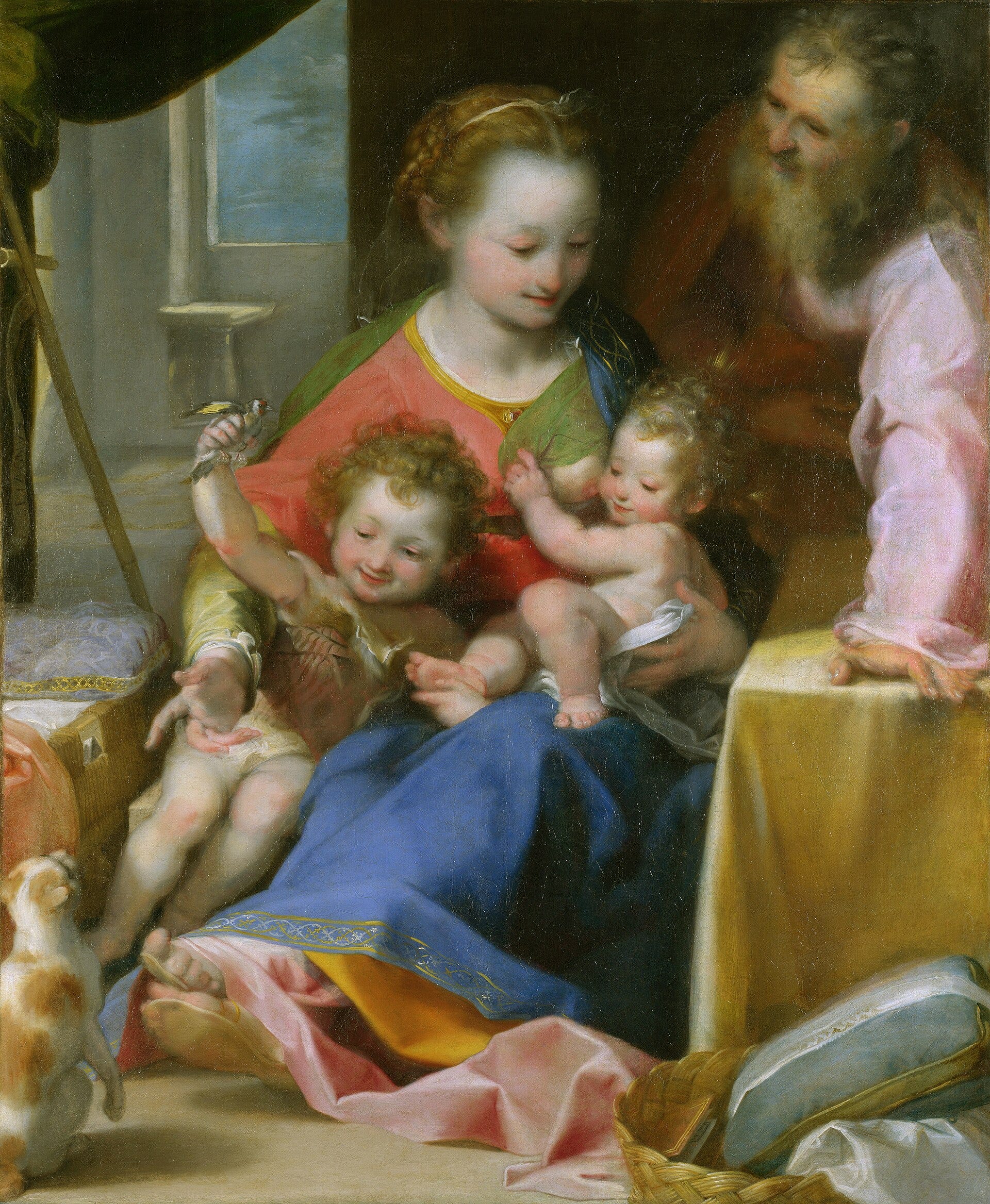
The cat has seen the bird. In a bedroom of a Renaissance palace, the young John the Baptist holds a goldfinch high above a cat that sits back on its haunches, ready to spring, while Mary nurses her baby and Joseph leans in from behind to watch. Federico Barocci painted the game around 1575, and the bird he gave the children is no ordinary bird.