

180 000+ readers learn art the fun way.
This is a preview. Paid subscribers get the full story.
You’ll also get:
10 new stories / month
The full archive (130+ Art stories)
Your personal art guide. Comment, ask questions, DM me anytime
Apple user? Subscribe at coolstoriesabout.art, not via the app. Apple adds 30% to the price.
One evening in January 1942, on the top floor of a building on Washington Square in New York, a woman of 58 has been posing since early afternoon.
She sits on a stool, one elbow on a small table that has been pushed against the wall. One hand raised in front of her face, eyes lowered to her own fingers: the posture of a customer at a bar.
Six feet away, a man paints standing up, a palette in his left hand.
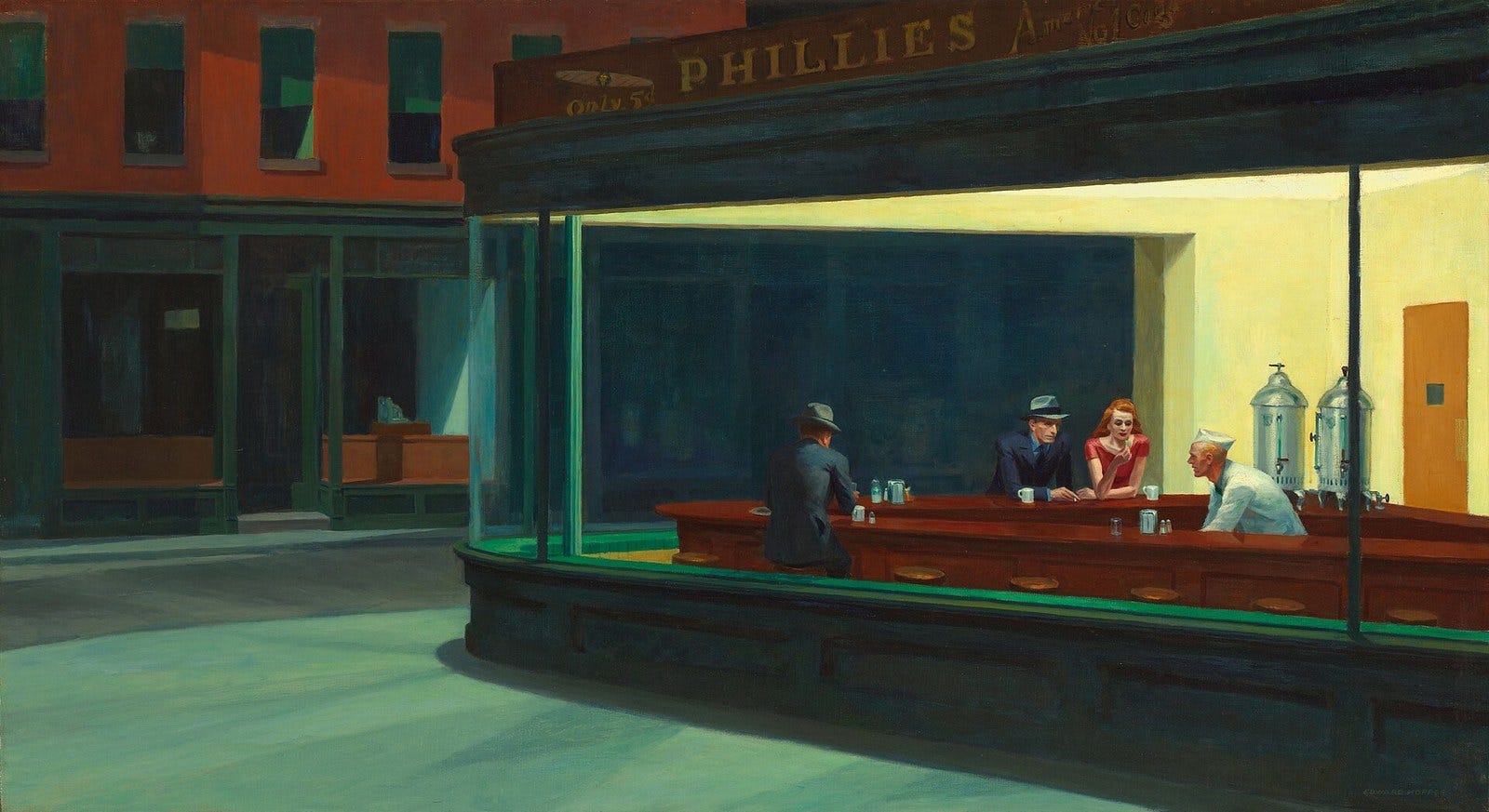
On his canvas, an all-night diner occupies the corner of a deserted street, seen from the opposite sidewalk, through a window that runs the full width of the picture. Two men in hats lean on the counter. A counterman bends behind it.
A little farther along the counter, a red-haired woman in a red dress is waiting for her face to exist. For now it is only a pale patch, and that face is what she is posing for.
She talks. She has always talked during sittings, she can't help it: how far along is he, is it coming, how much longer.
Across from her, nothing. Not a word, not a look, not even a movement of the hand that holds the brush.
So she tells him, without raising her voice: talking to him is like dropping a stone down a well. You wait for the splash, and it never comes.
Then she climbs down from the stool to go look at that face. Between her and the easel, in the middle of the floorboards, a stripe of paint crosses the studio from one wall to the other. She steps over it without slowing.
He sets down his brush and slaps her.
She rakes his cheek with her nails until it bleeds. They grapple standing up, between the easel and the small table, he holding her by both arms, she twisting free and biting.
He is a head and a half taller than she is. He is 59. She is 58.
The session ends there. Neither of them goes back to their place, she to the stool, he to the canvas. This apartment has seen dozens of evenings like this one over the past few years.
What remains is the stripe of paint on the floor. He painted it himself, and it divides the studio into two territories.
On his side, everything used for painting: the easel, the paints, the canvases stacked facing the wall. On the other side, everything else, and her.
The rules that go with this border are his, and there are three.
She does not cross the stripe. She does not touch his paints. And when visitors climb up to see his canvases, she does not show them hers.
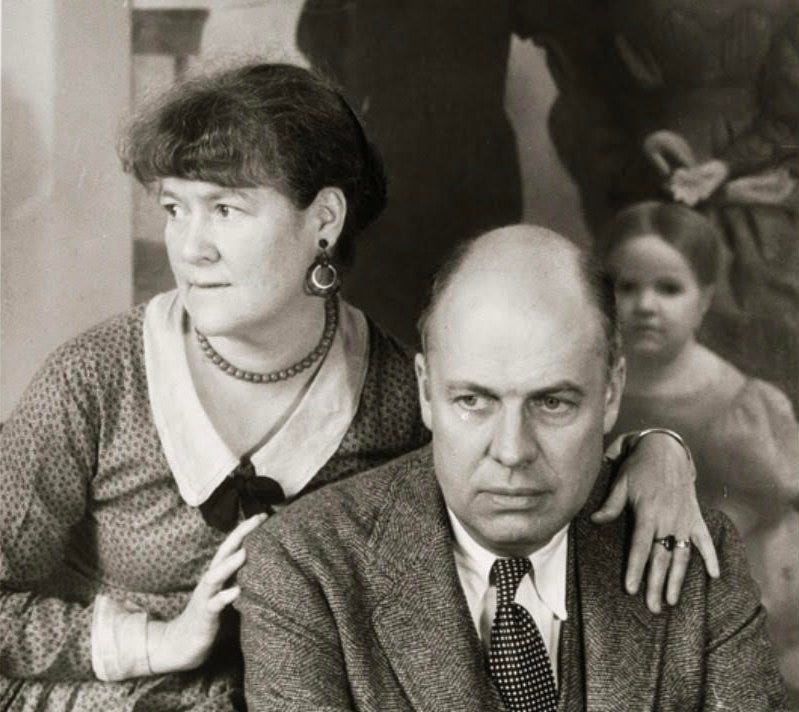
Her name is Josephine Nivison, Jo to everyone, and for 17 years she has been Edward Hopper's wife.
A painter, too.
A painter before he was.
Artist, Illustrator
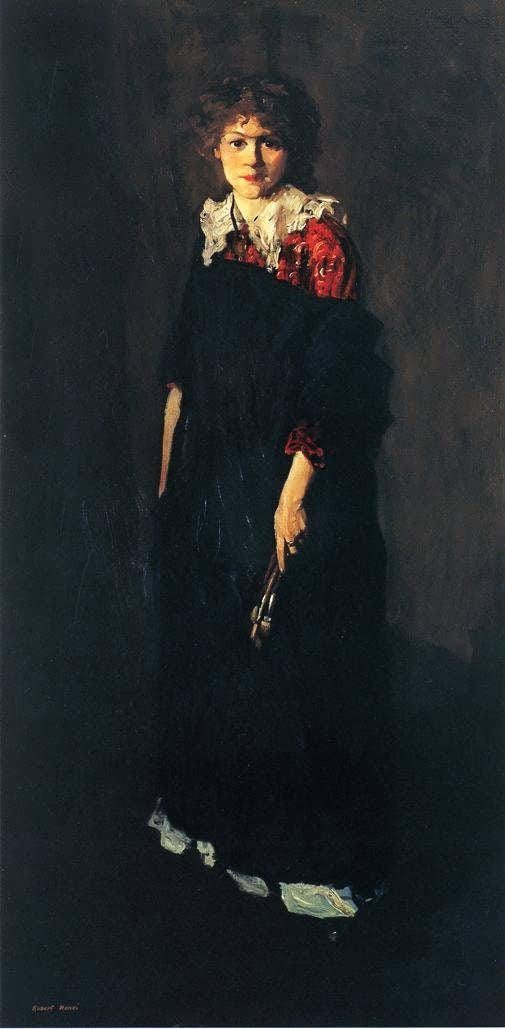
Their story begins long before this stripe of paint, in a New York art school where they study under the same teacher.
Two students the same age, in the same room, drawing from the model and from the street. She arrives with a degree from Hunter College. When she finishes school, she chooses watercolor, while he tries to sell his canvases and fails.
Her career is written on gallery walls. Her watercolors go into New York's group shows, alongside Man Ray and Stuart Davis, two names that already mean something.
She teaches drawing in the city's public schools and sells drawings to the newspapers. She also acts with a Greenwich Village theater company for several seasons.
In the New York City directory, under "occupation," she lists a single word: artist. She exhibits regularly. She makes a living at it.
He lives on commercial work. Covers and advertisements for trade magazines, from the movie business to wholesaling. The same directory, in the same column, files him under illustrator.
He paints in the evenings and on Sundays, and nobody buys. His last sale, for $250, is ten years behind him.
One summer, they cross paths again in Gloucester, Massachusetts. They work outdoors, side by side.
She in watercolor, which has always been her medium. He in watercolor too, because she has brought him back to it.
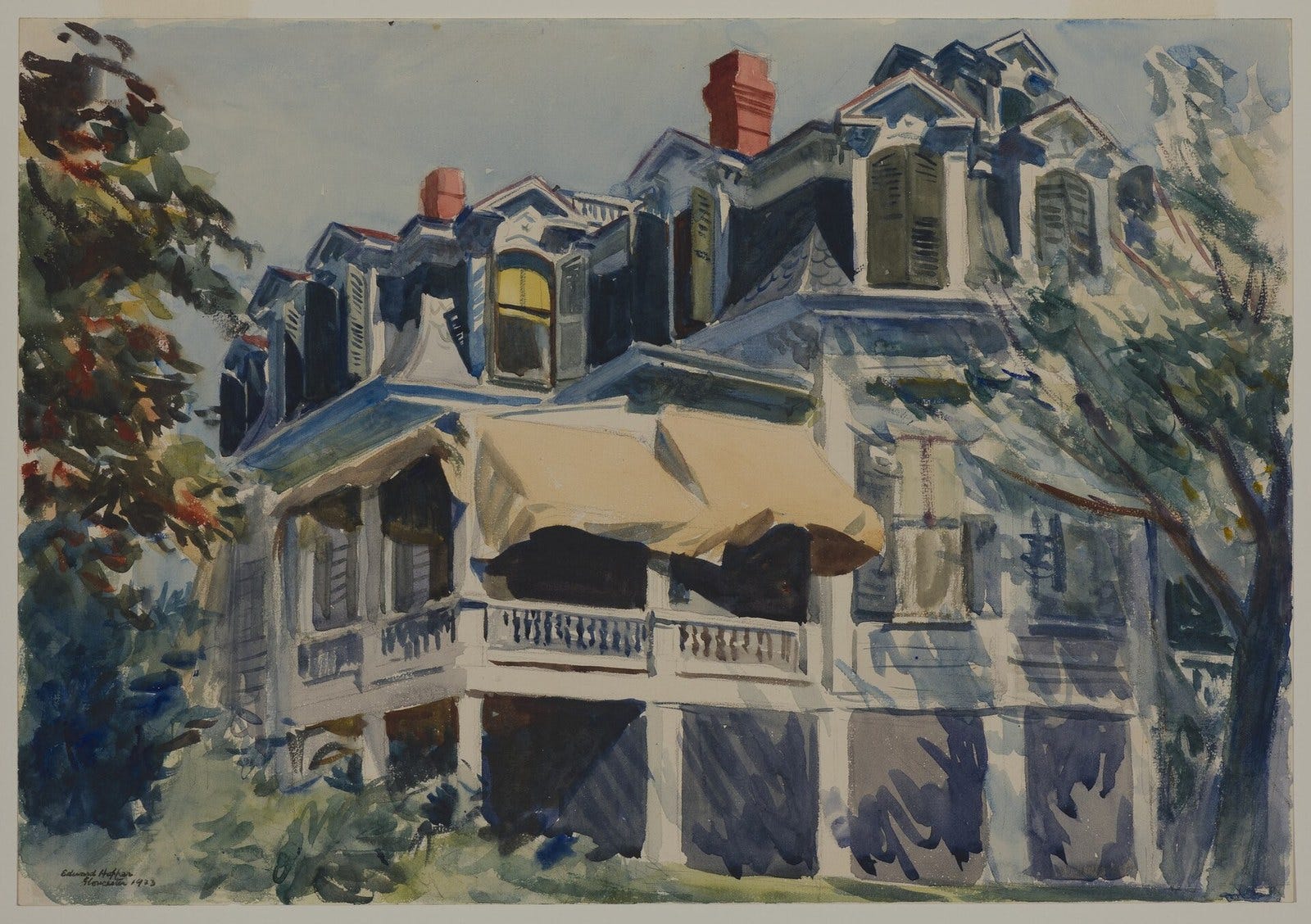
He has not done one in years. She pushes him and corrects him over his shoulder. From that summer he brings back a big wooden house with a mansard roof.
In the fall, in New York, the Brooklyn Museum is preparing a show of watercolorists and invites her. She brings her watercolors, and 6 of his with them, and gets the museum to hang those 6 in the same room as her own.
The museum buys one, the house with the mansard roof, for $100. It is the first picture Edward Hopper has sold in ten years. From Jo, the museum buys nothing.
One Condition
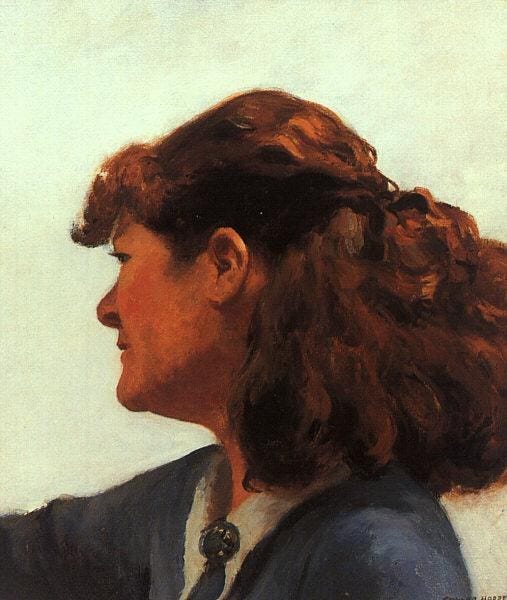
The following summer, on July 9, 1924, they marry in Manhattan, in a small church, with a painter friend as their witness. They are both 41.
She sets one condition on the marriage, only one: he will never again paint any woman but her. He agrees, and he keeps his word.
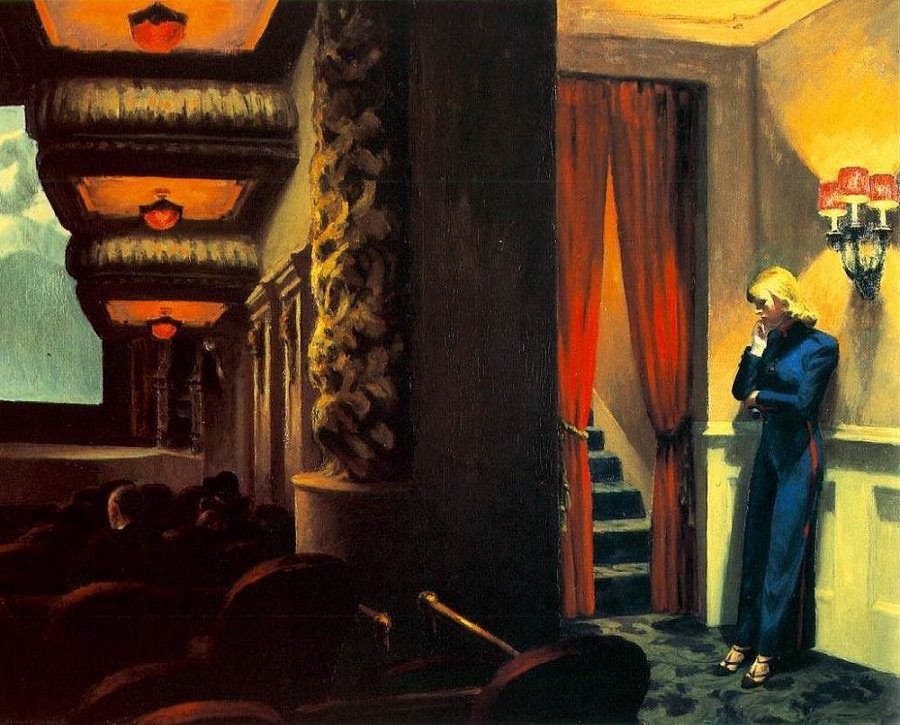
From that day on, every woman who appears on one of his canvases has Jo's face and Jo's body. The movie usherette, the secretary, the naked woman standing at her window, every one of them is her.
Three months after the wedding, a Fifth Avenue dealer hangs 11 of his watercolors, in the same vein as the Gloucester ones, and sells every one. The dealer takes him on. Hopper gives up magazine covers and from then on lives on nothing but his painting.
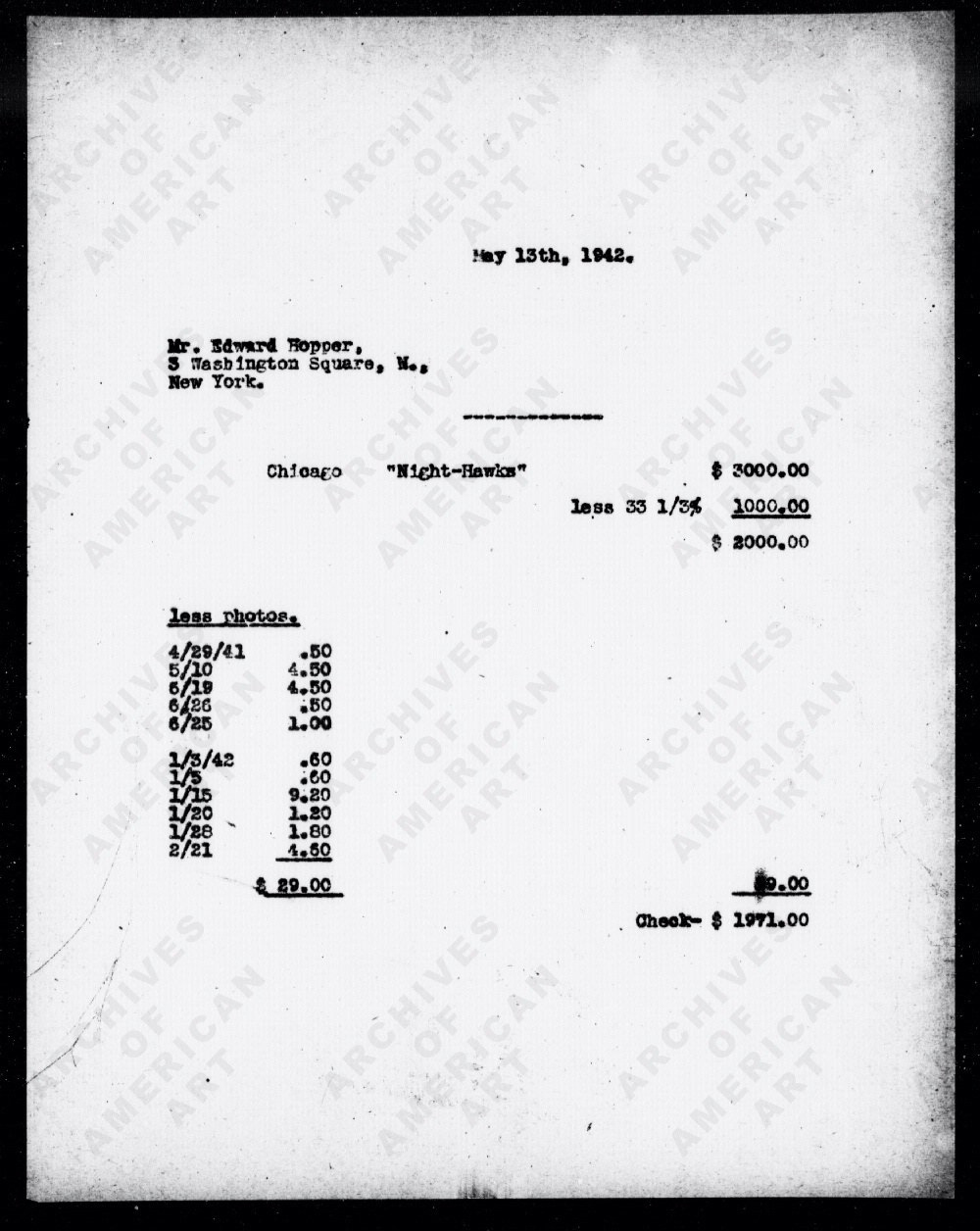
Jo's days change with his. She opens big bound ledgers and records every canvas he finishes: the date, the title, the price, the buyer's name. The letters from the dealer, the collectors, and the journalists pass through her hands.
She negotiates loans to exhibitions and keeps the household accounts. Whenever he needs a woman on a canvas, she climbs onto the stool. What is left of the day goes to her own painting.
Hopper does not look at that work, and he says nothing about it.
A painter friend of Jo's has a show in New York. Hopper goes, makes the rounds of the room, and lets drop that it is good. Jo passes it on to her friend in writing:
"E. Hopper, who is against all women's work on principle, was honest enough to say he liked your show."
Discover my new newsletter !

Twice a Year
Six years pass in the Washington Square apartment.
Jo has no dealer, and without a dealer, in New York, only one door is left: the group shows. You drop off your canvases, a jury of established painters picks the ones that will go on the wall, and the rest go home to whoever painted them. She submits twice a year.
When a canvas is taken, she goes to see it hang in empty rooms. Very little sells. No dealer comes looking for her, and no gallery offers her a show of her own.
During those same years, he sells a canvas for $1,500 at his dealer's, a record for him, and buys a used car with the money. He does the driving. He never lets her take the wheel, and the day she talks about getting her license, he refuses.
One evening, in the studio, she asks him: isn't it nice, though, to have a wife who paints?
"It stinks."
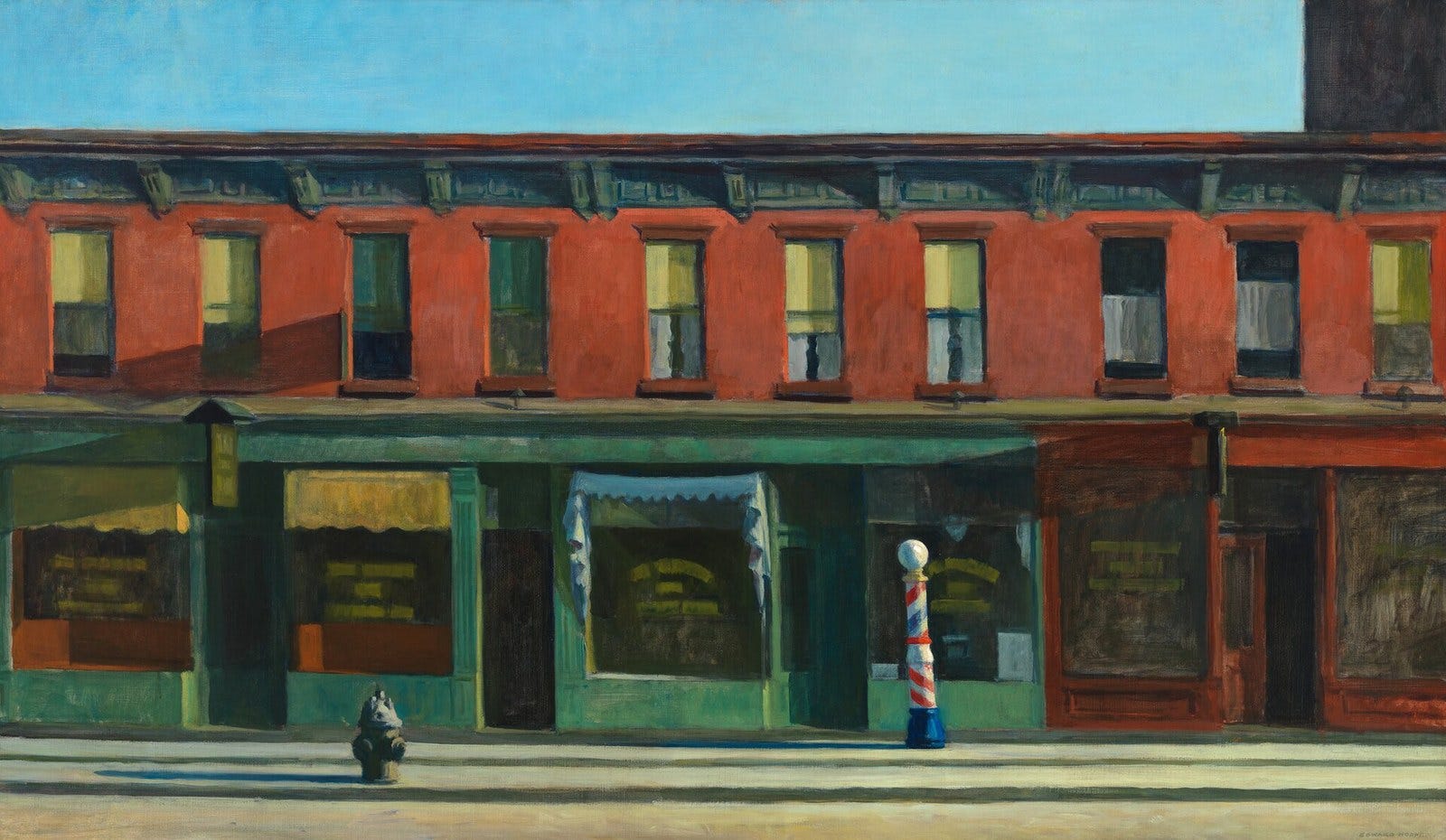
Then the Whitney opens its doors in New York. It is a brand-new museum, given over entirely to American art, and for its opening show it buys a Hopper, a row of shops shuttered on a Sunday morning. That year he sells 30 canvases, and other museums follow.
The organizers of New York's group shows, the same ones Jo has been submitting to for six years, now want Hopper on their juries. The seat brings nothing but a little prestige and a day on a chair, watching several hundred canvases go by. He accepts, and they ask him back.
On a jury day, in a gallery closed to the public for the occasion, chairs are set in a half-circle around an empty easel. Four or five painters sit in them, the catalogue of entries open on their laps.
Two men in smocks shuttle back and forth from the storeroom. One canvas per trip: they set it on the easel, wait, take it down, and go back for another.
Each canvas gets a minute, a word, sometimes two. Hands go up or stay down, and the canvas goes onto one of two piles, the one that will be hung and the one that will be sent back.
A harbor under snow: not a hand goes up. A still life with pears: two hands, not enough. Hopper says little and votes fast, and the shuttle from the storeroom goes on.
The two men set the next canvas on the easel. A small, pale canvas: a basket of fruit on a table, reds and a lemon yellow.
Hopper recognizes the hand before he reads the signature in the corner. It is a painting by Jo.
He knows what his vote can do to her career.