
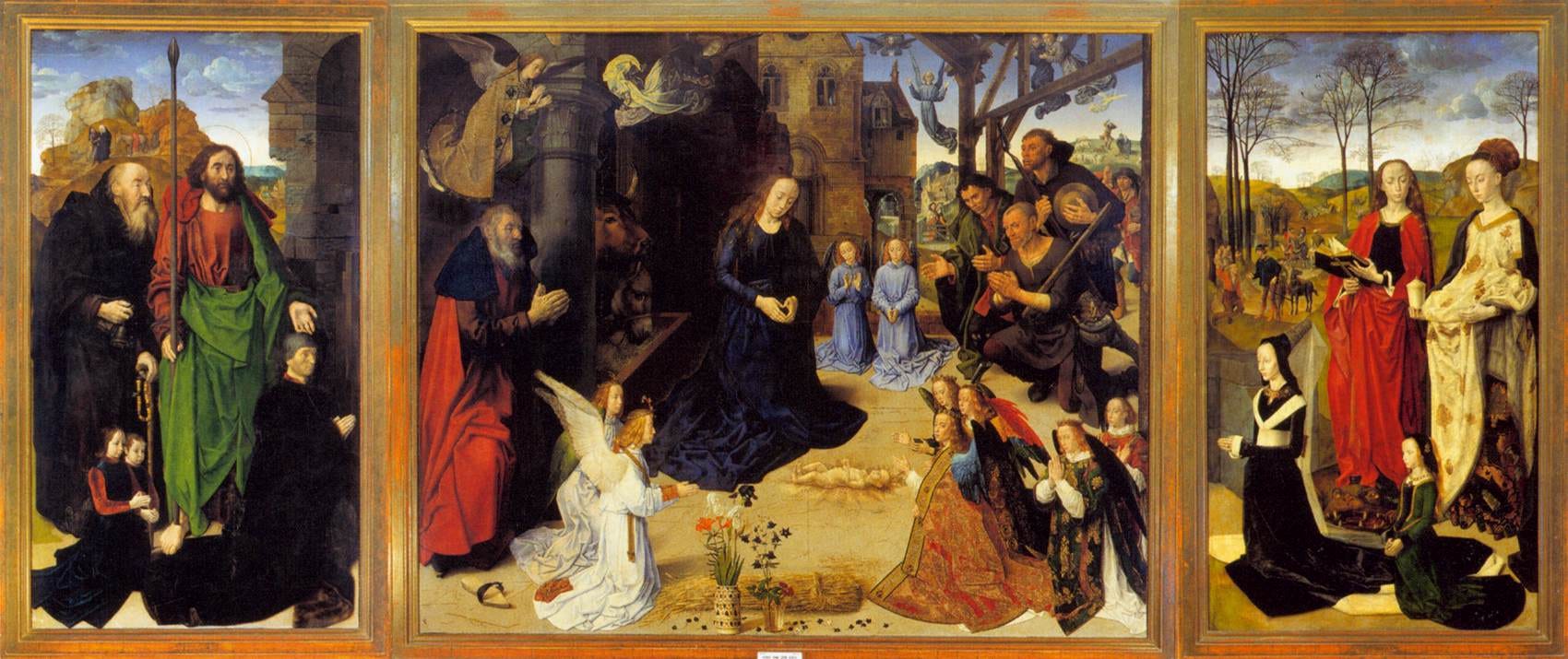
Hugo van der Goes (around 1440 to 1482) was a painter from Flanders, the Dutch-speaking north of today's Belgium, who worked in the city of Ghent. He is famous for The Portinari Altarpiece, a giant painting of the birth of Jesus now in Florence, Italy.
Cool Stories About Art is a newsletter to learn art the fun way.
Join 200,000+ readers and get:
10 new art stories / month
The entire archive of content (140+ articles)
Comment, ask questions, and chat with other readers
Hugo van der Goes was the painter every rich patron in Ghent wanted, and he died the lowest-ranking brother of a forest monastery, buried in its courtyard. Almost everything known about his last years comes from one brother of that monastery, a man who did not approve of him.
In the spring of 1468, dozens of artists were decorating Bruges, the richest city of Flanders, for the wedding of its ruler. Charles, the duke of Burgundy, whose lands included Flanders, was marrying Margaret of York, the sister of the king of England.
Hugo van der Goes was one of those artists. He came from Ghent, the other great city of Flanders, where the guild of painters, the association that decided who could open a workshop, had made him a master the year before.
Within a few years, no painter in Ghent was more in demand. In 1474, the guild elected him dean, its head, and he held the post for three years. Commissions came to him from the city government, from the court of Burgundy and from Italian merchants.
The richest of those merchants, Tommaso Portinari, ran the Bruges office of the Medici, the banking family that ruled Florence. He asked Hugo for an altarpiece, a painting set above an altar, for the church of a Florence hospital founded by one of his ancestors.
It was the largest commission of Hugo's life. Then, around 1477, at the height of his success, Hugo van der Goes closed his workshop in Ghent and entered the Red Cloister, a priory, a small monastery, in a forest near Brussels.
He joined as a lay brother, a member who was not a priest, at the lowest rank of the community. No surviving document gives his reason.
Could the painter most in demand in Ghent really leave the world behind the walls of a forest priory?
In the rest of the story
Which young prince, later an emperor, came to the priory to see Hugo.
What a brother of the priory wrote about Hugo, thirty years after his death.
What happened to Hugo one evening, on the road home from a journey.
Which famous painter, four centuries later, compared himself with Hugo, and why.