
Painters kept returning to frozen scenes for a reason that has nothing to do with taste. Between roughly 1300 and 1850 Europe went through a long cold spell, the canals froze, and painters had a subject outside their door. The Dutch winter landscape is a weather record as much as a genre.
Learn art the fun way
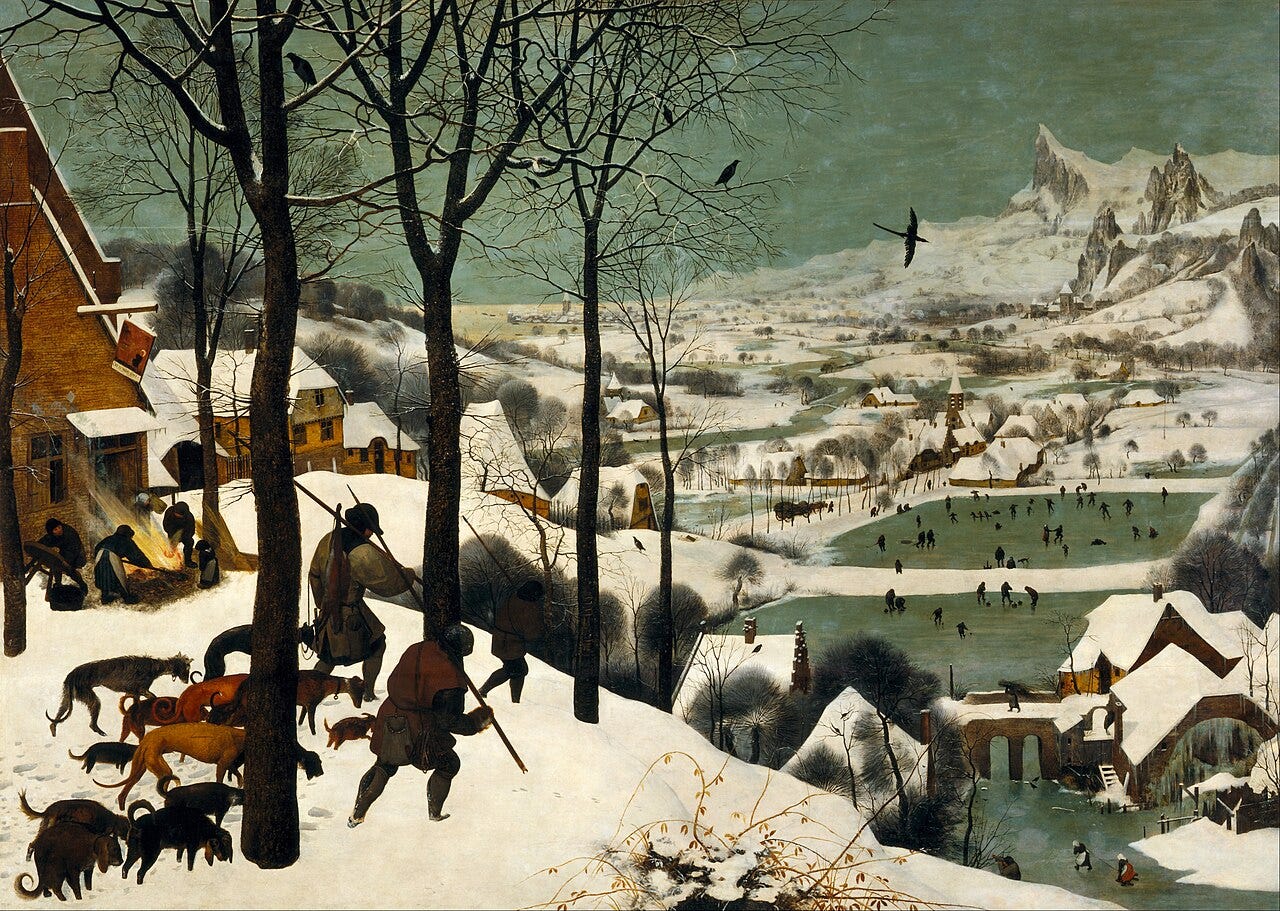
1 | The Hunters in the Snow, Pieter Bruegel the Elder (1565)
Three hunters and their dogs come back over a hill with almost nothing, while below them the whole village is out on the ice. The winter of 1564 to 1565 was one of the hardest on record.
More on him in Pieter Bruegel the Elder.
Bruegel hides more in a crowd than anyone. I show a few of the tricks in 7 secrets hidden in famous paintings.
It belongs to a cycle of six panels on the seasons painted for the Antwerp merchant Niclaes Jongelinck. Five survive, and three of them are in Vienna, which is why that room is the single best place to see Bruegel.
2 | The Sea of Ice, Caspar David Friedrich (around 1824)
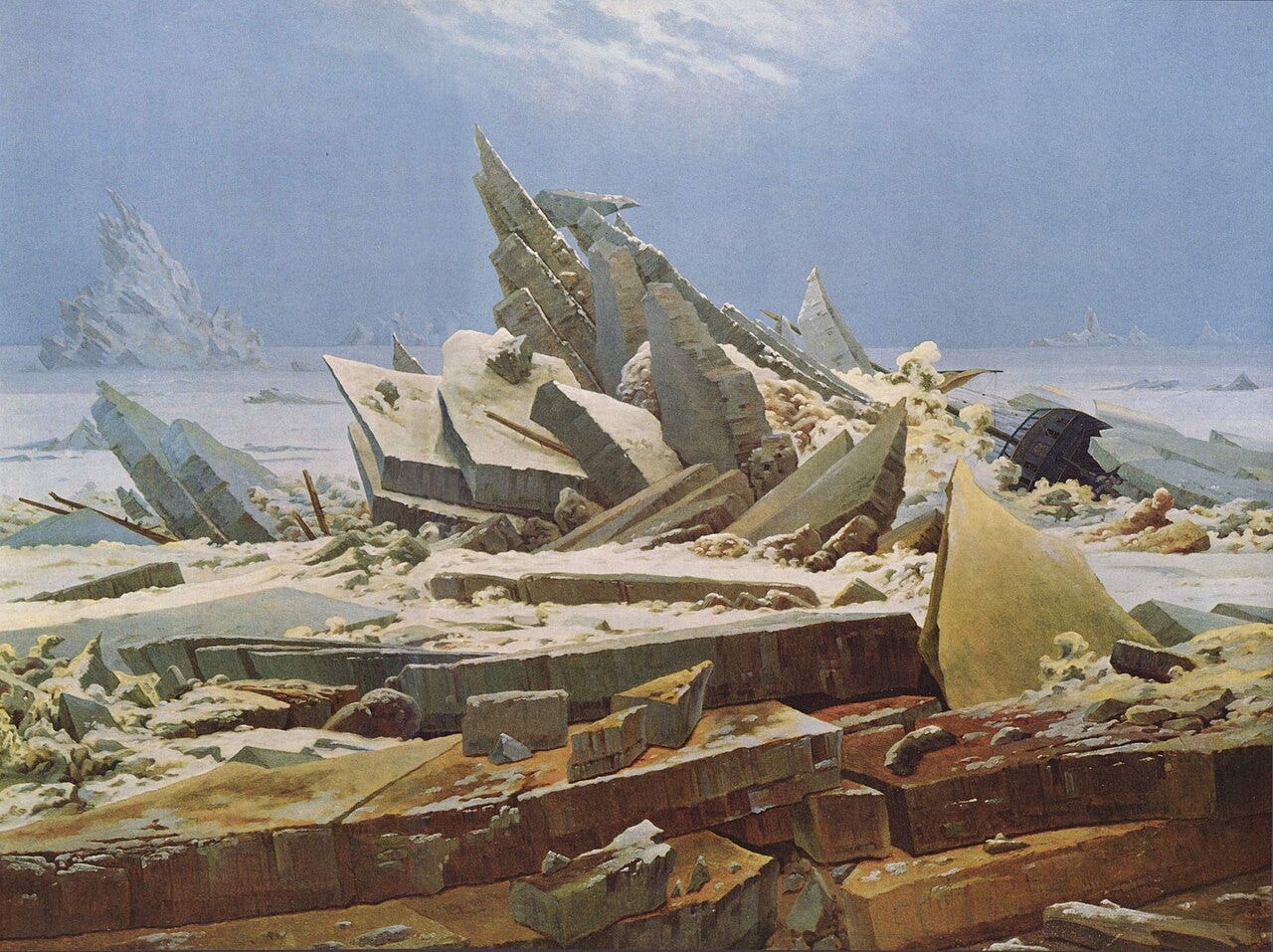
Slabs of ice piled into a wreck, with the stern of a ship barely visible in the debris. It went unsold and was still in his studio when he died.
More on him in Caspar David Friedrich.
It was inspired by reports of William Parry’s Arctic expedition of 1819 to 1820, and Friedrich studied ice floes on the Elbe to get the slabs right. It was bought only in 1843, cheaply, and was long known under the wrong title.
3 | Hendrick Avercamp and the frozen canal
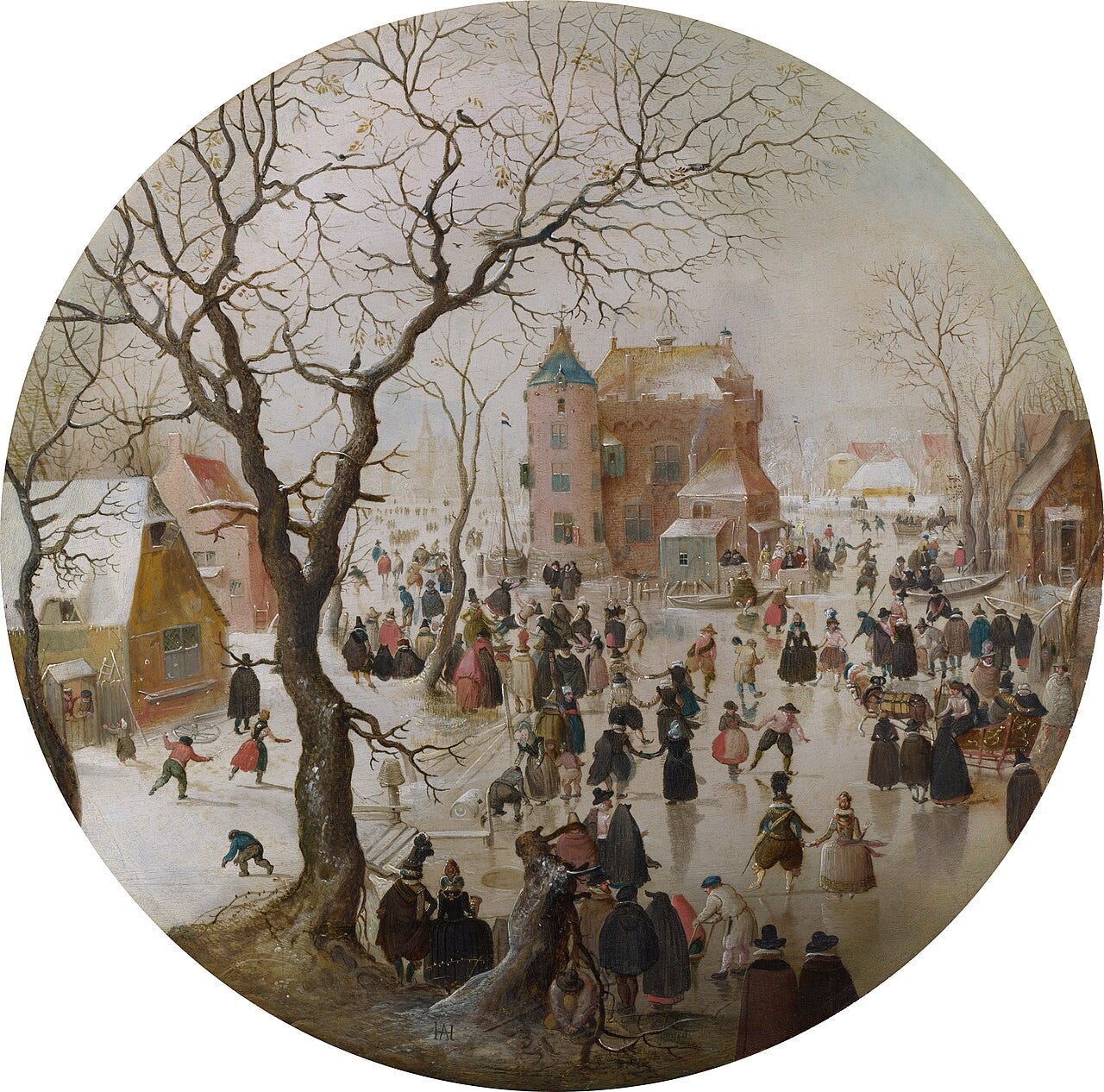
Avercamp was deaf and mute and painted crowded ice scenes from a high viewpoint, with dozens of small figures skating, falling, doing business and flirting.
More on the genre in what is genre painting.
He worked at Kampen and was known in his lifetime as de Stomme van Kampen, the mute of Kampen. His scenes are painted from a high viewpoint with a low horizon so that a hundred small figures stay legible at once.
4 | The frost fairs on the Thames
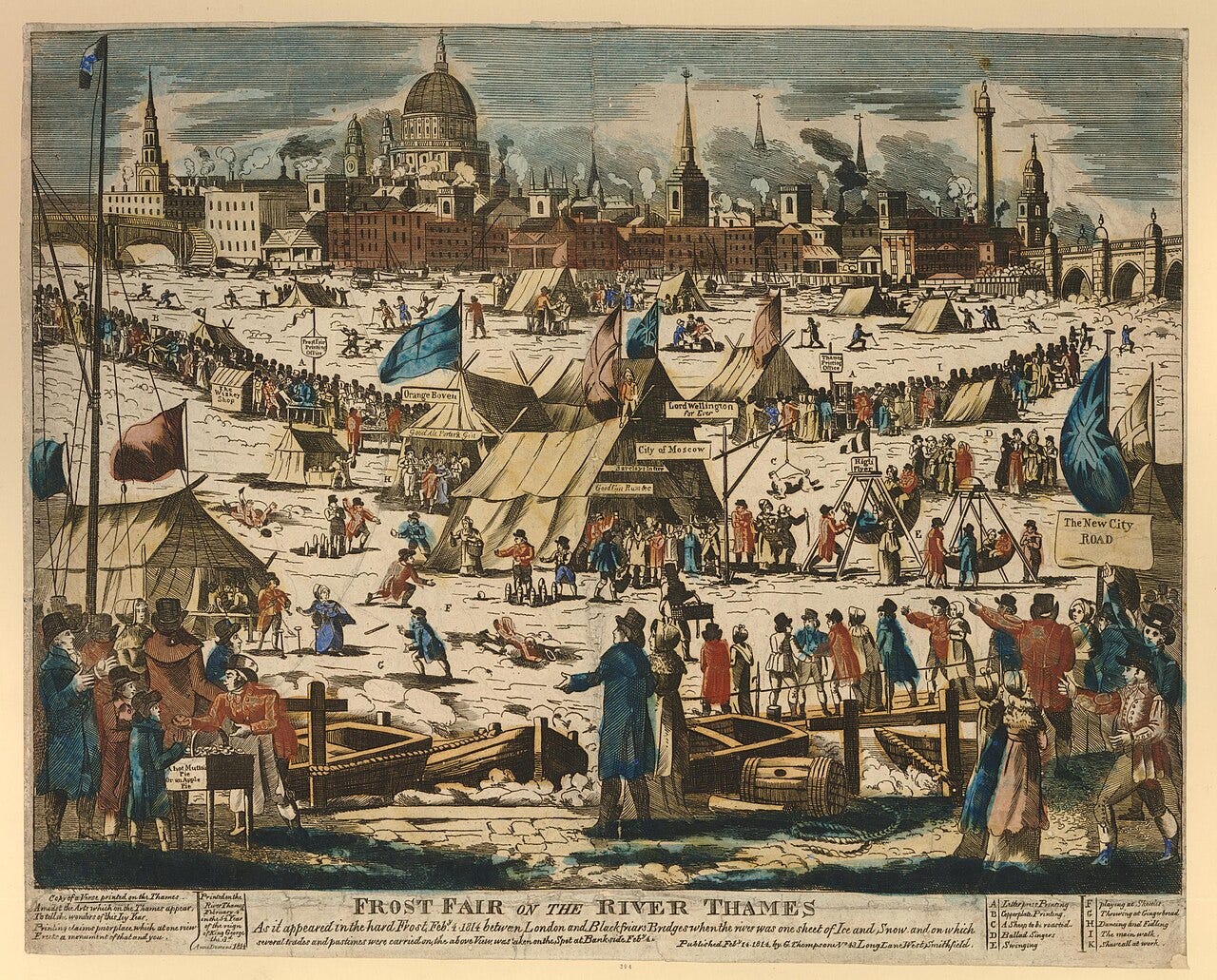
The river froze solid enough for fairs with tents, printing presses and even an elephant in 1814. Prints of these fairs were sold on the ice itself.
The old London Bridge slowed the current, which is part of why it froze at all.
5 | The Little Ice Age
Historians of climate use these paintings as evidence. The concentration of Dutch winter scenes maps onto the coldest decades of the seventeenth century.
Art history and climate history read the same pictures.
6 | Monet and the ice breaking up
In the winter of 1879 to 1880 the Seine froze and then broke apart. Monet went out and painted the floating ice slabs repeatedly, a series most people have never seen.
More on him in Claude Monet.
The Seine froze in December 1879 and broke up on 5 January 1880. He painted the debacle in a burst of around eighteen canvases in a few weeks, working from the bank at Vetheuil where his wife Camille had died the previous September.
7 | Why snow is not white
Painted snow is blue, violet, pink and grey. Pure white in a snow scene looks like a hole in the canvas, so painters mix everything except white into it.
More on the pigment question in what is oil painting.
8 | Japanese snow
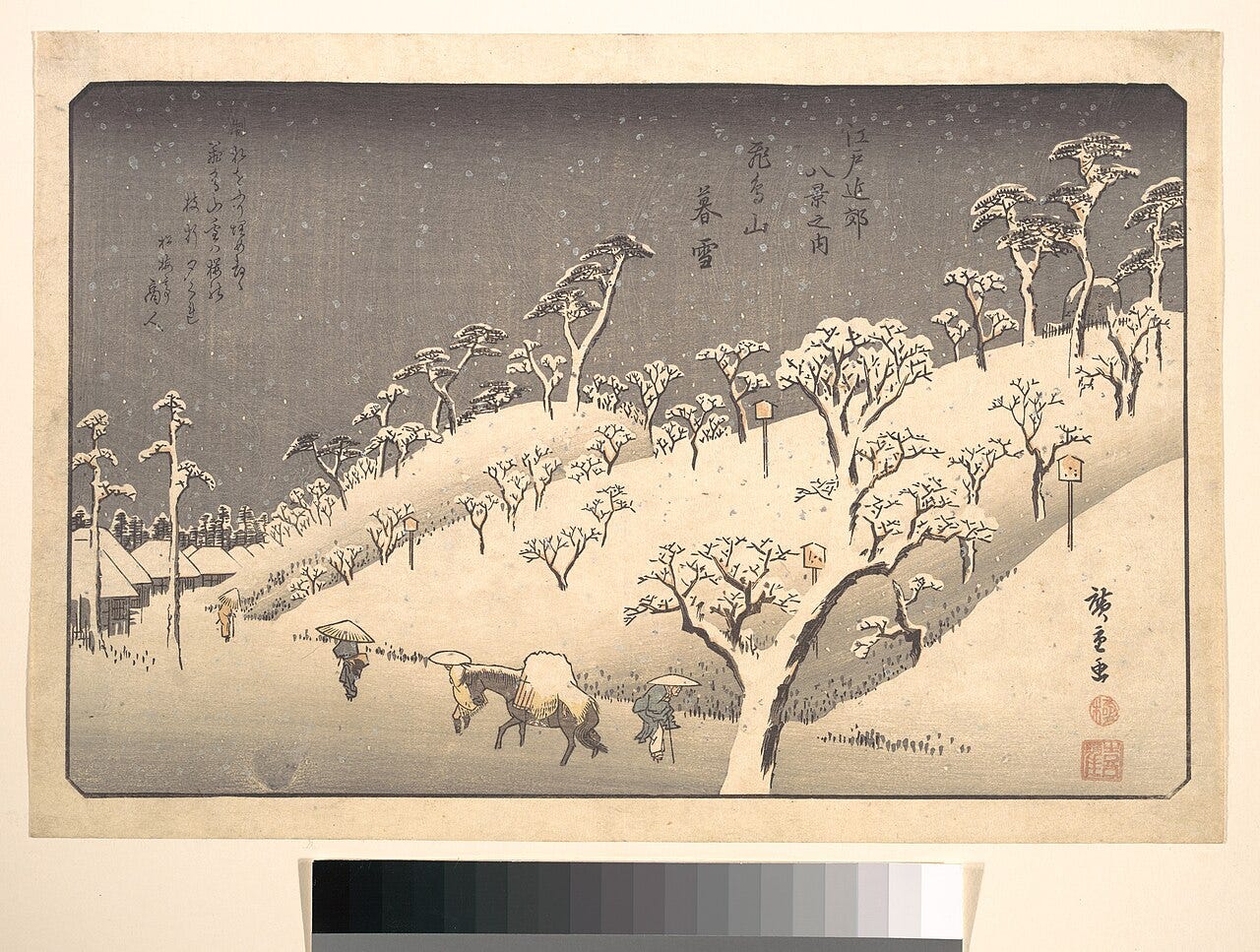
Hiroshige and Hokusai treated snow as flat shape rather than as light, leaving the paper bare and letting the outlines carry the weight.
More on him in Katsushika Hokusai.
Hiroshige devoted a large part of the One Hundred Famous Views of Edo, published from 1856, to snow and rain. The white is the bare paper, so the snow is literally an absence of ink.
9 | Napoleon in the snow
The retreat from Russia in 1812 gave nineteenth century painters a national subject in white, and the snow does the work that a battlefield usually does.
More in famous battle paintings.
10 | The polar expedition picture
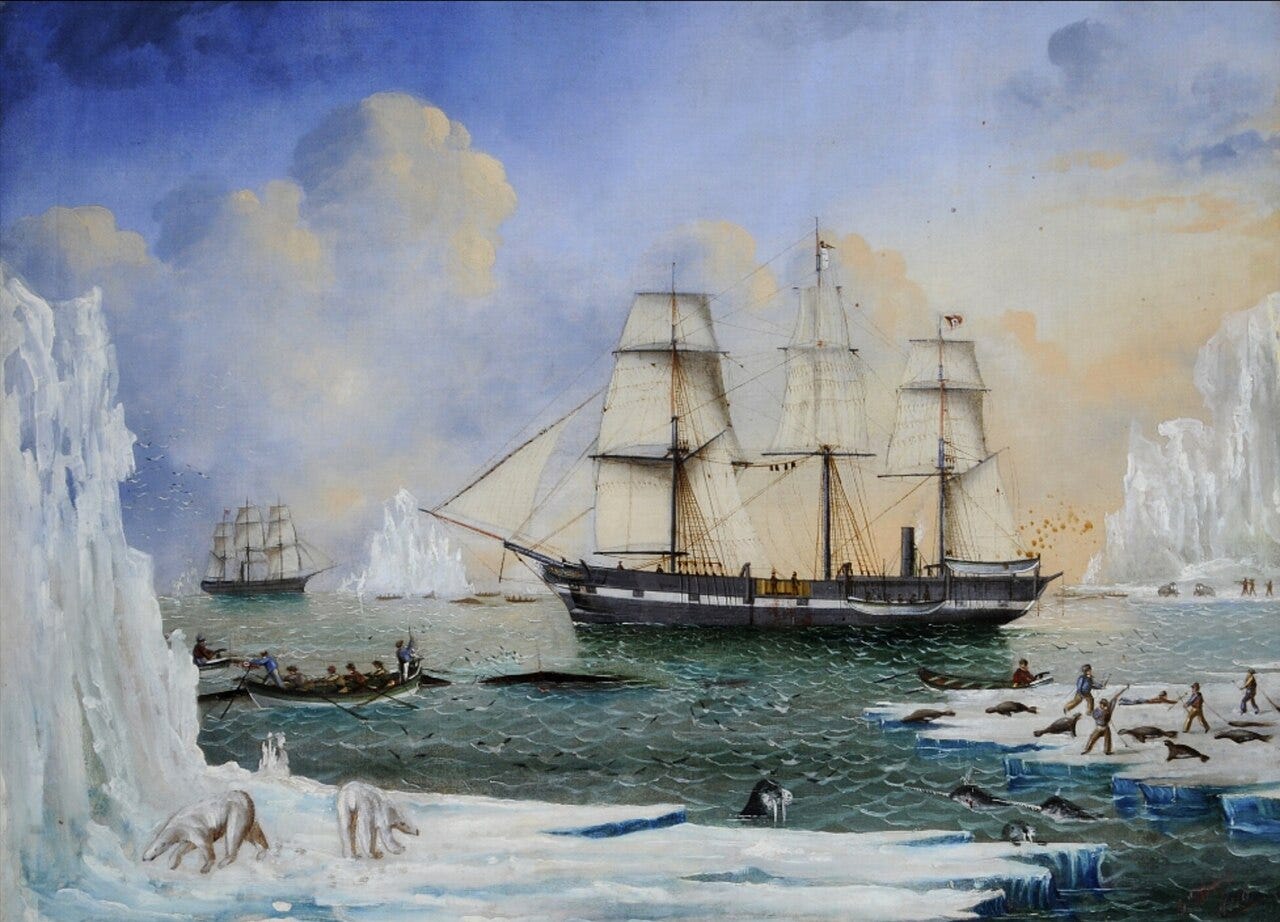
The search for Franklin and the race for the poles produced a run of paintings of ships trapped in ice, sold to a public following the newspapers.
More in famous shipwreck paintings.
Landseer painted Man Proposes, God Disposes in 1864 after the search for Franklin’s lost expedition. It hangs at Royal Holloway, where exam candidates are seated away from it because of a student superstition.
11 | Skating as a moral subject
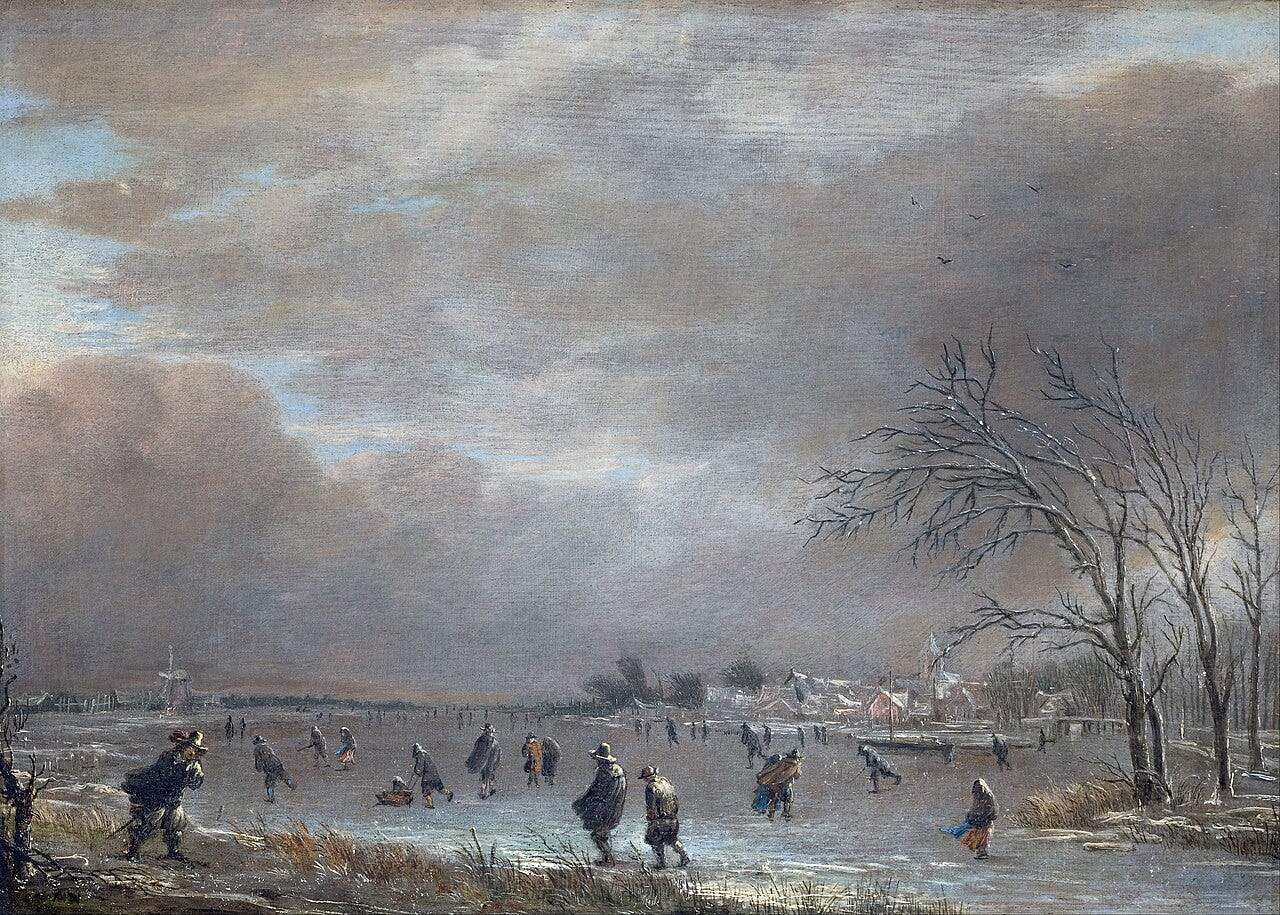
A skater on thin ice was a standard warning in Dutch prints: life is slippery, and the fall you are laughing at will be yours next.
The falling figures are not comic relief, they are the argument.
12 | What the ice gave painters
A frozen surface flattens a landscape into a stage, silences the colour, and puts every figure in the same plane. It is the easiest way to make a crowd readable.
Look at the horizon line. In ice scenes it is usually very low or very high, never in the middle.
Before you go: ice and snow
Why are there so many Dutch winter scenes? The Little Ice Age brought hard winters to northern Europe, canals froze regularly, and the frozen landscape became a marketable genre.
What is the Sea of Ice? A painting by Caspar David Friedrich of around 1824 showing a ship crushed by pack ice. It did not sell in his lifetime.
Were there really frost fairs on the Thames? Yes. The river froze several times, with tents, stalls and printing presses set up on the ice, the last in 1814.
Did Monet paint ice? Yes. He painted the Seine breaking up after the freeze of 1879 to 1880 in a series of canvases of drifting ice.
Where is The Hunters in the Snow today? Vienna for Bruegel, the Kunsthalle Hamburg for Friedrich, the Rijksmuseum for Avercamp.
Climate historians cite these paintings as data. Painters thought they were selling a pretty view, and they were writing down the weather.
Keep going in the collections of the Met and the Rijksmuseum.