
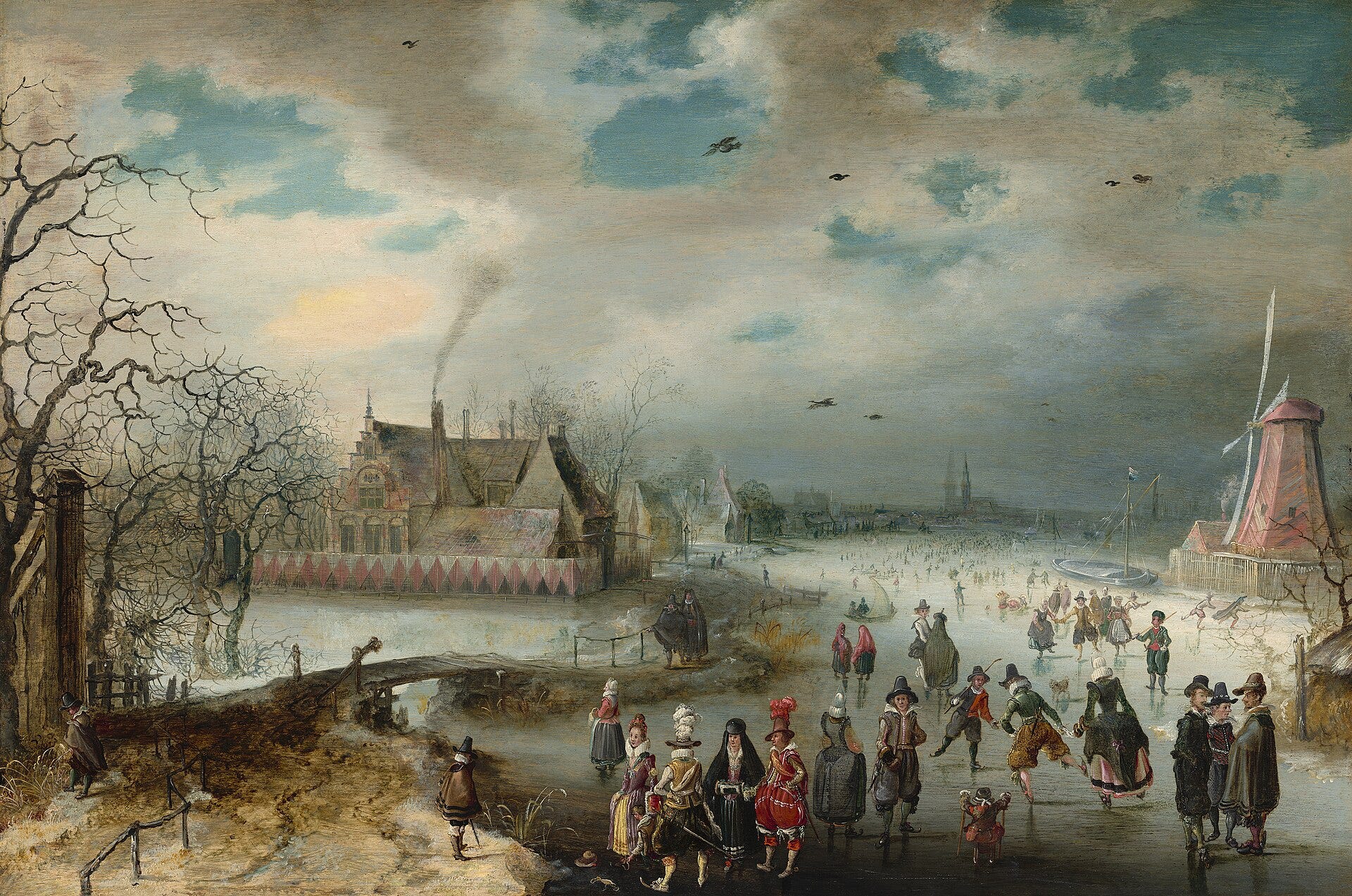
On the ice, painters found a stage that needed no props. Skaters fell, raced, showed off and courted in full view of the whole town, and for five centuries artists stood on the bank and took notes, from a woodcut printed in 1498 to the covered rinks of Paris and the carnivals of Montreal.
Cool Stories About Art is a newsletter to learn art the fun way.
Join 200,000+ readers and get:
10 new art stories / month
The entire archive of content (140+ articles)
Comment, ask questions, and chat with other readers
Why Painters Went Out on the Ice
Skating asked painters for something few subjects demand: a body halfway through a glide, on a surface that might crack beneath it. Balance, speed and the risk of a fall all had to show in a figure that cannot move.
The difficulty was worth it because of who stood on the ice. In the Low Countries, the skate began as a way to get around on canals that froze every winter, and once the canals froze, ranks mixed. Gentlemen, servants, orphans and preachers shared the same surface, so a painter could show a whole town in one view.
Every picture on this list therefore has someone in skates, and a story of its own to tell about them. Read in order, the twelve follow skating from the frozen canal to the rink, where people went as much to be seen as to skate.
12. Unknown artist, Lidwina's Fall on the Ice (1498)
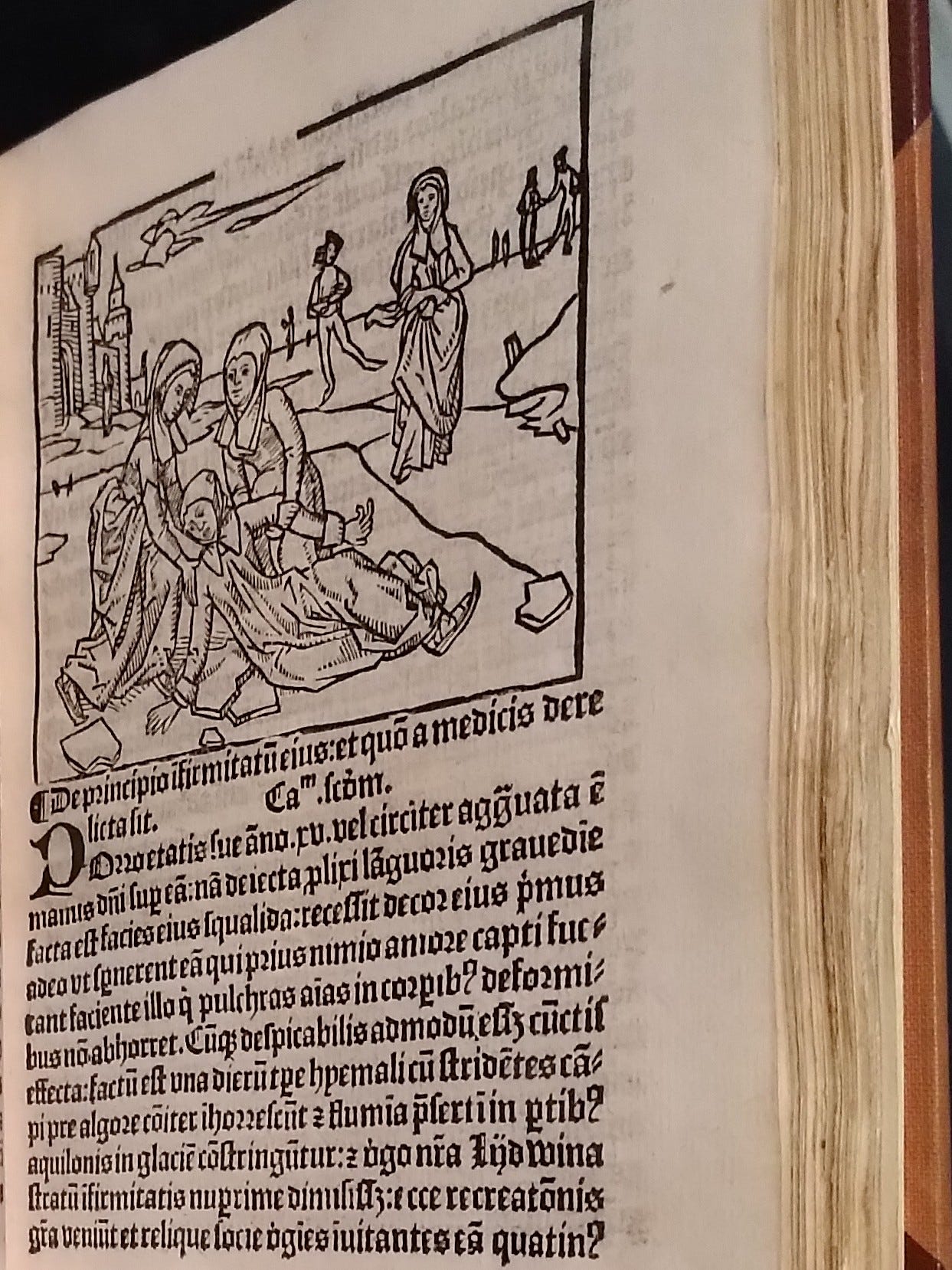
A girl lies on the ice with a skate still strapped to one foot, and two friends kneel to lift her. Behind them, another skater glides past a town gate as if nothing had happened. This small woodcut, printed in 1498 in Schiedam, a town near Rotterdam, is the oldest Dutch picture of skating, and what it shows is an accident.
The girl is Lidwina. According to the tradition, she was born in Schiedam in 1380 and fell on the ice at about fifteen while out with her friends. She broke a rib on her right side. An abscess followed, then one illness after another, and she spent the next thirty-eight years in bed until her death in 1433.
That long illness made her famous enough to become the subject of a book. The priest Johannes Brugman wrote her life in Latin in 1456, and another priest of Schiedam, Otgier Nachtegael, printed it with twenty woodcuts on a press set up in the town's convent of Saint Anne. This page is one of them.
The book, however, was not the first telling. An account written around 1435 puts her on the ice in "sandalijs", a word that can mean skates or simply shoes, and has another girl crash into her at full speed. Brugman himself wrote that she was not skating at all and was only watching her friends.
The woodcut ignores both versions. Pointed skates like the one on her foot came into use only around 1500, so the cutter gave a girl of the 1390s the skates of his own day. I like that slip, because without meaning to, he recorded what people in his town wore on the ice.
Lidwina was made a saint in 1890 and became the patron of the chronically ill. Skaters call on her too, which means the patron saint of their sport is a girl remembered for falling.
At a Glance
Artist: Unknown woodcut artist, for Johannes Brugman's Life of Lidwina
Made: 1498 (printed in Schiedam by Otgier Nachtegael)
Medium: Woodcut in a printed book
Size: Not published
Where to see it: Copies of the book in rare book libraries, among them the British Library, London
11. Nicolaas Baur, Women's Skating Competition on the Stadsgracht in Leeuwarden (1810)
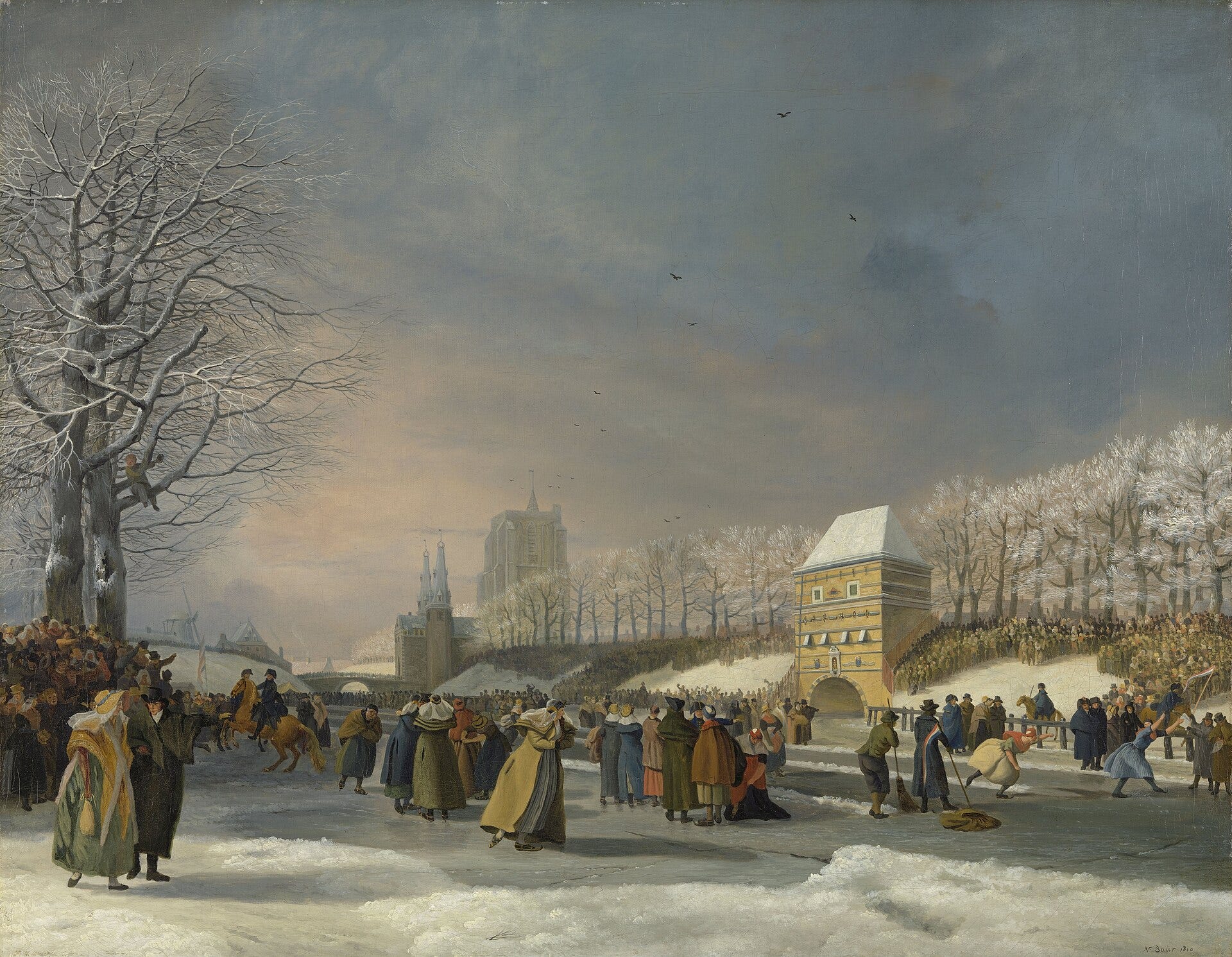
Two young women race side by side down a frozen canal, arms bare in the January cold, and one of them throws both hands into the air as she crosses the line. Thousands of people in heavy coats crowd the banks to watch. What that crowd saw put an end to races like this one.