Impression, Sunrise: How Monet Named Impressionism
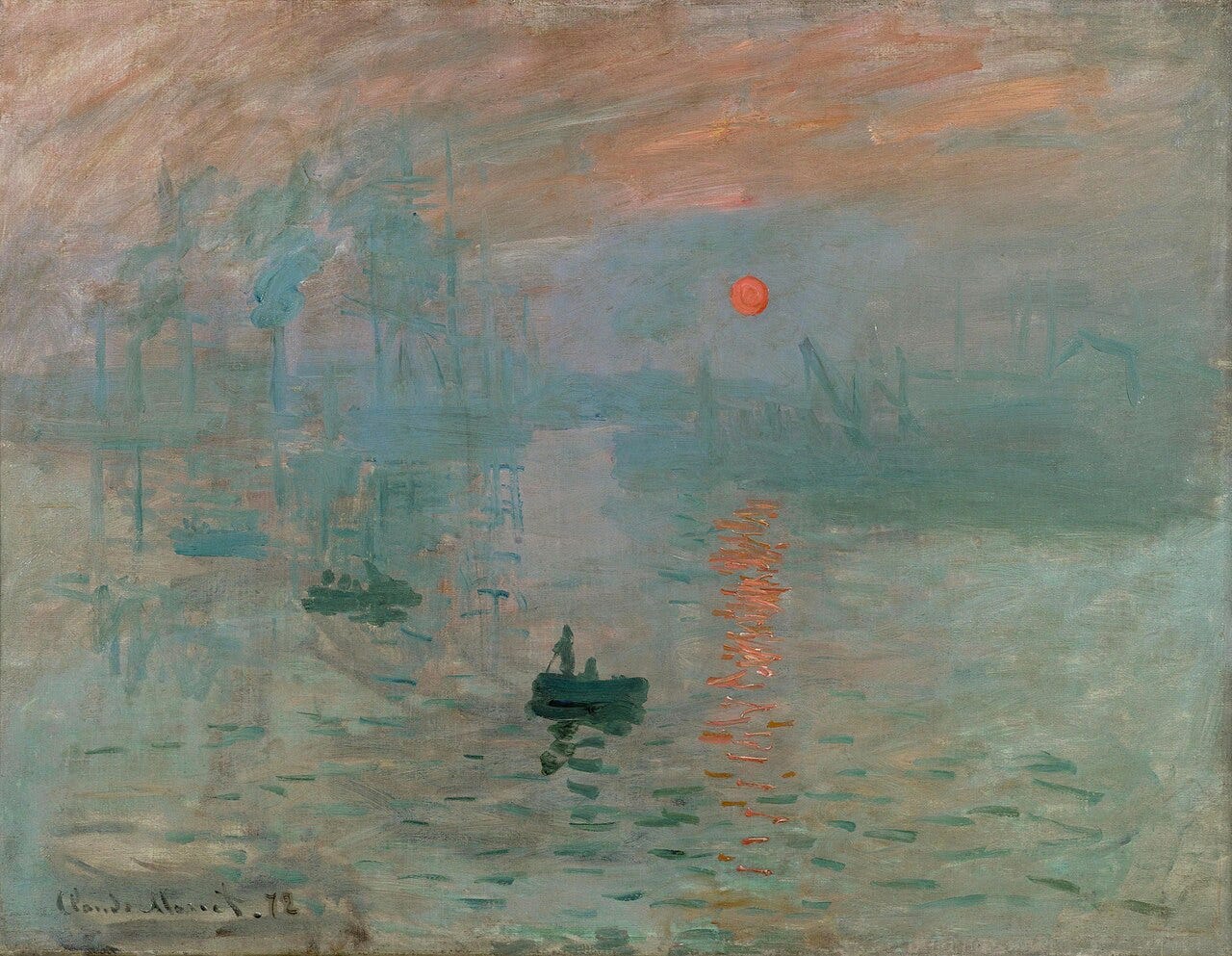
Impression, Sunrise is an 1872 painting by Claude Monet, in the Musee Marmottan Monet in Paris. It shows the harbour of Le Havre at dawn, an orange sun over misty water.
A critic used its title as an insult in 1874, and by accident he named a whole movement: Impressionism.
The painting is loose, quick, almost unfinished, and that was the scandal. Here is where the word Impressionism came from, the trick Monet played with the sun, and why the picture was once stolen.
A harbour at first light
Monet painted it from a hotel window in Le Havre, the port town where he grew up, looking out over the water at sunrise. The horizon sits high, so the sea fills most of the canvas, and three small boats drift in a diagonal toward the sun.
Behind the mist are the cranes, masts and smoking chimneys of a working industrial port, dissolved into a few soft strokes. He worked fast and thin, laying the boats and the sun in last, catching a moment of light rather than describing a place.
There is barely any detail, and that is the entire point.
The insult that became a name
In April 1874 Monet and about thirty friends, tired of being rejected by the official Salon, put on their own show. Among them were Degas, Renoir, Sisley and Pissarro.
When Edmond Renoir, the painter Auguste Renoir's brother, who was compiling the catalogue, asked what to call this loose harbour sketch, Monet shrugged and said to just put Impression.
A critic named Louis Leroy walked through the show, stopped at the picture, and wrote a savage review in the paper Le Charivari titled The Exhibition of the Impressionists.
He meant it as a sneer: these people could not finish a painting, they gave you only a sketchy impression. The artists took the insult and kept it.
The most famous movement in modern art was named by a man trying to mock it.
The sun that vanishes in a photograph
Here is the detail almost nobody notices. That glowing orange sun looks far brighter than the sky around it, but it is not. Monet matched the sun and the pale sky at almost exactly the same lightness, the same tone, so that only the color separates them.
Photograph the painting in black and white and the sun nearly disappears into the sky, and it is the trick I always point out first.
Its power on your eye comes purely from the warm orange against the cool background, not from any actual brightness. A scientist later used this picture to explain how the eye can be tricked by color, and it is one reason the little sun feels alive when everything around it is calm.
What Monet left out
The scene is not quite the real Le Havre either. Monet quietly dropped the row of houses that stood along the jetty, clearing the left of the picture so the misty industrial harbour and the sun could dominate without distraction.
It is the same instinct Turner and the Impressionists all shared: paint the effect of a moment, not an inventory of a place. Monet was not lying about Le Havre.
He was editing it down to the feeling of standing at that window while the sun came up over the water.
In the Marmottan, and the 1985 theft
Impression, Sunrise is in the Musee Marmottan Monet in Paris, which holds the largest collection of Monet in the world. It is not for sale.
In 1985 a gang burst into the Marmottan in daylight and walked out with this painting and eight others in one of the boldest art thefts in French history.
It vanished for five years and was recovered in Corsica in 1990, unharmed, and quietly returned to the wall. The picture that named Impressionism has hung there ever since.
The morning it was painted, to the minute
For a picture this famous, its date was long a guess, until an American astrophysicist settled it. Donald Olson matched the height and position of the sun, the state of the tide, the smoke drifting on the wind and old weather records against the view from Monet's hotel window, and concluded the scene shows the morning of the 13th of November 1872, at around half past seven.
It is a strange thing to know the exact minute of a sunrise painted a century and a half ago, and it turns the loose sketch into a record: Monet really did stand at that window on that morning and put down what the light was doing, fast, before it changed.
The show that flopped and named a movement
Impression, Sunrise hung in the spring of 1874 at the former studio of the photographer Nadar, in a show the artists put on themselves because the official Salon kept rejecting them.
About thirty painters took part, among them Degas, Renoir, Pissarro and Sisley.
Commercially it was a failure. Few pictures sold, the reviews were mostly cruel, and Monet was close to broke for years afterward.
But the insult stuck to the group as a name they decided to keep, and a flop in a photographer's studio became the birth certificate of Impressionism.
Impression, Sunrise, quick answers
Why was Impression, Sunrise controversial? It looked unfinished. Critics said it was a sketch, not a painting, and one used its title to mock the artists as mere Impressionists.
What is the meaning of Impression, Sunrise? It captures a fleeting moment of light over the harbour of Le Havre at dawn, valuing the impression of a scene over precise detail.
Who painted it and when? Claude Monet, in 1872. It was shown in 1874 at the first Impressionist exhibition.
Where did the word Impressionism come from? From this painting's title. The critic Louis Leroy used it to sneer at the 1874 show, and the artists adopted the name.
Where is Impression, Sunrise? The Musee Marmottan Monet in Paris.
If this painting pulled you in, you will love these too:
Was Monet really the first Impressionist, the painting that may have got there first
Inside Monet house at Giverny, room by room, including his own bedroom
Six women, one monster, what Picasso did to the women who loved him
The painting that was almost thrown away
For a long time nobody thought this was Monet's best work, least of all Monet. It was a quick harbour study he nearly did not bother to show.
Yet of all the hundreds of pictures he made, this rushed little sunrise is the one that gave a name to Impressionism and changed what painting was allowed to be.
The most important title in modern art was decided by a shrug at a catalogue desk.
You can see Impression, Sunrise in person at the Musee Marmottan Monet. For more by the artist, browse the Metropolitan Museum collection.
How Impression, Sunrise got its name
Was Monet really the first Impressionist, the painting that may have got there first
Inside Monet house at Giverny, room by room, including his own bedroom
The Arnolfini Portrait, detail by detail, the mirror, the dog, and the question everyone asks