
The Impressionists, the Paris painters who from 1874 showed their work together and set out to paint light and weather as they saw them, are best known for summer: poppy fields and sunlight on the river. Many of them also planted their easels in the snow.
Camille Pissarro painted a snowy road in a London suburb as a refugee, while enemy soldiers lived in the house he had fled near Paris.
A few years later he covered a field with frost so thickly that a critic, in 1874, called it palette scrapings on a dirty canvas.
Cool Stories About Art is a newsletter to learn art the fun way.
Join 200,000+ readers and get:
10 new art stories / month
The entire archive of content (140+ articles)
Comment, ask questions, and chat with other readers
Why Snow Was Never White
Snow set the Impressionists one of their hardest problems. A white field has hardly any color of its own. It borrows the color of the sky and of everything around it, so its shadows can turn blue or violet, and a painter who reaches for plain white paint loses the light.
Snow scenes were common enough in French painting to have a name of their own, an effet de neige, a snow effect. Such a picture came with a deadline. The painter had to work fast, often outdoors and in the cold, because a thaw could turn the whole white field to mud overnight.
12. Paul Gauguin, Snow, Rue Carcel (1883)
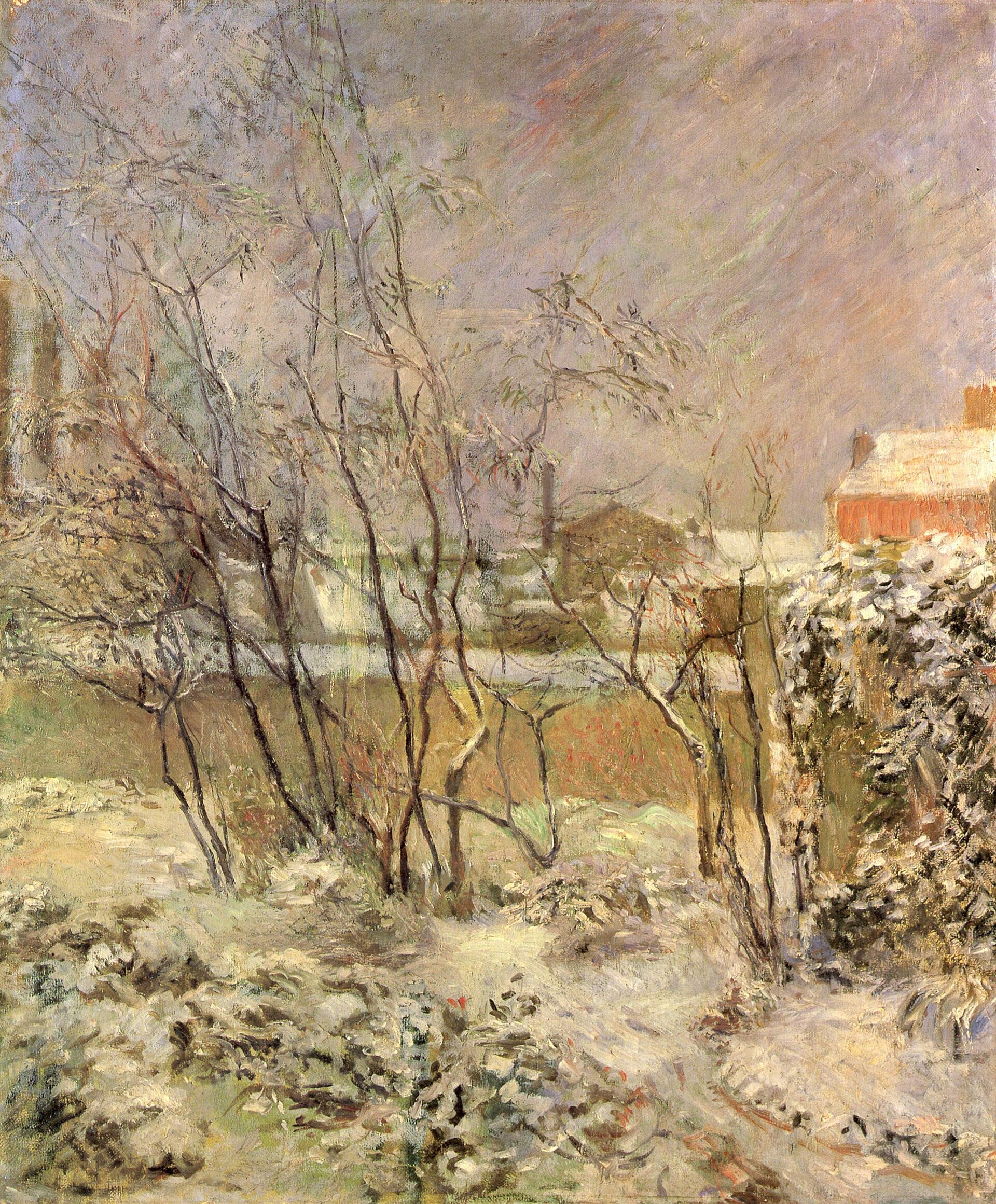
Snow covers a small garden behind a row of Paris houses. A fence crosses it, a few bare trees stand in it, and the sky above is a flat gray. The man who painted this quiet garden in 1883 had just lost his job.
Until 1882, Paul Gauguin painted only in his spare time. His days belonged to the Paris stock exchange, where his guardian, Gustave Arosa, had found him a place as a stockbroker's agent. His canvases were nonetheless good enough to hang with the Impressionists in 1880, 1881 and 1882.
In 1882 the Paris stock exchange crashed, and Gauguin's position as an agent went with it. Buyers for paintings grew scarce at the same time. In October 1883 he wrote to the painter Camille Pissarro that he had decided to make his living from painting.
The garden in this canvas was his own, behind the family home on the Rue Carcel, in Vaugirard, a district on the southern edge of Paris. In 1881 he had painted the rooms of that house, and his wife and children in this same garden.
Two years later he came back to it more than once and painted it with nobody there. By then the family living there had young children and no salary coming in.
The family did not stay in Vaugirard. In January 1884 they moved to Rouen, where living cost less, and by the end of that year they were in Copenhagen, home of his wife, Mette, whose relatives could help them.
The move did not keep the family together. In June 1885 Gauguin went back to Paris with his six-year-old son Clovis. Mette kept the other four children with her in Denmark.
At a Glance
Artist: Paul Gauguin (1848 to 1903)
Painted: 1883
Medium: Oil on canvas
Size: 60 × 50 cm (23.6 × 19.7 in)
Where to see it: Ny Carlsberg Glyptotek, Copenhagen
11. Camille Pissarro, Fox Hill, Upper Norwood (1870)
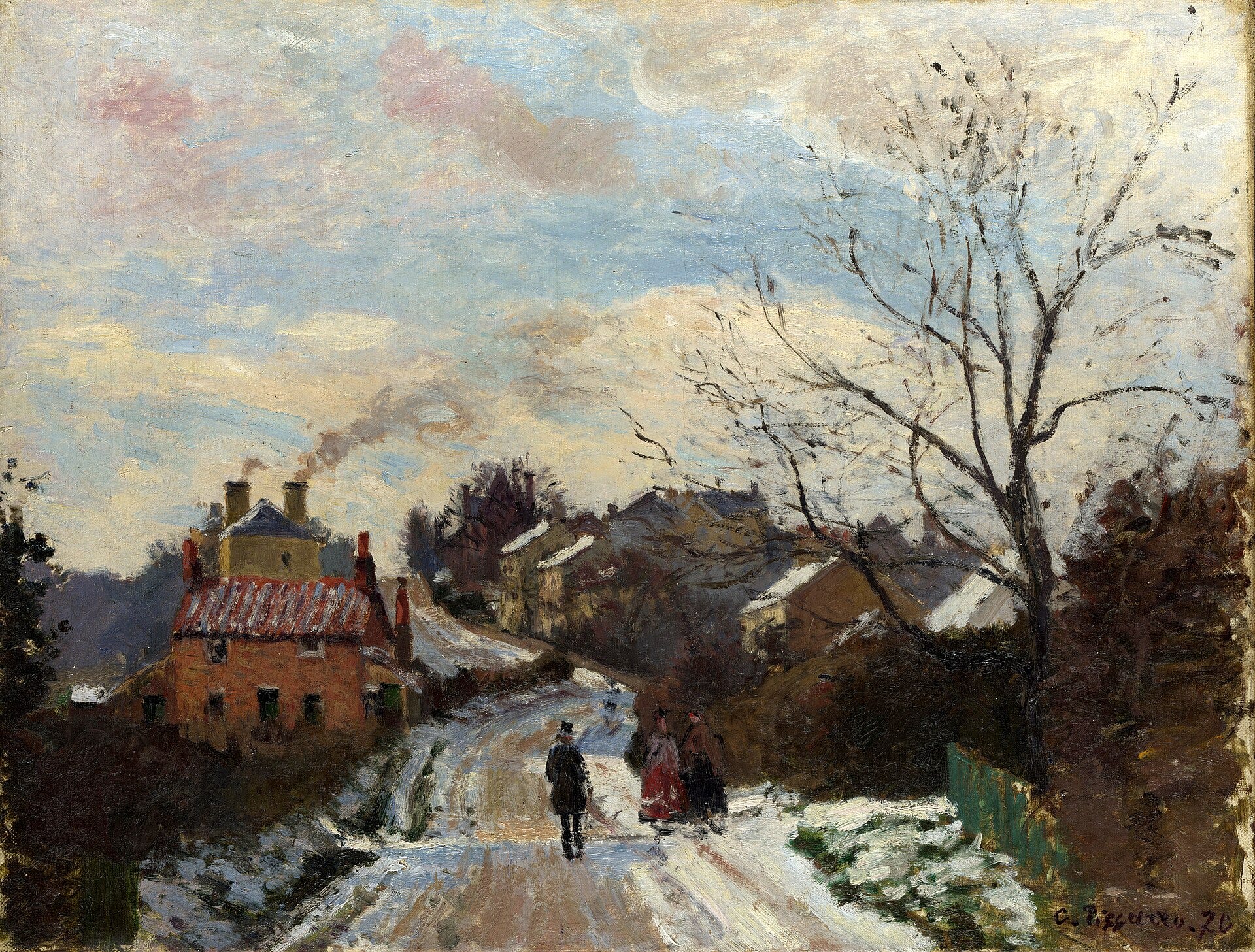
A curving road in a suburb lies under snow, and the shadows on it are the same blue as the sky. Two women in red clothes meet a man in a top hat who carries a cane. The man was not in the first version of the picture.