
The Inquisition was a court that judged what people believed, and for centuries it wanted its verdicts to be seen. Its own friars ordered the first pictures of its ceremonies, with a saint among the judges. Those who painted the court again in the nineteenth century, when the court was fading or already gone, turned the light toward the accused.
Cool Stories About Art is a newsletter to learn art the fun way.
Join 200,000+ readers and get:
10 new art stories / month
The entire archive of content (140+ articles)
Comment, ask questions, and chat with other readers
What the Inquisition Asked of Artists
The Inquisition was a Church court set up to hunt heresy, the beliefs the Church condemned. Its Spanish branch, founded in 1478, pursued above all converted Jews and Muslims suspected of keeping their old faith, and it lasted until 1834.
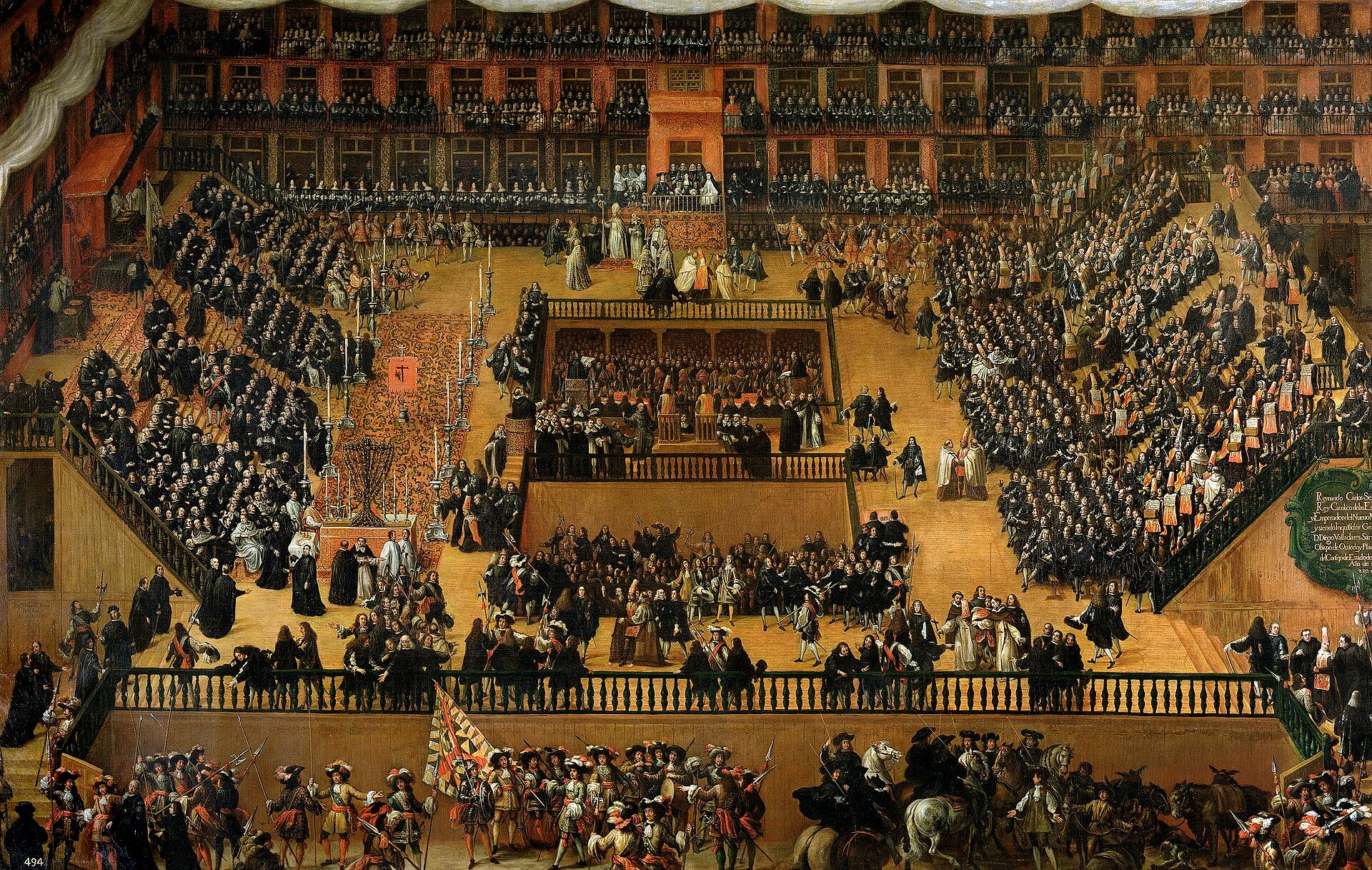
For artists, the subject meant painting a trial of ideas: a hall, a bench of judges, and the accused, recognizable by a penitent's tunic, the sanbenito, and a tall pointed cap. Sentences were read in public at a ceremony called an auto-da-fé, an act of faith.
The oldest works chosen here were made for the tribunal or under its eye. The later ones, almost all from the nineteenth century, came from its critics, after its power had collapsed. Each shows its trials, its ceremonies or the people it pursued, from Spain to Venice, Rome, southern France and Mexico.
12. Moshe Maimon, The Marranos (1893)
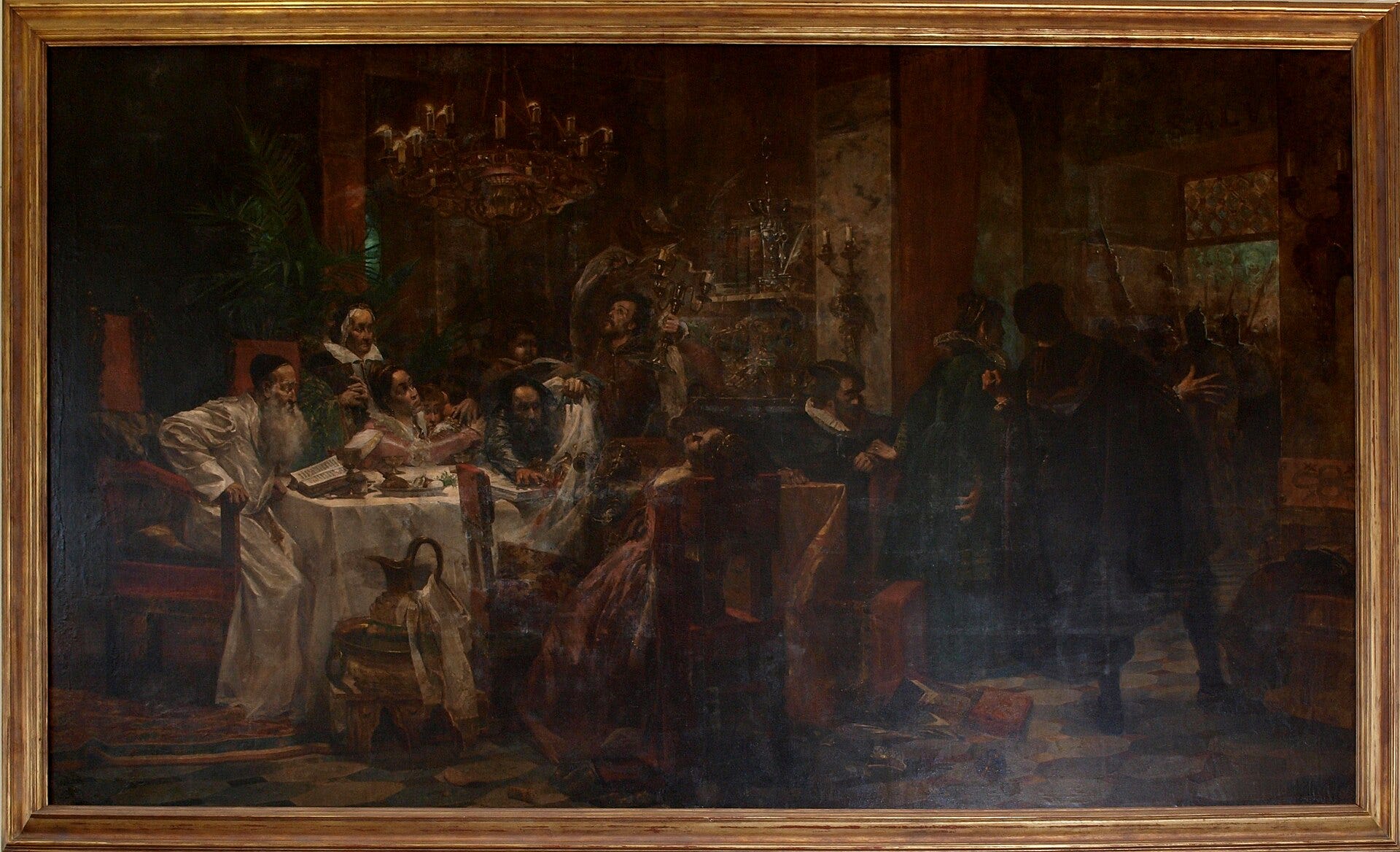
Armed men in masks push into a dark dining room. The family at the table turns toward them, and a woman sinks back in her chair. Only the old man in white, at the far side of the table, keeps his eyes on his book.
That book explains the scene. It is the Haggadah, the text read aloud at the seder, the dinner that opens Passover. The family are Marranos, the name given in Spain to Jews forced to become Christians who went on practicing their religion in secret. For them, keeping the seder was exactly the kind of secret the Inquisition was there to uncover.
The painter was not thinking only of Spain. Moshe Maimon, a Jewish painter trained at the Imperial Academy of Arts in Saint Petersburg, finished The Marranos in 1893. According to the art historian Hillel Kazovsky, its starting point was much closer to home: a seder in Saint Petersburg broken up by the Russian police.
That is why he needed Spain. His teachers at the Academy had advised him not to exhibit such a subject. By tying it to the four hundredth anniversary of the expulsion of the Jews from Spain in 1492, Maimon turned a raid of his own time into a historical scene he could show.
The disguise fooled no one. Russian critics read the painting as a political statement, and the Academy refused it as anti-Christian, while making Maimon an academician on the strength of it.
Inside the picture, the old man has heard the door like everyone else. He goes on reading, as if he will go with them only once he has finished.
At a Glance
Artist: Moshe Maimon (1860 to 1924)
Painted: 1892 to 1893
Medium: Oil on canvas
Size: 60 x 104.5 cm (23.6 x 41.1 in)
Where to see it: Private collection
11. Anonymous, An Auto-da-fé in the Town of San Bartolomé Otzolotepec (about 1716)
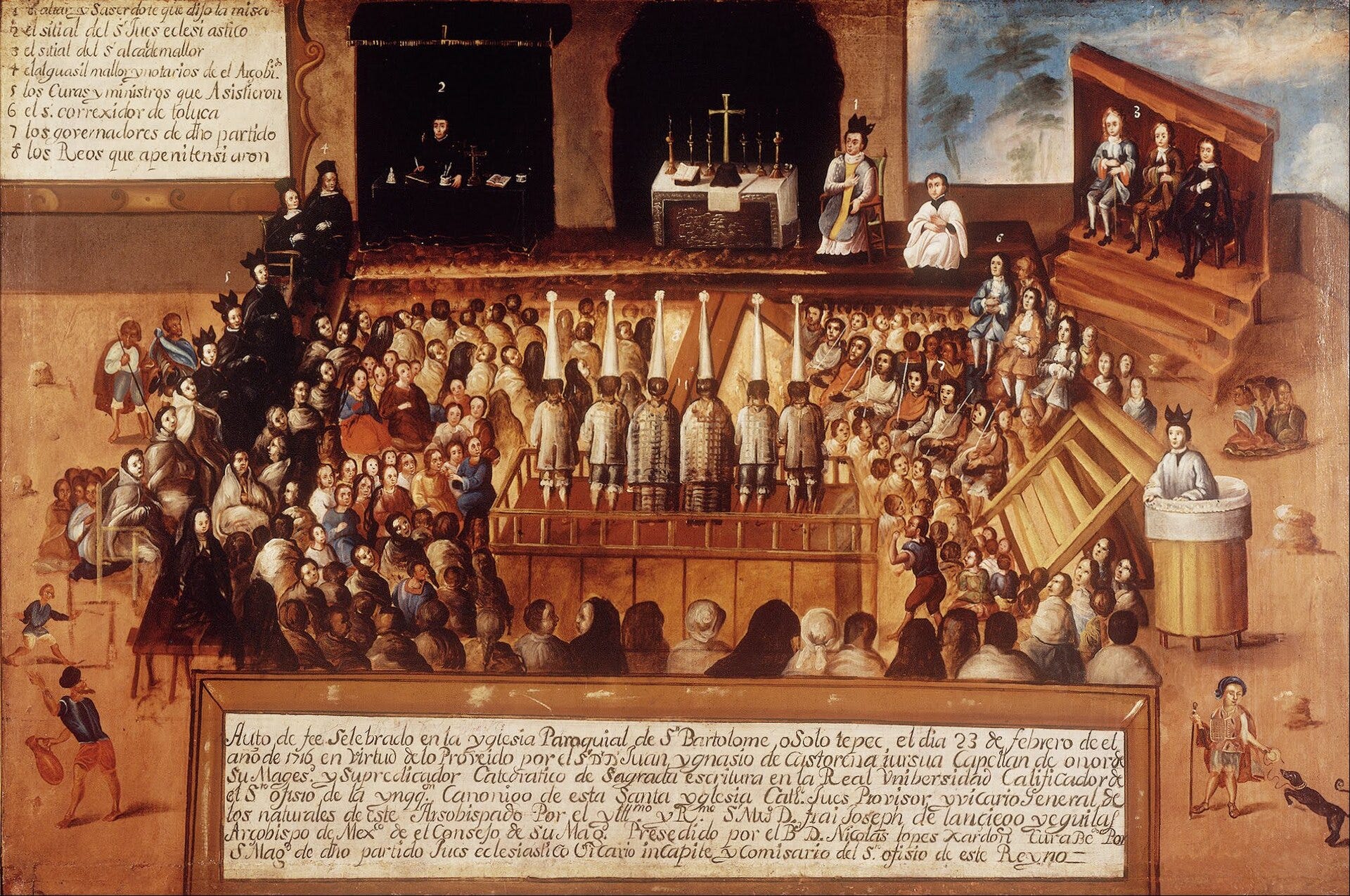
Six penitents stand with their backs to us on a wooden platform inside a village church, each in a tall pointed cap, a long candle held across the chest. An inscription at the bottom gives the place and the day: the parish church of San Bartolomé Otzolotepec, in Mexico, on February 23, 1716. Everything recalls an auto-da-fé of the Inquisition, and yet the Inquisition had no power to judge these six people.