

170 000+ readers. Learn art the fun way.
This is a preview. Paid subscribers get the full story.
You’ll also get:
10 new stories every month
The full archive (130+ Art stories)
Your personal art guide. Comment, ask questions, DM me anytime
iPhone user? Subscribe at coolstoriesabout.art, not via the app. Apple adds 30% to the price.
You know those football programmes where for hours, blokes in suits debate whether Messi’s better than Ronaldo? Or those endless discussions about Federer versus Nadal, Jordan versus LeBron?
Today, we’re doing the same thing. But with painting.
The question: Is Raphael the greatest painter of all time? The absolute GOAT?
To answer, we’re going to rate him like a FIFA card. Six criteria. Numbers. Facts. And at the end, you’ll decide.
WHO IS RAPHAEL?
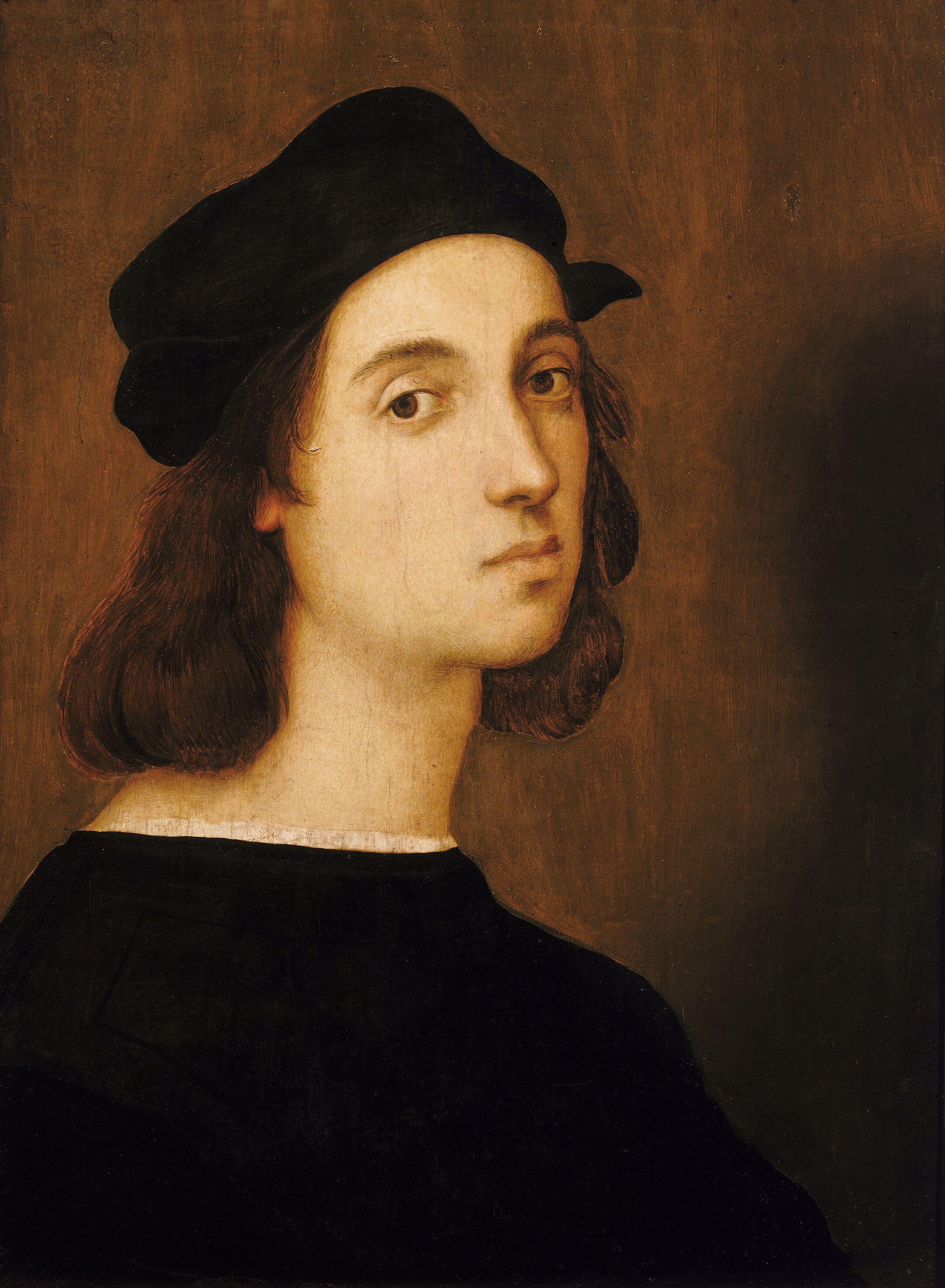
Raffaello Sanzio dies on 6th April 1520 in Rome. He’s 37 years old. On his birthday.
The entire city stops. Cardinals rush to his side, artists weep, Pope Leo X organises a state funeral. He’s buried in the Pantheon, an extraordinarily rare privilege for a painter.
On his tomb, an inscription proclaims: “Here lies Raphael, by whom Nature feared to be conquered whilst he lived, and when he was dying, feared herself to die.”
An honour almost no painter would receive after him.
In two decades of dazzling career, this son of a painter from Urbino redefined what it means to “paint perfectly”. Trained under Perugino, inspired by Leonardo and Michelangelo, he synthesised everything the Renaissance had achieved into a style of unequalled grace.
His Vatican frescoes (The School of Athens, The Disputation of the Holy Sacrament) became foundational texts of Western visual language. His Madonnas fixed for centuries the very image of the Virgin and Child.
Giorgio Vasari, his first biographer, calls him “the divine one”. For 300 years, his name would be synonymous with pictorial perfection. Then came contestation, rejection, before contemporary rediscovery.
But does he truly deserve the title of GOAT? Let’s put him to the test.
Discover my new newsletter !

Keep learning art the fun way


THE CARD
TEC (Technique/Mastery): 99/99
What it judges: Drawing ability, perspective management, anatomy, texture rendering, sfumato, compositional complexity. Does the painter master their tool or are they struggling?
Raphael is what you’d call a technical monster.
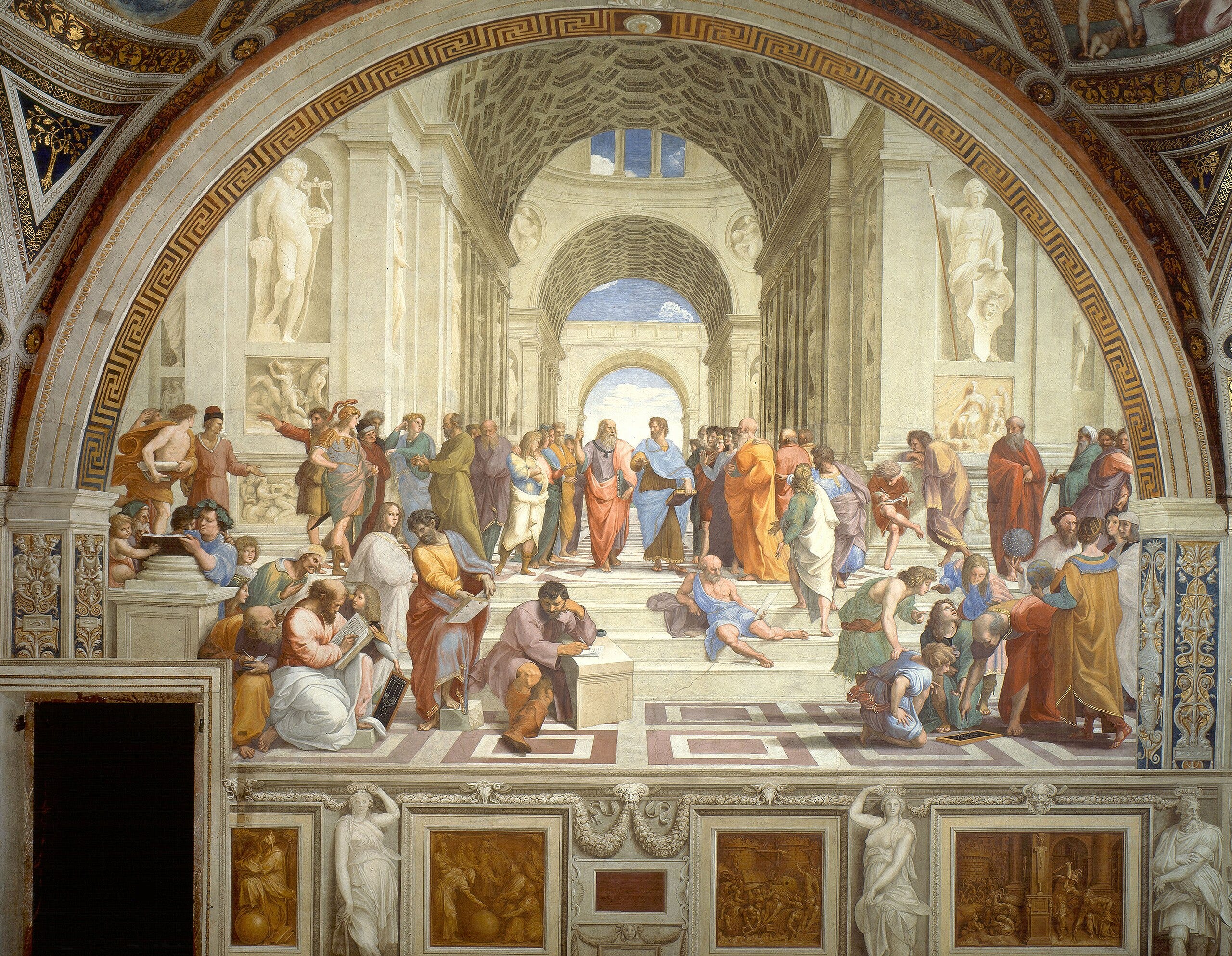
His draughtsmanship achieves almost surgical precision. In The School of Athens (1509-1511), he masters linear perspective to perfection, creating the illusion of an immense architectural space on a flat wall. Each figure occupies exactly the right place within the frame. The balance is mathematical, almost musical.
Vasari calls him “the Prince of painters”. It’s deserved. Raphael dominates his medium without apparent weakness. His preparatory work reveals a terrifying ease: he gives form to his ideas with a stroke of the pen, varies techniques (lead point, ink, red chalk) with disconcerting facility.
By comparison, even Leonardo sometimes struggled with his compositions (how many unfinished works?). Michelangelo excelled in sculpture but painted like a sculptor, with a sometimes heavy touch. Raphael never struggles.
This absolute mastery has been consensus for five centuries. On a purely technical level, he has no equal in the Renaissance. The 99/99 isn’t an exaggeration, it’s a statement of fact.
INV (Innovation/Revolution): 60/99
This is the “Avant-garde” rating. Did this painter change the rules of the game? Did he invent a new way of seeing the world? Or did he “just” copy his predecessors very well?
Careful, slippery ground.
Raphael isn’t Caravaggio inventing dramatic chiaroscuro. He isn’t Picasso shattering perspective. He didn’t create an entirely new technique.
His revolution is more subtle: he synthesises. He takes Leonardo’s vaporous sfumato, Michelangelo’s sculptural power, and fuses it all into a style of unprecedented harmony. This “perfect grace” itself becomes a standard.
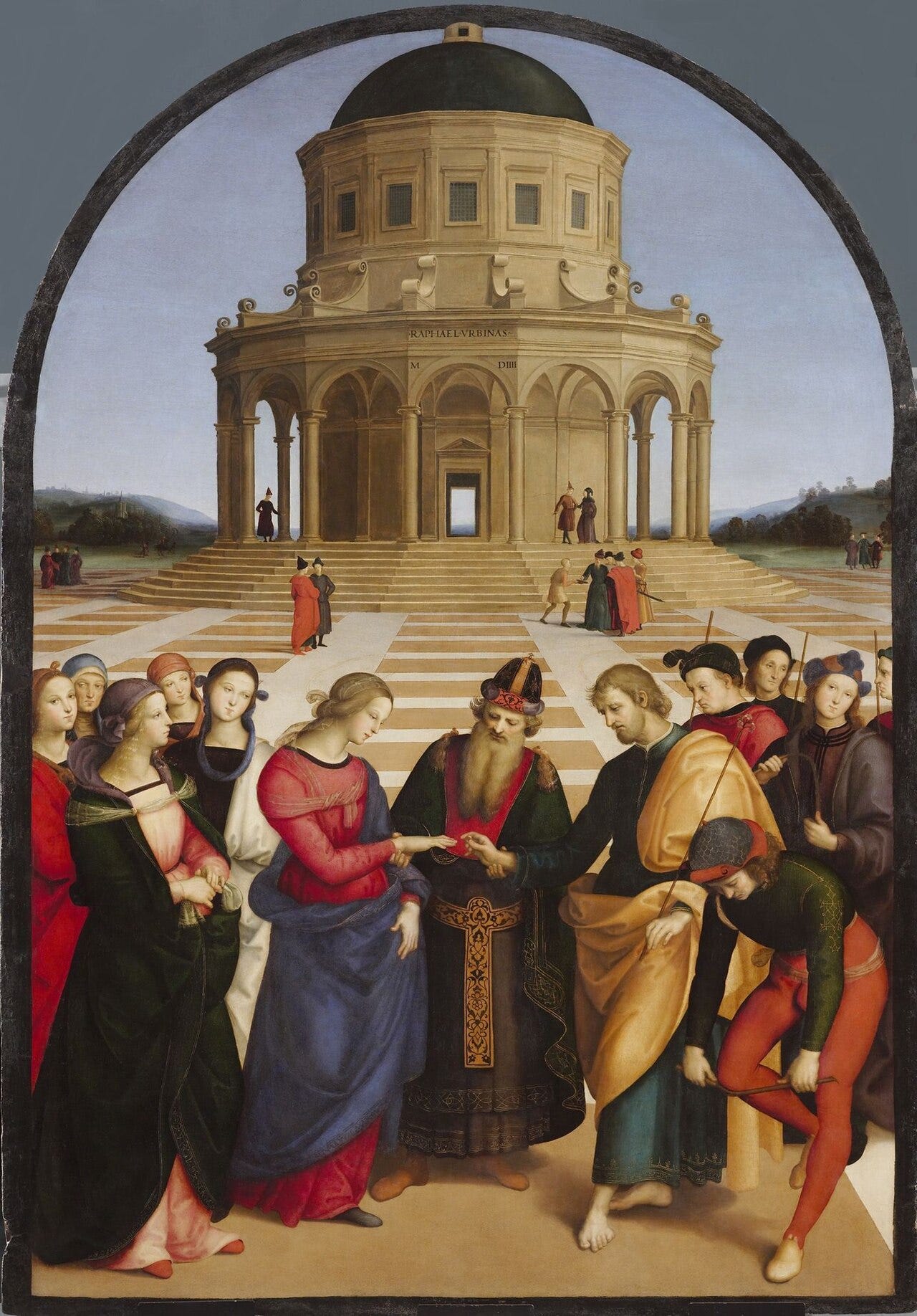
Take The Marriage of the Virgin (1504). Raphael takes up a traditional composition but breathes into it a deeper perspective, more vivid figures. He doesn’t invent, he perfects. He carries his predecessors’ achievements to their apex.
The School of Athens integrates all the Renaissance’s advances (realistic anatomy, perspective architecture, measured expression) into a unified vision that would become the model for centuries. It’s a gentle revolution, not a brutal rupture.
Where Leonardo intellectualises and Michelangelo dramatises, Raphael harmonises. He sets the bar very high, establishes the canons of classical beauty. But he’s not a radical avant-gardist.
Hence the 60/99. A respectable score, but not that of a pure revolutionary.