
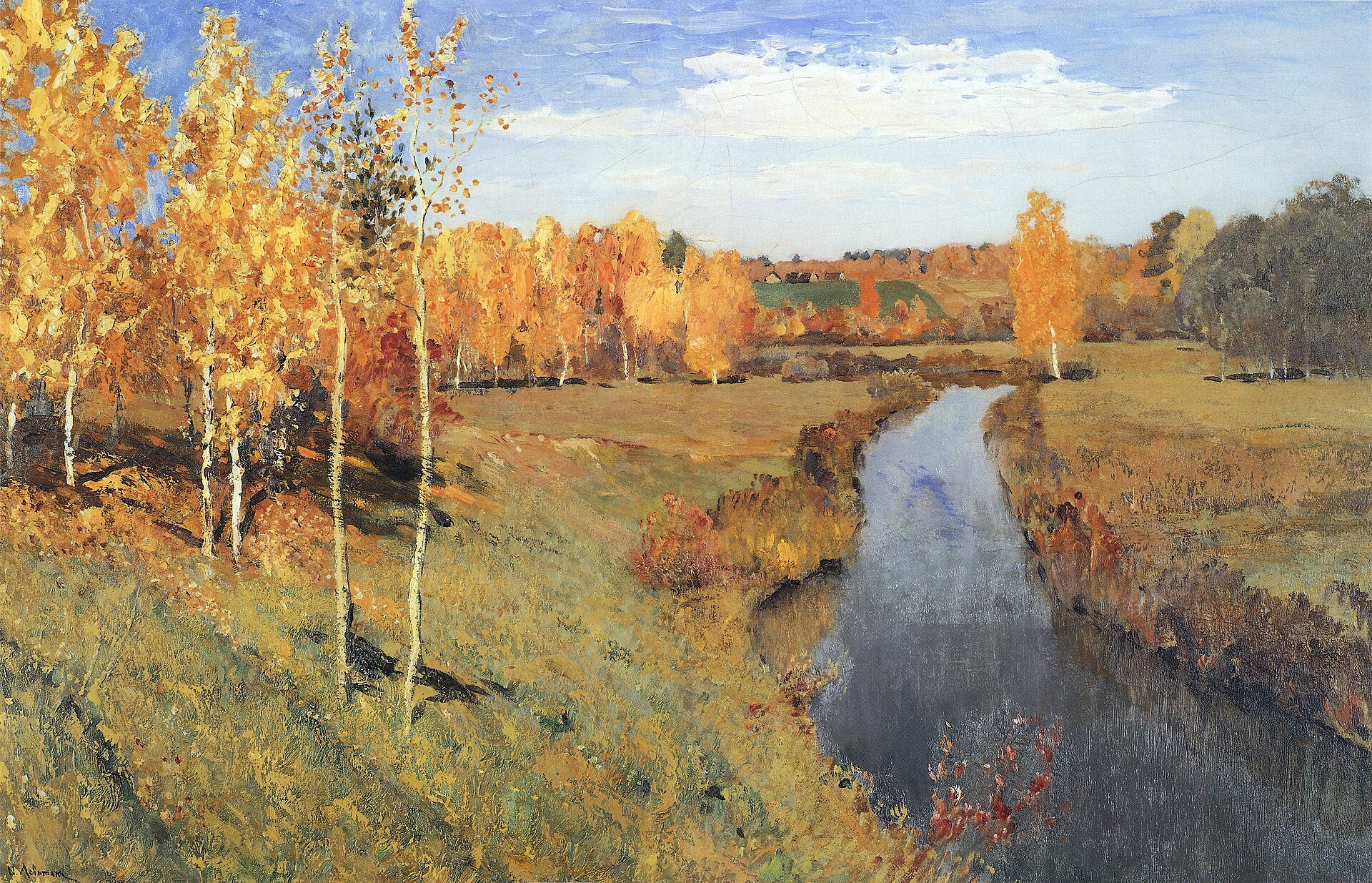
Isaac Levitan (1860 to 1900) was a Russian landscape painter. He painted the birch woods, rivers and muddy country roads of central Russia, in pictures like Golden Autumn and March, now at the Tretyakov Gallery in Moscow.
Cool Stories About Art is a newsletter to learn art the fun way.
Join 200,000+ readers and get:
10 new art stories / month
The entire archive of content (140+ articles)
Comment, ask questions, and chat with other readers
Anton Chekhov, the great Russian writer and Levitan's closest friend, called him the best landscape painter in Russia. Yet twice, in 1879 and again in 1892, the government of the tsar, the emperor of Russia, ordered Levitan out of Moscow, the city where he lived and painted, because he was Jewish.
Isaac Levitan was born in 1860 in Kibarty, a small town of the Russian Empire on the border with Prussia, the German kingdom next door, in what is now Lithuania. His family was Jewish. His father, the son of a rabbi, taught German and French for a living.
Around 1870, the family moved to Moscow, and at thirteen Isaac followed his older brother Avel into the Moscow School of Painting, Sculpture and Architecture. Their mother died in 1875 and their father in 1877, leaving the four Levitan children with almost nothing. The school let Isaac study for free.
The tsar's laws limited where Jews could live. Most had to stay in the western provinces of the empire, and in Moscow a Jewish family lived only with the permission of the authorities.
In April 1879, a young radical, Alexander Solovyov, fired at Tsar Alexander II in Saint Petersburg, the capital, and missed. Solovyov was not Jewish, but the police crackdown that followed his attack hit people who had nothing to do with it. In May, the authorities drove Jews out of Moscow.
Levitan, eighteen years old, had to go. He moved to Saltykovka, a village of summer houses east of Moscow, and went on painting. That fall, patrons of the arts who had noticed his talent pressed the authorities, and Levitan was allowed to come back.
Back in Moscow, Levitan painted Autumn Day. Sokolniki, a path covered with fallen leaves in Sokolniki, a large wooded park of the city. The picture hung in the school's exhibition of student work in 1880.
A collector bought it for 100 rubles, a seventh of the price he would pay for Golden Autumn sixteen years later. He was Pavel Tretyakov, a rich Moscow merchant who was gathering Russian paintings for a gallery of his own.
How did a young Jewish painter whom the tsar's police could send away at any moment become the painter of the Russian landscape in Tretyakov's own gallery?
In the rest of the story
What Chekhov wrote that made Levitan stop speaking to him for three years.
Which unlikely friend brought Levitan back to Moscow after the second expulsion.
Why Levitan gave away a painting that nobody had bought.
What Levitan painted in half an hour for Chekhov, in the painter's last winter.