
Islamic art is everything made for Muslim patrons, or by artists working in the lands Muslims ruled, from a shrine to a drinking glass. Among these eleven works are an enameled beaker that an English legend says the fairies left behind, and a carpet that reached London whole only because its twin was cut up to repair it.
Cool Stories About Art is a newsletter to learn art the fun way.
Join 200,000+ readers and get:
10 new art stories / month
The entire archive of content (140+ articles)
Comment, ask questions, and chat with other readers
Writing, Plants and Figures
The term reaches well beyond religion. It takes in the furnishings of a mosque, but just as much a cup, a basin or a carpet made for a ruler. Its story begins under the Umayyad caliphs, from 661 to 750, and runs on through the Abbasids of Baghdad and a string of regional dynasties, down to the Safavids of Iran, the Ottomans and the Mughals of India.
Writing, plants and figures come back from one end of that world to the other, often spread over the whole surface of an object. The figures surprise people most, because Islam is often thought to forbid images.
Islam's holy book condemns the worship of idols, but it contains no ban on pictures. The condemnation of image makers comes from the hadith, the sayings reported from the Prophet. In practice, no living being was shown in places of worship or in copies of the holy book. Everywhere else, in palaces, on objects and in books, people and animals abound.
Each of these eleven was chosen because writing on it, or about it, still tells part of its story, a name, a date, a wish or a poem. They were made between the seventh and the sixteenth centuries, from Spain to what is now Afghanistan, in glass, ivory, bronze, brass, glazed ceramic, paper, parchment, wool, marble and gold mosaic, and the most famous come last.
Three of them were kept for centuries by Christian owners, a family in England, a cathedral in Italy and the kings of France.
11. The Luck of Edenhall (about 1350)
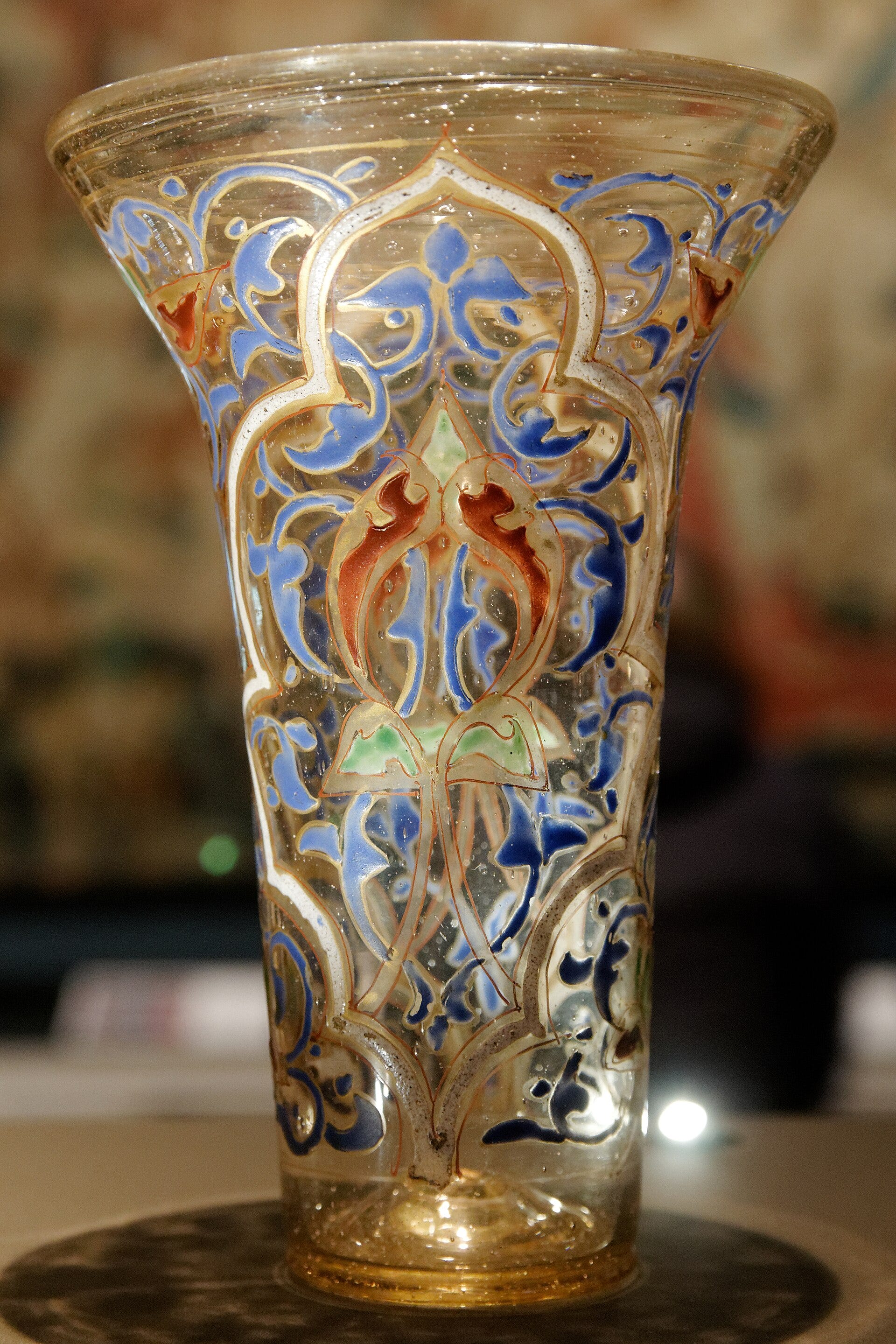
A tall beaker of clear glass widens toward its rim, painted with bands of red, blue, green and white enamel and touched with gold. The Luck of Edenhall, as it came to be called, was made in Egypt or Syria around 1350. By the 1400s at the latest it had reached England, though nobody knows how.
A case of tooled leather was made to hold it, probably in France or England, and its lid was stamped with IHS, a Greek abbreviation of the name of Jesus. On the case of a glass from a Muslim land, that Christian sign may have served as a charm to keep it from harm.
The glass belonged to the Musgraves of Edenhall, a house in Cumbria, in the north of England. In that part of the country, a "luck" was a precious vessel on which a family's fortune was believed to depend. The beaker first appears under that name in 1677, in the will of Sir Philip Musgrave.
The fairies arrived only in the 18th century, when local antiquarians collected the legend, or made it up. According to it, fairies had been drinking by St. Cuthbert's Well, next to the house, until curious onlookers disturbed them. They fled and left their cup behind.
The last of them cried out a warning: "If this cup should break or fall / Farewell the Luck of Edenhall." The rhyme was printed in 1791.
The Musgraves kept the glass at Edenhall until 1926, when they lent it to a museum in London. Soon afterward the house itself was demolished. The cup has never been broken.
At a Glance
Artist: Unknown glassmakers in Egypt or Syria
Made: About 1350 (leather case 1400 to 1500)
Medium: Glass with enameled and gilded decoration
Size: 16 cm high (6 1/4 in)
Where to see it: Victoria and Albert Museum, London
10. The Pyxis of al-Mughira (968)
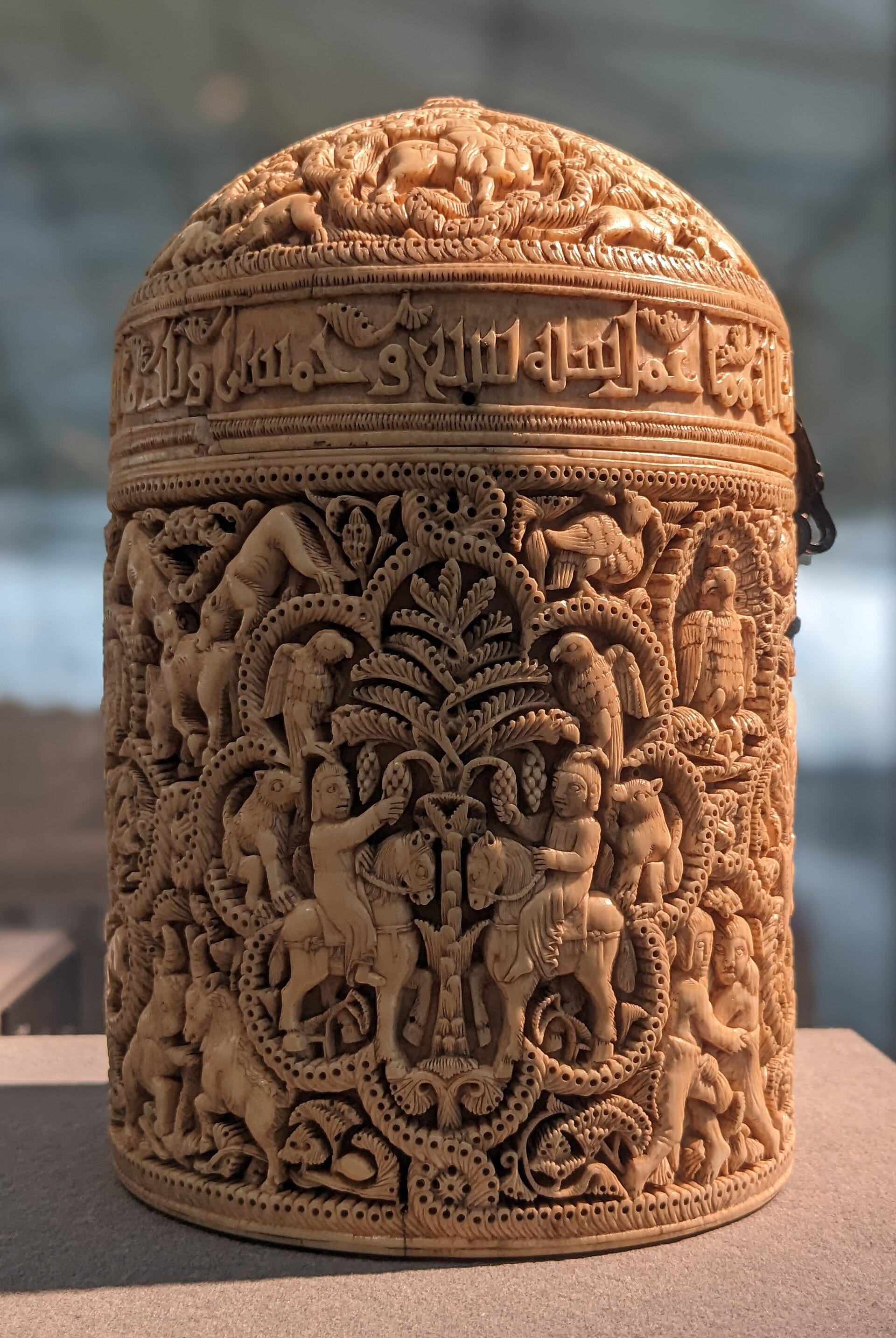
Lions sink their claws into the backs of bulls all around an ivory cylinder the height of a hand, and two men climb toward falcons' nests to steal the eggs. Around the lid, carved letters wish blessings and joy to a young man who had just turned eighteen. His father, the caliph, was dead, and his older brother ruled in his place.