
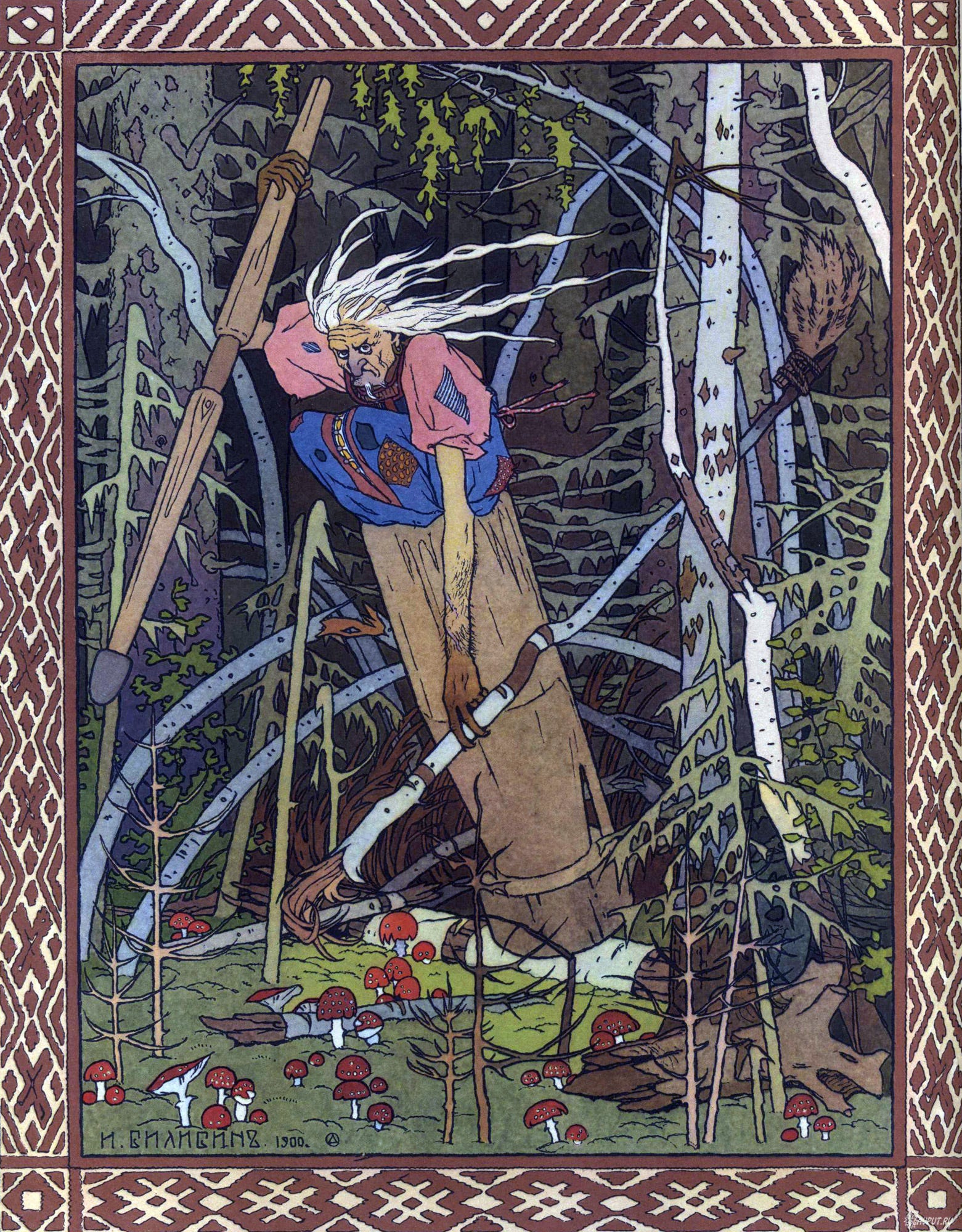
Ivan Bilibin (1876 to 1942) was a Russian illustrator and stage designer. He became famous for his pictures of Russian fairy tales, like Baba Yaga, the witch who flies over the forest in a mortar, a wooden bowl for crushing grain.
Cool Stories About Art is a newsletter to learn art the fun way.
Join 200,000+ readers and get:
10 new art stories / month
The entire archive of content (140+ articles)
Comment, ask questions, and chat with other readers
Ivan Bilibin spent his life drawing the old Russia of fairy tales, a land of tsars in golden robes, witches and magic birds. Yet in 1906, he drew the real tsar of his day, Nicholas II, as a donkey. In 1917, a revolution ended the rule of the tsars.
Ivan Bilibin was born on August 16, 1876, in Tarkhovka, a village near Saint Petersburg, then the capital of the Russian Empire. His father, Yakov Bilibin, was a doctor in the Russian navy.
Yakov Bilibin wanted his son to have a serious profession, so from 1896 to 1900, Ivan studied law at the University of Saint Petersburg. At the same time, he learned to draw with Ilya Repin, the most famous Russian painter of the day.
In the winter of 1898, in Moscow, Bilibin saw The Bogatyrs, a painting by Viktor Vasnetsov, a painter of Russian legends. It shows three knights of the old tales on horseback. Soon after, Bilibin began to draw fairy tales himself.
In the summer of 1899, in a village northwest of Moscow, Bilibin illustrated an old Russian tale, Ivan Tsarevich, the Firebird and the Gray Wolf. A tsarevich is the son of a tsar, and the Firebird is the magic bird of Russian tales.
Bilibin drew each picture in black ink, with a clean, sure line, then filled it with watercolor and set it inside an ornamented frame. His line was so steady that his colleagues nicknamed him Ivan the Iron Hand.
The publisher of the tale was unexpected: the Expedition for the Preparation of State Papers. In old Russian, an expedition could also mean a government department. This one was the printing works of the Russian state. Its presses turned out the empire's banknotes, stamps and official papers.
From 1901 to 1903, the state printing works published Bilibin's fairy tales as six slim, large picture books.
Once the tsars fell, what became of the man who had drawn one as a donkey, and of his fairy tales?
In the rest of the story
What the tsar's printing works did after Bilibin drew the tsar as a donkey.
Why an opera about a lazy tsar and a golden rooster alarmed the censors.
Which Russian institution still uses an emblem Bilibin drew in 1917.
Where Bilibin's fairy tales turned up again, 27 years after his death.