
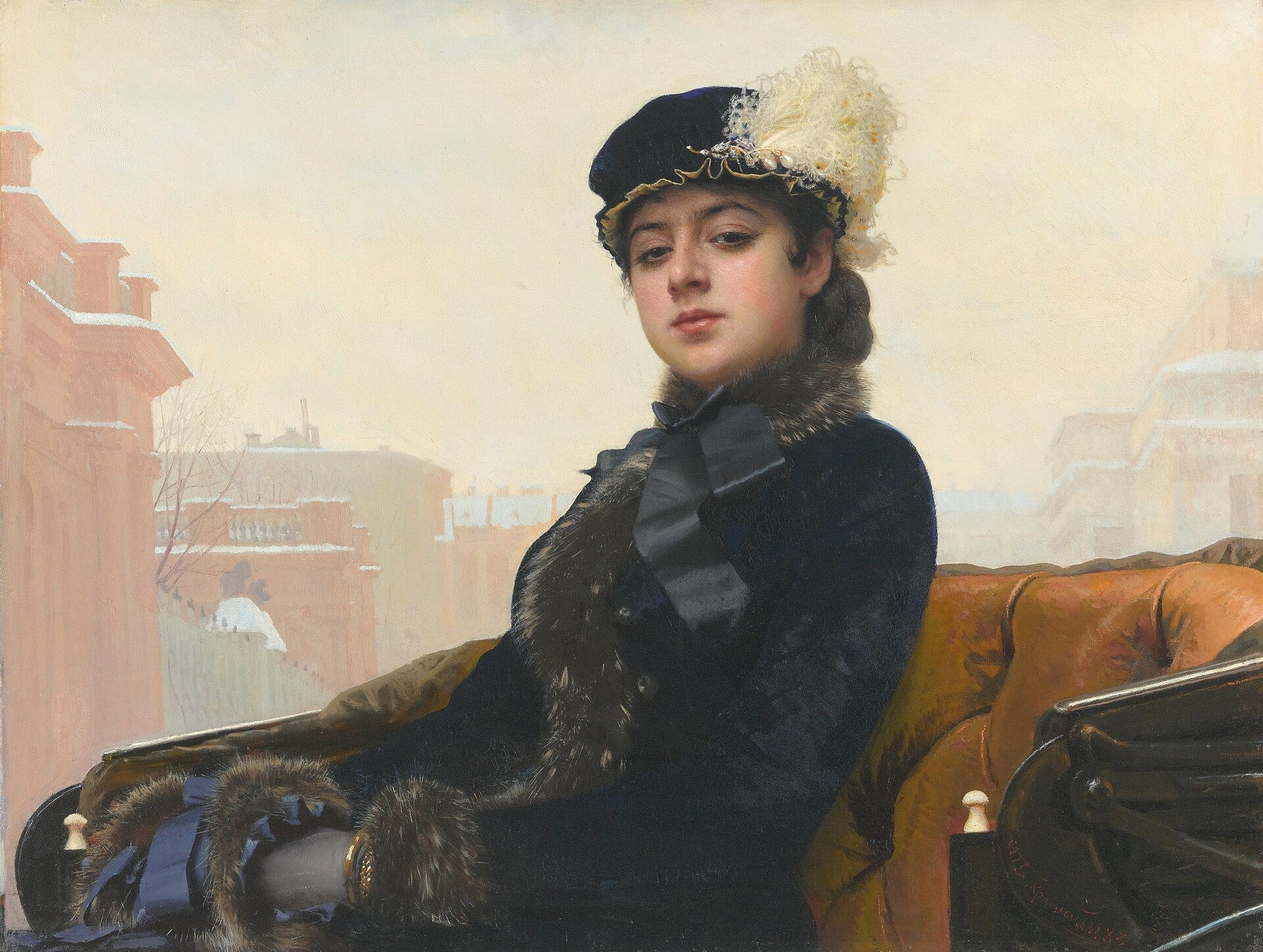
Ivan Kramskoi (1837 to 1887) was a Russian painter who helped found the Wanderers, artists who took their exhibitions from city to city. He is best known for Christ in the Wilderness and Unknown Woman, a young woman in an open carriage.
Cool Stories About Art is a newsletter to learn art the fun way.
Join 200,000+ readers and get:
10 new art stories / month
The entire archive of content (140+ articles)
Comment, ask questions, and chat with other readers
Ivan Kramskoi painted many portraits to order, even one of Tsar Alexander III, the emperor of Russia. Yet nobody ordered the two pictures that made his name. Since his student days, Kramskoi had fought for the right to choose his own subjects.
Kramskoi was born in 1837 in Ostrogozhsk, a small town in southern Russia. His father, a town hall clerk, died when Ivan was about twelve, and the boy became a copyist there, writing out official papers.
At about fifteen, Ivan joined an icon painter, a maker of holy images for churches, in the nearby city of Voronezh. The master had him carry water and wash pots, never paint.
Back in Ostrogozhsk, Mikhail Tulinov, a local amateur artist, taught Ivan to retouch photographs. A retoucher went over each black-and-white print with a brush and watercolor to hide flaws.
In 1853, Ivan left with a traveling photographer from Kharkov, today Kharkiv, in Ukraine. By 1857, the best photographers of St. Petersburg, then the capital of Russia, called him "the god of retouching."
That year, Kramskoi entered the Imperial Academy of Arts, the state school that trained the empire's painters. Its top prize, the grand gold medal, paid for six years of study in Italy.
In 1863, as the Academy prepared for its hundredth anniversary, its Council of professors changed the rules of the grand gold medal competition. Every candidate, whatever he usually painted, would work on one subject chosen by the Council.
Fourteen painters, Kramskoi among them, were in the running. They asked twice, in writing, to choose their own subjects, and got no answer.
Konstantin Thon, an architect on the Council, told some of them that in earlier times they would all have been sent off as soldiers.
The competition was set for November 21, 1863. Kramskoi had a lot to lose: three weeks earlier, he had married Sofia Prokhorova, and their son was two weeks old.
What would Kramskoi give up for the right to choose what he painted?
In the rest of the story
What Kramskoi carried, folded in four, into the Council's hall.
What a shocked visitor shouted in front of Christ in the Wilderness.
What the clothes of the woman in the carriage told visitors in 1883.
Who was posing for Kramskoi on the last day of his life.