
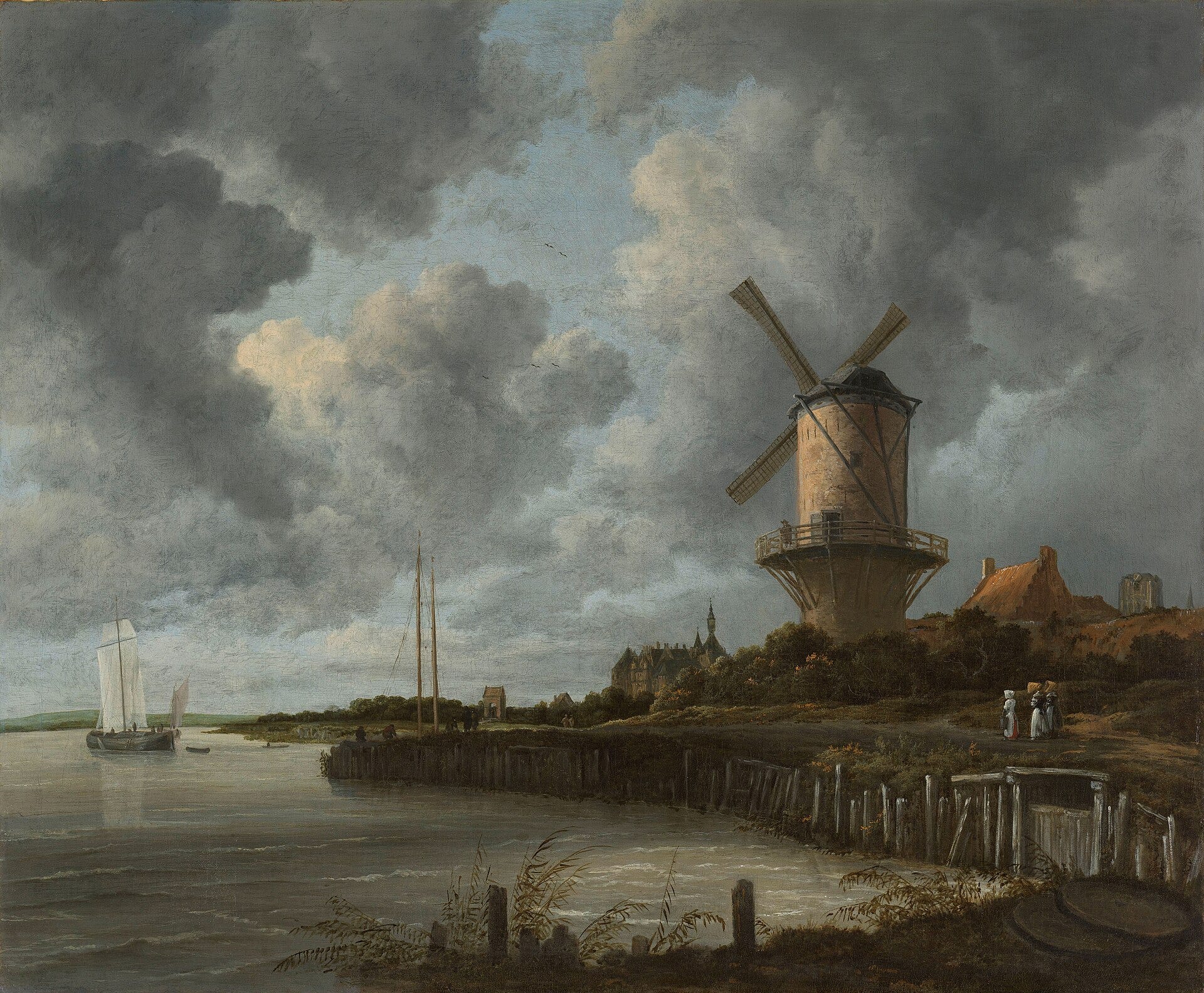
Jacob van Ruisdael (1628 or 1629 to 1682) was one of the greatest Dutch landscape painters. He painted dunes, forests and windmills under stormy skies, like The Windmill at Wijk bij Duurstede, at the Rijksmuseum in Amsterdam, and The Jewish Cemetery, in Detroit.
Cool Stories About Art is a newsletter to learn art the fun way.
Join 200,000+ readers and get:
10 new art stories / month
The entire archive of content (140+ articles)
Comment, ask questions, and chat with other readers
Jacob van Ruisdael spent almost his whole life in one of the flattest countries in Europe, and he painted its dunes, trees and windmills with great exactness. Yet in several of his best-known pictures, real buildings and real graves stand in landscapes that never existed.
Ruisdael was born in Haarlem, a town of the Dutch Republic, today's Netherlands. Haarlem lies just west of Amsterdam, between the dunes of the North Sea coast and wide, flat fields.
Jacob's father, Isaack, made picture frames and also painted and sold pictures. The best-known painter of the family was Isaack's brother, Salomon, a landscape painter who spelled the family name Ruysdael, with a "y."
Salomon probably trained his nephew, and the dunes and rivers of the uncle's pictures come back in Jacob's first paintings. Jacob's earliest dated works are from 1646, when he was seventeen or eighteen.
In 1648, Jacob joined the Guild of Saint Luke in Haarlem, the association of the town's painters, which gave members the right to sell pictures. That same year, he signed and dated Dunes by the Sea, now at the National Gallery of Art in Washington.
In Dunes by the Sea, a dune of grass and sand rises from the shore, with broken trunks covered in ivy and a brick wall climbing its side. Ruisdael saw dunes like this one every day around Haarlem, and he painted them as they stood.
In the summer of 1650, Ruisdael crossed into Germany, just east of the Dutch border, and saw Bentheim Castle. The castle stands on a low hill, barely higher than the plain around it.
Back in Haarlem, Ruisdael painted Bentheim Castle about a dozen times. In one version, dated 1653, the low hill has become a tall mountain covered with forest.
If a low hill could become a mountain, what in Jacob van Ruisdael's famous landscapes was really there, and what did he build himself?
In the rest of the story
Whose real graves appear in one of Ruisdael's best-known paintings.
Where the waterfalls of a painter from a flat country came from.
What Ruisdael changed in his most famous windmill.
Which false story about Ruisdael's death was told for sixty years.