
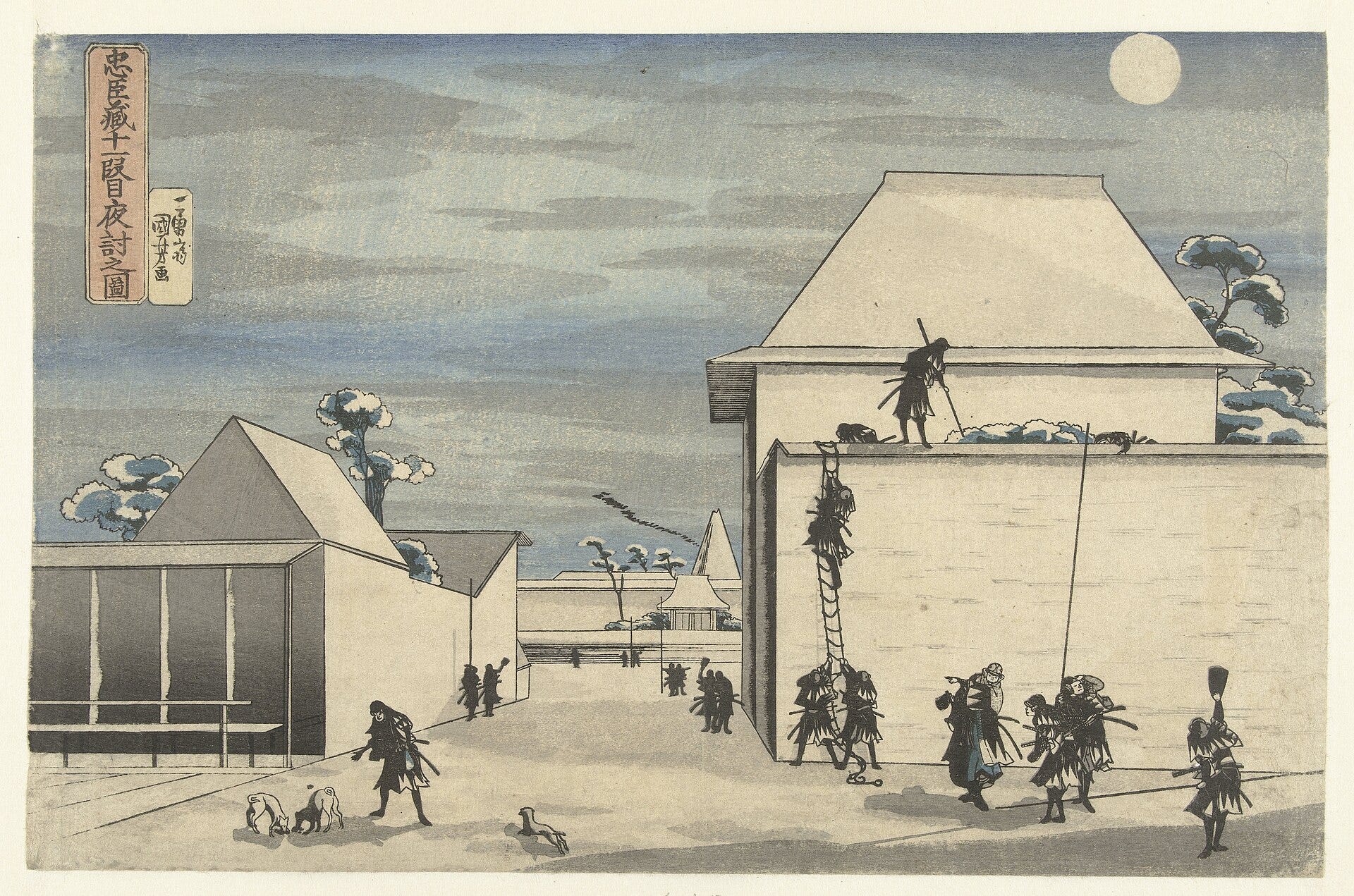
In many Japanese snow prints, nobody printed the snow. It is the paper itself, left bare while carved wooden blocks laid ink and color all around it. The artists who designed these cheap sheets for the shoppers of Edo, the city now called Tokyo, found that this untouched white could hold far more than winter weather, including one of the most famous nights of revenge in Japanese history.
Cool Stories About Art is a newsletter to learn art the fun way.
Join 200,000+ readers and get:
10 new art stories / month
The entire archive of content (140+ articles)
Comment, ask questions, and chat with other readers
Snow Made of Paper
A Japanese woodblock print was the work of a team. An artist drew the design, a carver cut it into wood, one block for each color, and a printer pressed the paper onto the inked blocks by hand. A publisher paid for all of it and sold the sheets.
The buyers were the townspeople of Edo, who paid about as much for a print as for a bowl of noodles. Snow suited the craft because it needed no ink. The bare paper was enough, and sometimes a block pressed with no color raised it in relief.
The selection spans the 1760s, when full color reached Edo, to the 1920s, when Tokyo printed for buyers abroad. In each print, snow carries the scene, and the way the artist made it on paper is part of the story.
12. Utagawa Kuniyoshi, Nichiren in the Snow at Tsukahara (about 1835)
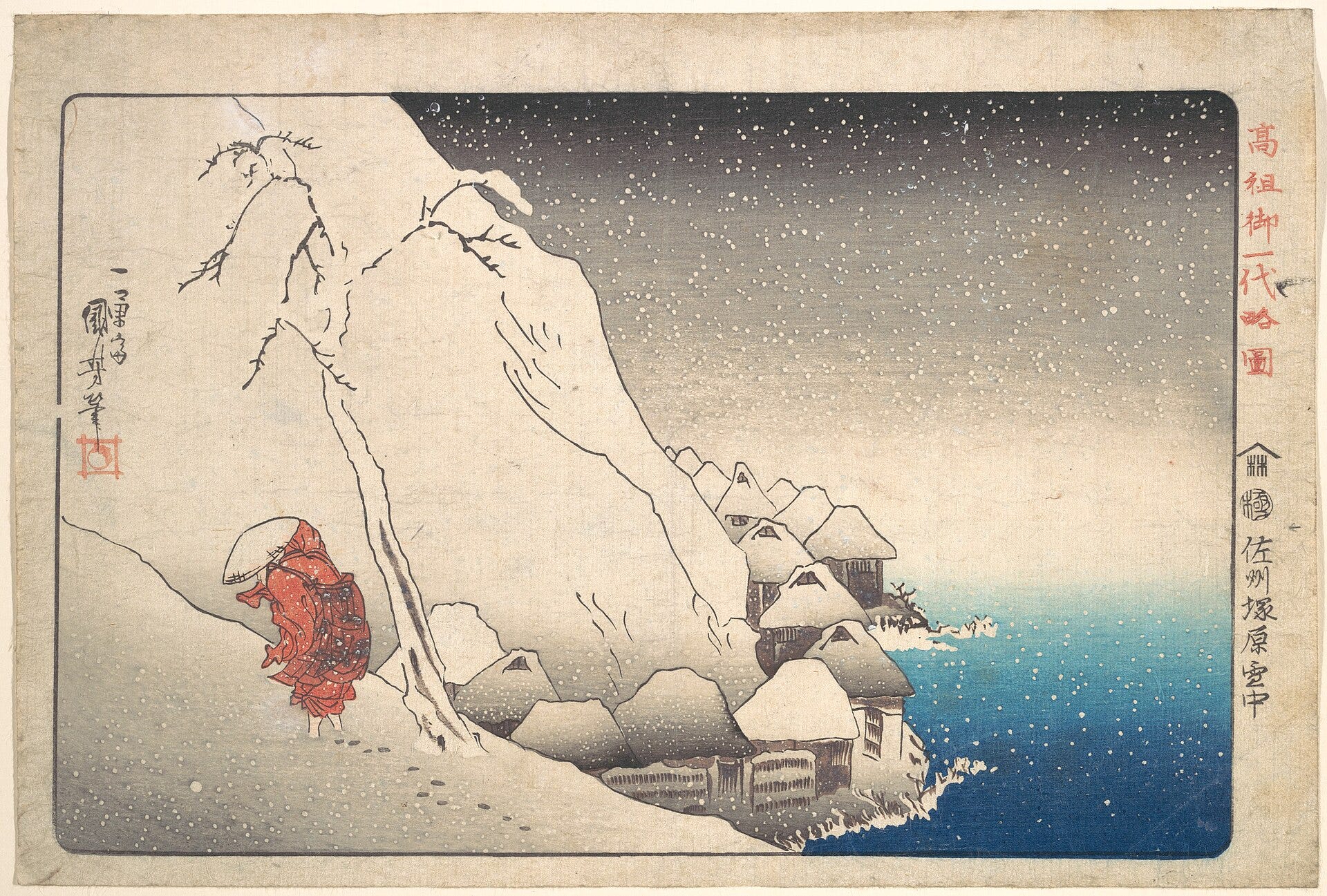
A small figure in a red robe climbs a white slope, bent forward under the falling snow. Below him, the roofs of a village are half buried. The climber is Nichiren, a Buddhist monk of the thirteenth century, and the island he is crossing is his place of exile.
His exile began with his preaching. Nichiren founded the school of Buddhism that still carries his name, and his attacks on the other schools made him powerful enemies. In 1271 he was arrested and condemned to death. The sentence was lifted at the last moment, and a legend retold for centuries says that rays of light broke the executioner's sword.
Instead of dying, he was sent to Sado, an island in the Sea of Japan, where he arrived at the start of winter. He was lodged at Tsukahara, in a small hall inside a graveyard, and there, in the snow of early 1272, he wrote one of his major works, The Opening of the Eyes. He stayed on the island until a pardon came in the spring of 1274.
Nearly six centuries later, the story reached the print shops of Edo. Utagawa Kuniyoshi, a designer best known for his warriors and heroes, told Nichiren's life in a set of ten prints, Sketches of the Life of the Great Priest, published around 1835. The scene at Tsukahara is often called the finest sheet of the set.
Its strength lies in how little Kuniyoshi colors. The red of the robe is the only strong note, so the eye finds the exile before anything else, and the snow does the rest. It turns the hills and the roofs into the same white and covers every path around the monk, leaving the village below as the only sign that anyone else lives on the island.
At a Glance
Artist: Utagawa Kuniyoshi (1797 to 1861)
Made: About 1835
Medium: Color woodblock print, ink and color on paper
Size: 22.5 × 34.5 cm (8 7/8 × 13 5/8 in), image without margins
Where to see it: The Metropolitan Museum of Art, New York
11. Suzuki Harunobu, Two Lovers Beneath an Umbrella in the Snow (about 1767)
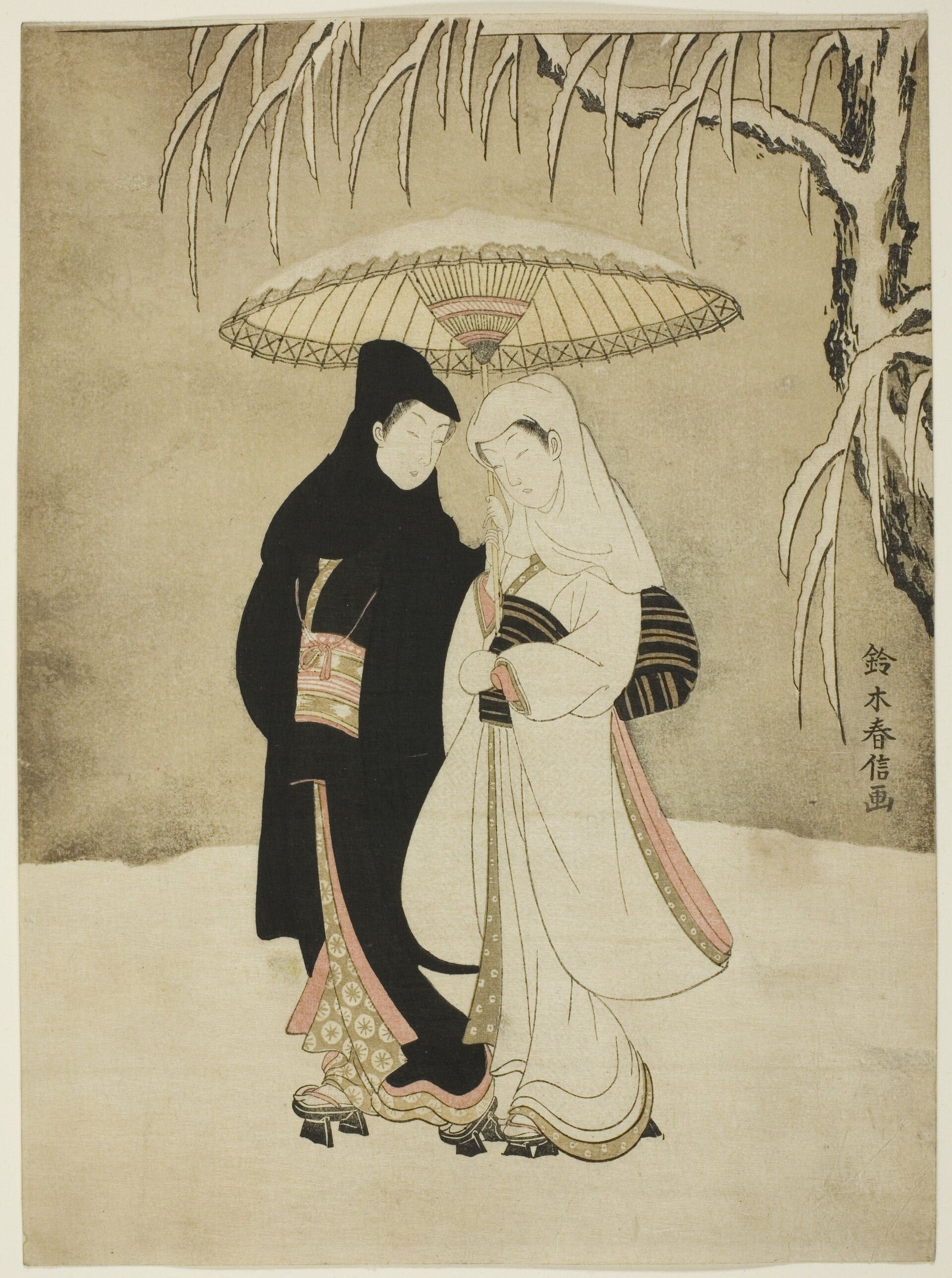
Two young people walk through falling snow under a single umbrella, close enough for their sleeves to touch. One wears black, the other white. Buyers in Edo knew couples like these from the theater, and they knew where such walks usually led.