
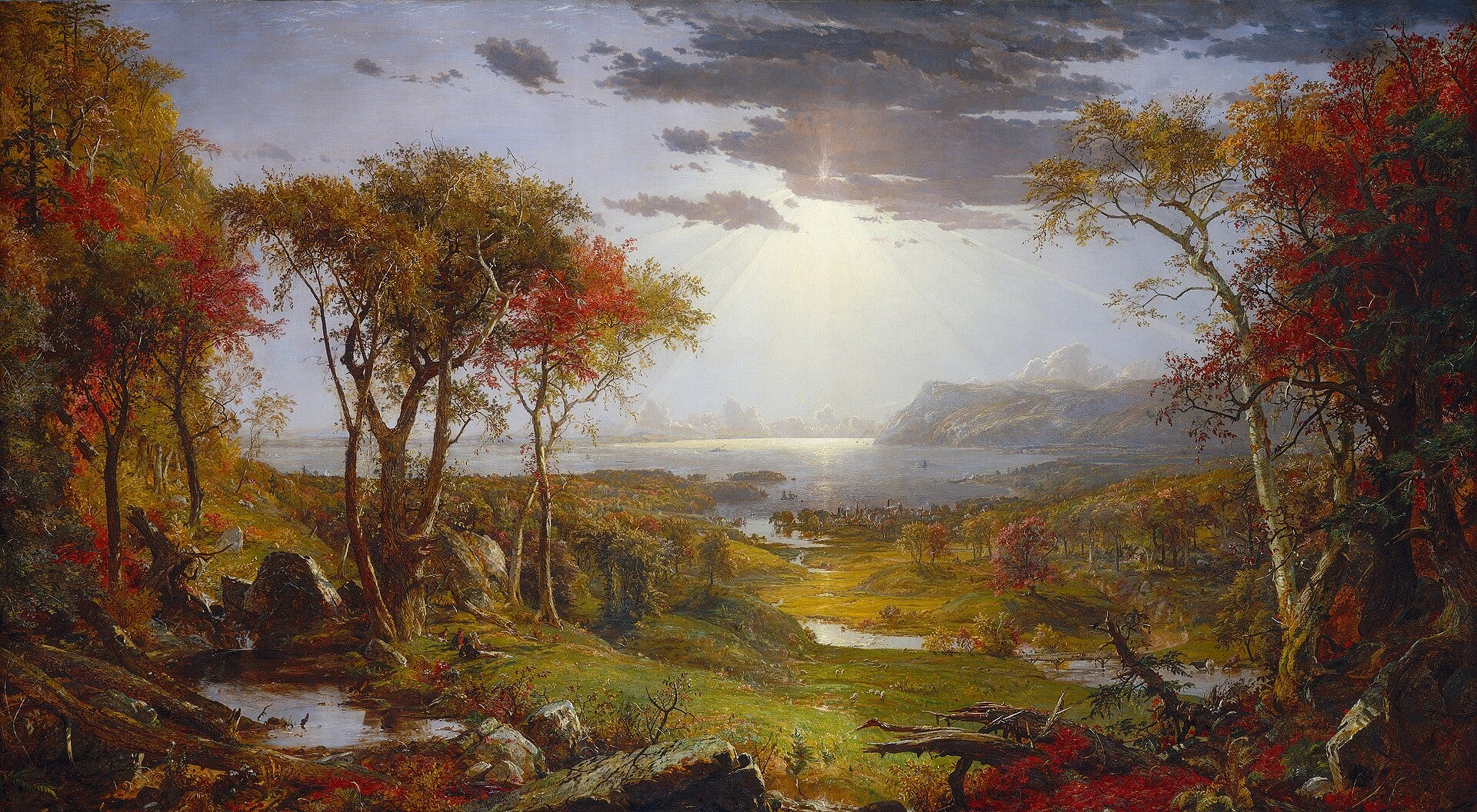
Jasper Francis Cropsey (1823 to 1900) was an American architect and landscape painter. He painted the forests, lakes and rivers of the Northeast in their fall colors, as in Autumn, on the Hudson River, now at the National Gallery of Art in Washington.
Cool Stories About Art is a newsletter to learn art the fun way.
Join 200,000+ readers and get:
10 new art stories / month
The entire archive of content (140+ articles)
Comment, ask questions, and chat with other readers
Jasper Francis Cropsey painted the view above, the Hudson River in autumn, in 1860, from memory, in a studio in London, more than three thousand miles from the river. The man who brought an American autumn to London had been trained, as a boy, to design houses.
Cropsey was born on February 18, 1823, on his father's farm at Rossville, a village on Staten Island, in New York Harbor. The oldest of eight children, he was often sick, and he taught himself to draw and to build small wooden models of buildings.
In 1837, at about fourteen, the boy sent one of his model houses to the fair of the Mechanics' Institute of New York, a society of craftsmen and builders, and won a diploma. Around Rossville, neighbors called him "the boy that built the house."
That same year, Joseph Trench, an architect in Manhattan, took him on as an apprentice, a beginner who learns a trade by working in an office. Trench gave him a studio and art supplies, and the apprentice ended up making all the finished drawings of the firm's projects.
In Trench's office, Cropsey also took up oil painting. He admired Thomas Cole, the most famous American landscape painter of the day, and went to study Cole's canvases at the National Academy of Design, the society of New York artists, which held an exhibition every year.
By twenty, the young man had his own architecture office and had designed a church for the Moravians, a small Protestant community, on Staten Island. He also began to show his own paintings at the National Academy.
In 1844, at twenty-one, Cropsey was elected an associate member of the National Academy, the first step toward full membership. After that honor, the architect put buildings aside to devote himself to landscape painting.
How did a painting of an American river, made from memory in London, convince the British that its colors were real?
In the rest of the story
What visitors in London found next to his canvas.
What happened when the American painter met Britain's queen.
What became of the 29-room house the architect designed for himself.
How long his Hudson River painting waited before coming home to America.