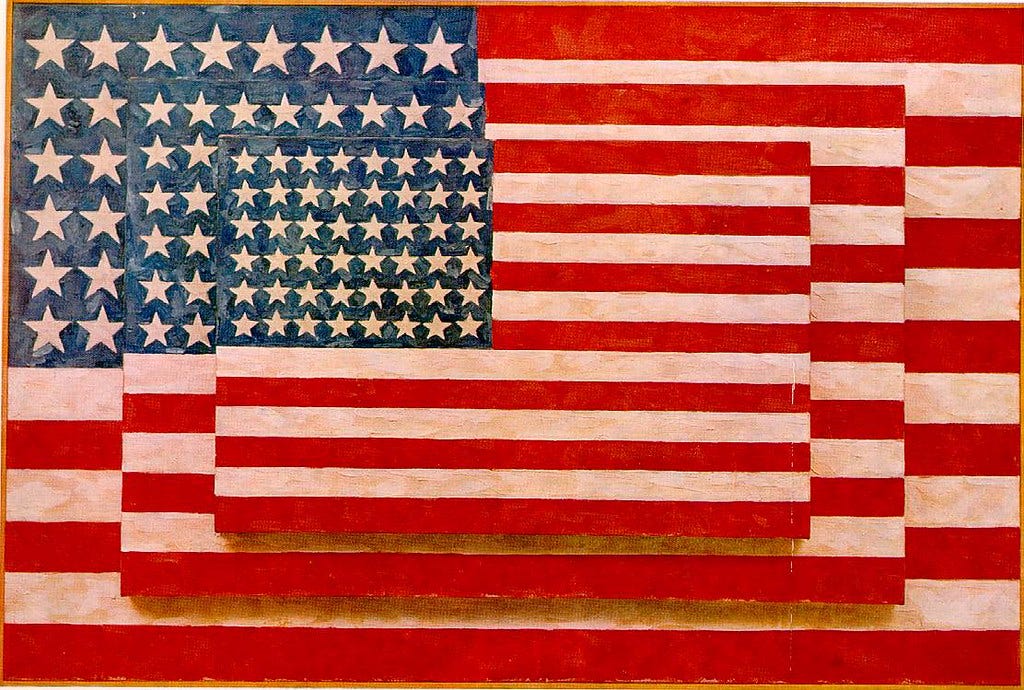
Jasper Johns: The Complete Story
Jasper Johns is the American painter who dreamed of a flag in 1954, painted it, and changed what a painting could be. Born in Georgia in 1930, he is the living bridge between Abstract Expressionism and everything after.
Is it a flag, or a painting of a flag? Seventy years on, the question still has no safe answer, which is exactly what he wanted.
Jasper Johns at a glance:
1930: born in Augusta, Georgia, and raised in small-town South Carolina, passed between relatives after his parents split.
1954: dreams of painting a large American flag and starts it the next morning, in encaustic.
1958: his first solo show at Leo Castelli nearly sells out, and the Museum of Modern Art buys three works on the spot.
1980: the Whitney pays 1 million dollars for Three Flags, then a record for a living American artist.
2011: receives the Presidential Medal of Freedom from Barack Obama, the first painter so honored since Alexander Calder.
The dream and the flag
In 1954, a young Southerner recently out of the army, Johns destroyed nearly all his early work and started over from a dream: he had painted a large American flag.
He made it real in encaustic, pigment in hot wax, over scraps of newspaper, so the surface is both the most familiar image in America and a slow, hand built painting. Flag took him into art history at 24.
1958: the show that turned the page
His first solo show, at Leo Castelli's gallery in January 1958, is one of the famous debuts of the century: flags, targets and numbers, nearly everything sold, and MoMA bought three works on the spot. Abstract Expressionism's heroic gesture suddenly had an alternative: things the mind already knows, painted so carefully you had to look again.
More incredible painter stories
If Jasper Johns pulled you in, you will love these too:
Rauschenberg, Cage, Cunningham
Through the mid 1950s Johns and Robert Rauschenberg were partners in art and life, trading ideas daily in neighbouring studios, alongside the composer John Cage and the choreographer Merce Cunningham. That quartet quietly redirected American art: away from the self, toward the found, the everyday, the already known.
The myth: the man who paints flags
Johns is filed as the flag painter, but the flags were a beginning, not a brand.
Targets, stencilled numbers, maps of the states, crosshatch fields in the 1970s, the haunted Regrets and Seasons series later: each decade he changed subject while keeping the same question, how does an image mean.
He also became modern printmaking's greatest practitioner, with the lithographs and etchings to match the paintings.
Records and medals
His False Start of 1959 sold privately in 2006 for a reported 80 million dollars, then the highest price for a living artist, and a Flag changed hands for around 110 million in 2010.
In 2011 Barack Obama gave him the Presidential Medal of Freedom, the first painter or sculptor so honoured since Alexander Calder in 1977.
In 2021 the Whitney and the Philadelphia Museum ran a double retrospective, Mind/Mirror, across two cities at once.
Where to see Jasper Johns
MoMA in New York hangs Flag and Target with Four Faces; the Whitney and the Philadelphia Museum hold him in depth. Now in his nineties, Johns still works in Sharon, Connecticut, the last giant of his generation at the easel.
Targets, numbers, maps: things the mind already knows
Johns said he picked subjects the mind already knows, flags, targets, stenciled numbers, so the looking could happen on other levels. You never stop to ask what a target is.
The target paintings came right after the flag, some topped with hinged wooden boxes holding plaster casts of faces and body parts. Critics found the boxes disturbing, which was fair.
The number and alphabet paintings stack 0 through 9, or A through Z, on a single canvas until the figures blur into gray weather.
The maps arrived in 1961: the American states painted loose and dripping, each name stenciled roughly where it belongs. Familiar shape, unfamiliar handling, and the gap between the two is the subject.
The ale cans and the coffee can
In 1960 Johns heard that Willem de Kooning had grumbled about the dealer Leo Castelli: give that man two beer cans and he could sell them. So Johns cast two cans of Ballantine ale in bronze, painted the labels by hand, and Castelli sold them.
Painted Bronze is the joke that outlived the joke. One can is opened and empty, the other sealed and full, and people have argued about that asymmetry for sixty years.
He gave the same treatment to the Savarin coffee can that held his turpentine-soaked brushes. It became his stand-in self-portrait: the tools, never the face.
The Seasons, and what a shadow admits
For thirty years Johns kept himself out of his pictures. Then in 1985 and 1986 he painted The Seasons, four canvases that each carry the same traced human shadow. The shadow is his own.
The late work kept letting personal things in: a tracing from the Isenheim Altarpiece, the floor plan of his grandfather's house in Allendale, a ladder, a length of string, the Big Dipper.
In 2012 he began the Regrets paintings, working from a torn, creased photograph of the young Lucian Freud. The title comes from a rubber stamp Johns had made for declining invitations.
The Jasper Johns questions that keep coming up
What is he known for? Flags, targets, numbers and maps, painted as things the mind already knows.
Why did he paint the flag? It came to him in a dream in 1954; he painted it the next day and kept going.
What is encaustic? Pigment suspended in hot wax, the ancient technique that gives his surfaces their skin.
Is he still alive? Yes, born in 1930, still working in Connecticut in his nineties.
How much does a Jasper Johns cost? False Start reportedly changed hands privately for about 80 million dollars in 2006, and Flag was reported near 110 million in 2010. Museum-grade Johns almost never reaches auction.
Where does he work? In Sharon, Connecticut. Born in 1930, he kept painting, printing and reworking his old motifs into his nineties.
More secrets to unlock
The painting once too hot for MoMA
When the Medal of Freedom citation was read at the White House in 2011, it noted that Flag had once been considered too controversial for MoMA to buy directly; a trustee bought it and gave it later. The painting once too hot for the museum is now the museum's front page.