
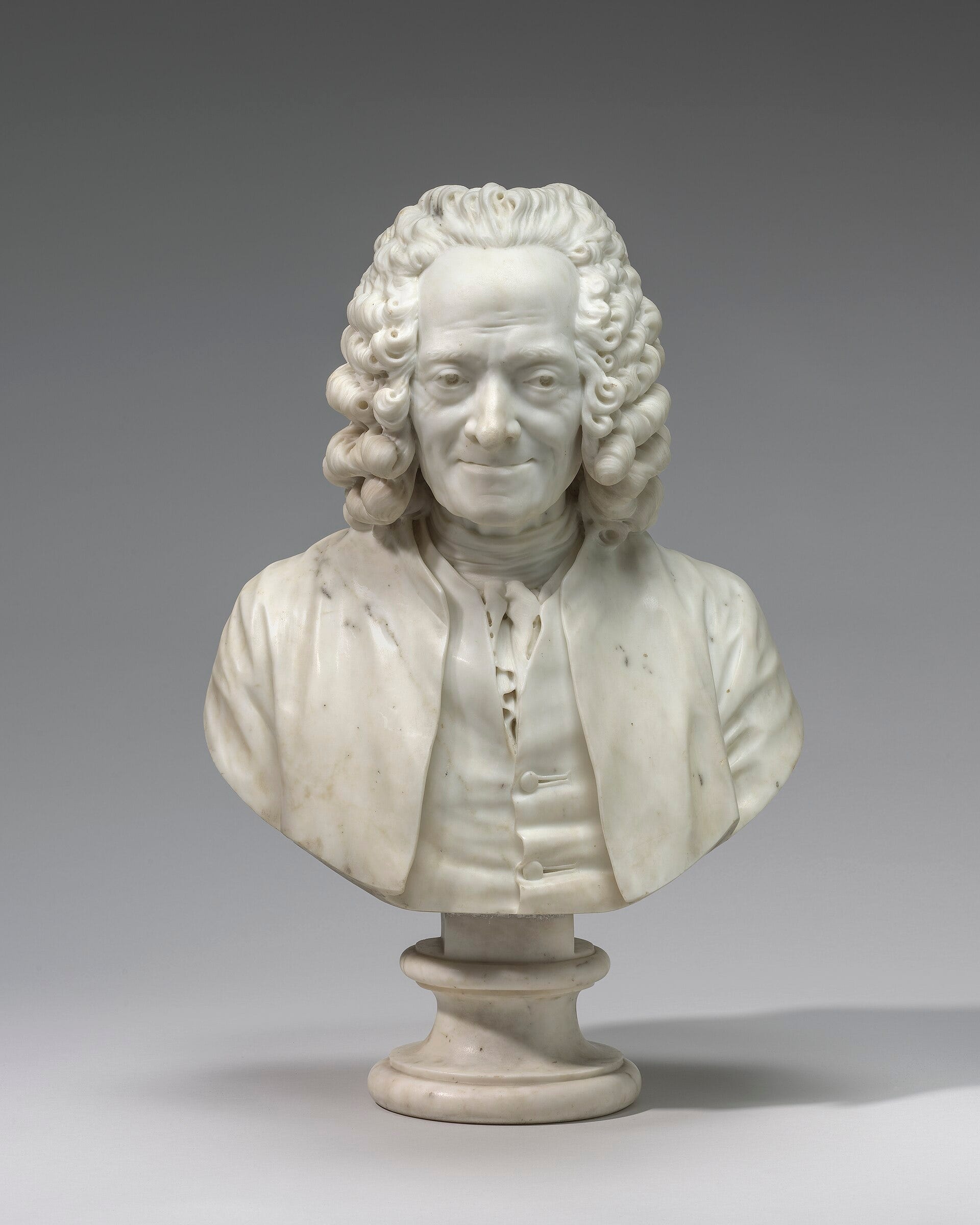
Jean-Antoine Houdon (1741 to 1828) was a French sculptor, famous for his marble portraits of the great men of his time, like his bust of Voltaire. His statue George Washington still stands in the Virginia State Capitol in Richmond.
Cool Stories About Art is a newsletter to learn art the fun way.
Join 200,000+ readers and get:
10 new art stories / month
The entire archive of content (140+ articles)
Comment, ask questions, and chat with other readers
Jean-Antoine Houdon spent only two weeks with George Washington, in October 1785, at Mount Vernon, Washington's home in Virginia. He never went back to America. Yet bronze copies of the statue that came out of those two weeks now stand from New York City Hall to Los Angeles.
Houdon was born on March 20, 1741, in Versailles, the town built around the palace of the kings of France. His father, Jacques Houdon, was a servant who later became caretaker of a house in Paris.
That house became a school in 1749 for the best young students of the Royal Academy, the king's school of painters and sculptors. The boy grew up among the students' studios and began to sculpt at about nine.
At twenty, in 1761, Houdon won the Prix de Rome, the Academy's great contest, and with it a stay in Rome at the king's expense. After three more years at the school where he grew up, he left in 1764 and stayed four years.
In Rome, Houdon modeled an écorché, a standing man without skin, every muscle bare. The figure made him famous at once, and plaster copies taught anatomy in drawing schools for generations.
Back in Paris in 1768, Houdon became the sculptor of famous faces. In 1771, he showed a bust of Denis Diderot, the writer who led the Encyclopédie, a huge dictionary of all knowledge. Houdon left Diderot without a wig, although gentlemen in Paris wore one in public.
Voltaire, the most famous writer in Europe, came to pose in Houdon's studio in 1778, at eighty-three. That same year, Houdon carved Benjamin Franklin, the American inventor of the lightning rod, then in Paris as an envoy of the United States.
The lawmakers of Virginia voted in 1784 for a statue of George Washington, the general who had led the American War of Independence. The task went to Houdon, who had never seen Washington.
A painted portrait of Washington was to serve as the sculptor's model, but Houdon refused to copy it and offered to cross the ocean instead.
What did Houdon carry home from Virginia that the painting could never have given him?
In the rest of the story
Why a six-year-old girl was frightened to find Washington lying on a table.
What Washington replied when asked if his statue should wear a Roman toga.
What Houdon did with a saint's statue to survive the French Revolution.
Which object in American pockets still carries Houdon's work.