
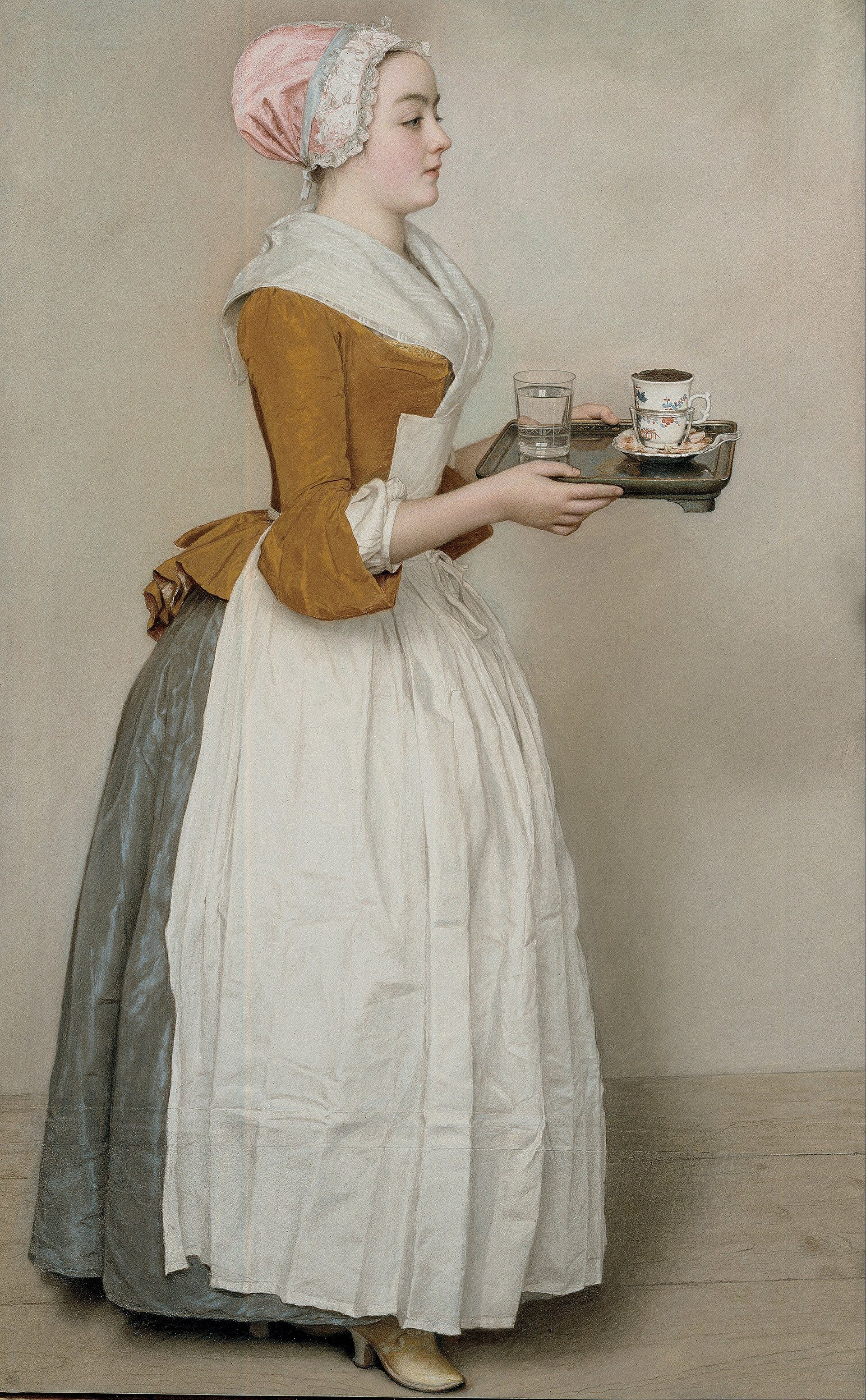
Jean-Étienne Liotard (1702 to 1789) was a Geneva portrait painter who worked mostly in pastel, sticks of powdered color. He drew Empress Maria Theresa of Austria and the French king's daughters, yet his most famous picture shows a maid: The Chocolate Girl, in Dresden, Germany.
Cool Stories About Art is a newsletter to learn art the fun way.
Join 200,000+ readers and get:
10 new art stories / month
The entire archive of content (140+ articles)
Comment, ask questions, and chat with other readers
Jean-Étienne Liotard believed that a portrait should show a face exactly as it was, with no flattery and no visible trace of the painter's hand. In 1762, he printed the rule in a Paris magazine: "Nature has no touches," meaning that nothing in nature shows the mark of a brush.
Yet for years, the same painter went around Europe in an Ottoman robe and a fur hat, with a beard that reached his waist. The Ottoman Empire, whose capital was Constantinople, today's Istanbul, then stretched across southeastern Europe, western Asia and North Africa.
On a portrait of himself, Liotard wrote that he was "nicknamed the Turkish painter." Europeans of his time called almost everything from the Ottoman Empire "Turkish."
The man behind the nickname was born on December 22, 1702, in Geneva, then a small independent republic and today a city of Switzerland. His parents were Huguenots, French Protestants who had fled France after King Louis XIV outlawed their religion in 1685.
Young Liotard trained for only four months with a Geneva painter of miniatures, tiny portraits that people carried with them. In 1723, at 20, he left for Paris.
Nine years later, Liotard entered the contest of the Royal Academy of Painting in Paris, the official society of French artists, whose winners were sent to study in Rome. He won nothing.
Three years later, Liotard reached Italy anyway, with the French ambassador to the kingdom of Naples. After a few months there, he moved to Rome and worked in pastel, rubbed straight onto paper. Pastel needs no brush, so it leaves no brushstroke.
In a coffee house in Rome, Liotard met two British lords on the Grand Tour, the long journey through Italy that finished the education of rich young men. They were William Ponsonby, Viscount Duncannon, and John Montagu, Earl of Sandwich, the lord who later gave his name to the sandwich.
Lord Sandwich wanted pictures of the clothes people wore in every country on the lords' route, and he took Liotard into his service to draw them.
On April 3, 1738, Liotard sailed from Naples with Duncannon toward the eastern Mediterranean. He went on drawing for Lord Sandwich until September 1738. Later that year, the painter reached Constantinople, where he stayed about four years.
Why would a painter who showed every face exactly as it was keep wearing Ottoman clothes for years after leaving the Ottoman Empire?
In the rest of the story
What an English writer predicted the robe would bring the painter.
What the first buyer of The Chocolate Girl compared it to.
What the painter lost just before his wedding at 53.
What Empress Maria Theresa carried with her on every journey.