
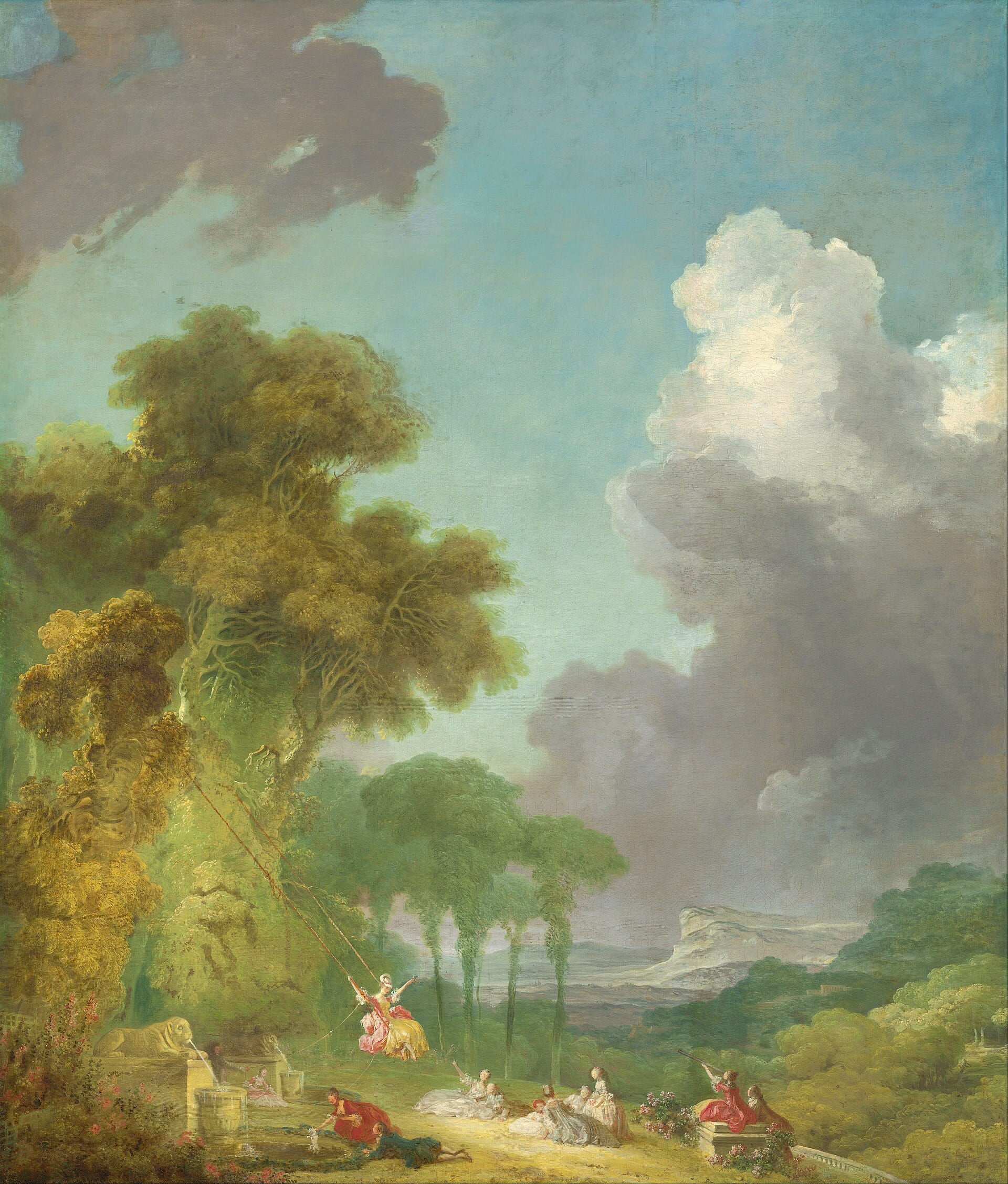
Jean-Honoré Fragonard was a French painter, born in Grasse in 1732 and dead in Paris in 1806, who painted the most famous swing in art. The Swing, made around 1767 for a courtier who wanted his mistress pushed through the air, is the one picture most people know.
Fragonard trained under Boucher, won the Prix de Rome, lost his patrons to the Revolution, and ended his life as a museum official, nearly forgotten.
The picture is smaller than its fame suggests, 81 by 64 centimetres, made for a private room and not for a public wall. Its title appears in writing only in 1782, on an engraving.
Cool Stories About Art is a newsletter to learn art the fun way.
Join 200,000+ readers and get:
10 new art stories / month
The entire archive of content (1,000+ articles)
Comment, ask questions, and chat with other readers
The story of how it came to exist survives in one place, the journal of the songwriter Charles Collé, who wrote it down in October 1767.
A gentleman of the court, he reported, had first gone to the painter Gabriel-François Doyen, who had just made his name at the Salon with a religious picture of Saint Geneviève. The gentleman wanted his mistress painted on a swing, pushed by a bishop, with himself placed where he could see her legs.
Doyen was so startled that he passed the job to Fragonard, who was already at work on it, Collé says, by the time the tale reached him. Everything known about the commission comes from Collé, who had it from Doyen, so the story was told twice before anyone wrote it down. And Collé never gave the gentleman's name.
That gap matters, because books often name him as a baron called Saint-Julien. The Wallace Collection, which owns the painting, calls that identification an assumption. As for the bishop, the older man on the right wears blue, not black, as the cleaning of 2021 confirmed. That figure will matter later.
What You'll Discover
Where a garden taught him to draw.
The ceiling he never began.
Who is really pushing the swing.
Why a king's favorite sent them back.
What the label on the back says.
Who found him work in the Revolution.