
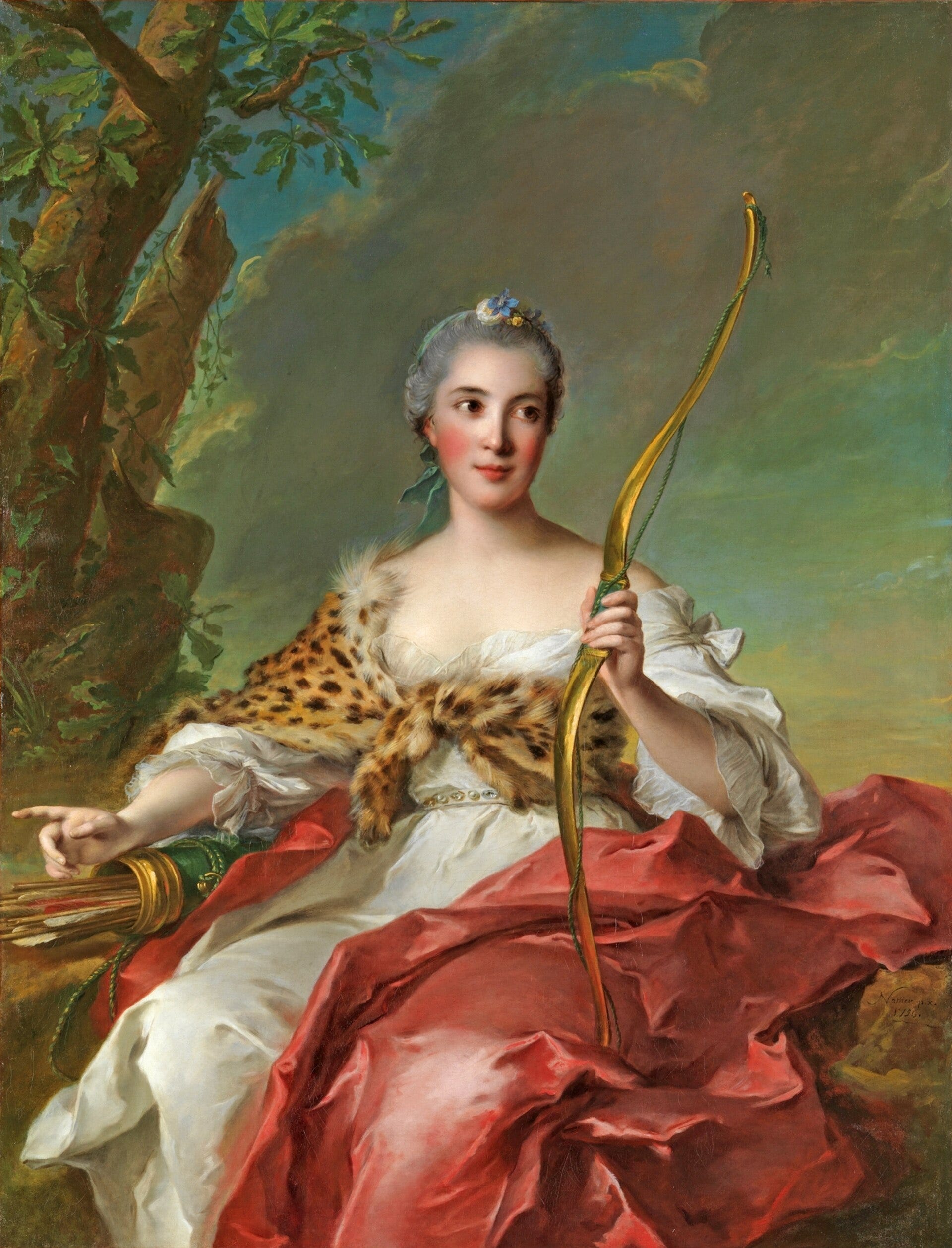
Jean-Marc Nattier (1685 to 1766) was a French painter at the court of King Louis XV. He is famous for portraits of the king's daughters and of Paris ladies, like Madame Bergeret de Frouville as Diana, at the Metropolitan Museum of Art in New York.
Cool Stories About Art is a newsletter to learn art the fun way.
Join 200,000+ readers and get:
10 new art stories / month
The entire archive of content (140+ articles)
Comment, ask questions, and chat with other readers
As a young man, Nattier wanted to paint gods and heroes. At the Royal Academy, the official society of the king's painters, big scenes from myths, the Bible and ancient history were called history painting. They ranked above every other kind of picture, portraits included.
In 1709, twenty-four-year-old Jean-Marc Nattier was offered a place, as a pupil paid by the king, at the French Academy in Rome. King Louis XIV sent his best young artists there to copy ancient statues and the paintings of the Italian master Raphael. Jean-Marc said no.
He had been born in Paris on March 17, 1685, the second son of a family of painters. His father, Marc, painted portraits and belonged to the Royal Academy. His mother painted miniatures, portraits small enough to hold in one hand.
His uncle, Jean Jouvenet, was one of the leading history painters in Paris, known for his large religious scenes. In 1700, at fifteen, Jean-Marc won the Academy's first prize for drawing.
The reason for his refusal was a job. In his late teens, he had begun to copy the 24 large canvases that Peter Paul Rubens, a painter from Flanders, in today's Belgium, painted in the 1620s for the Luxembourg Palace in Paris. They told the life of Marie de' Medici, queen of France, among gods and heroes.
Jean-Marc drew them with his father and his older brother, Jean-Baptiste, for engravers. An engraver copied each drawing onto a copper plate, which could print hundreds of copies. In 1709, the engravers were pressing him to finish.
Jean-Baptiste had studied at the school in Rome from 1704 to 1709. Jean-Marc stayed in Paris and kept drawing. In 1710, the drawings came out as a giant book of prints, about two feet tall, dedicated to Louis XIV. The book made Jean-Marc famous.
Jean-Baptiste, back from Rome, had been received at the Academy in 1712 as a history painter, the rank his brother wanted. Jean-Marc never forgave himself for missing the king's school for painters of gods and heroes.
So could Nattier, without Rome, still become a painter of gods and heroes?
In the rest of the story
Which foreign emperor Nattier dared to say no to.
What Nattier really got for his Rubens drawings in 1719.
Why Louis XV sent Nattier far from Paris to paint three of his daughters.
The cruel line a famous writer wrote about the old Nattier.