
Jean-Siméon Chardin was a French painter, born in Paris in 1699, who died there in 1779 after a career spent painting kitchen tables, copper pots, game and children at play.
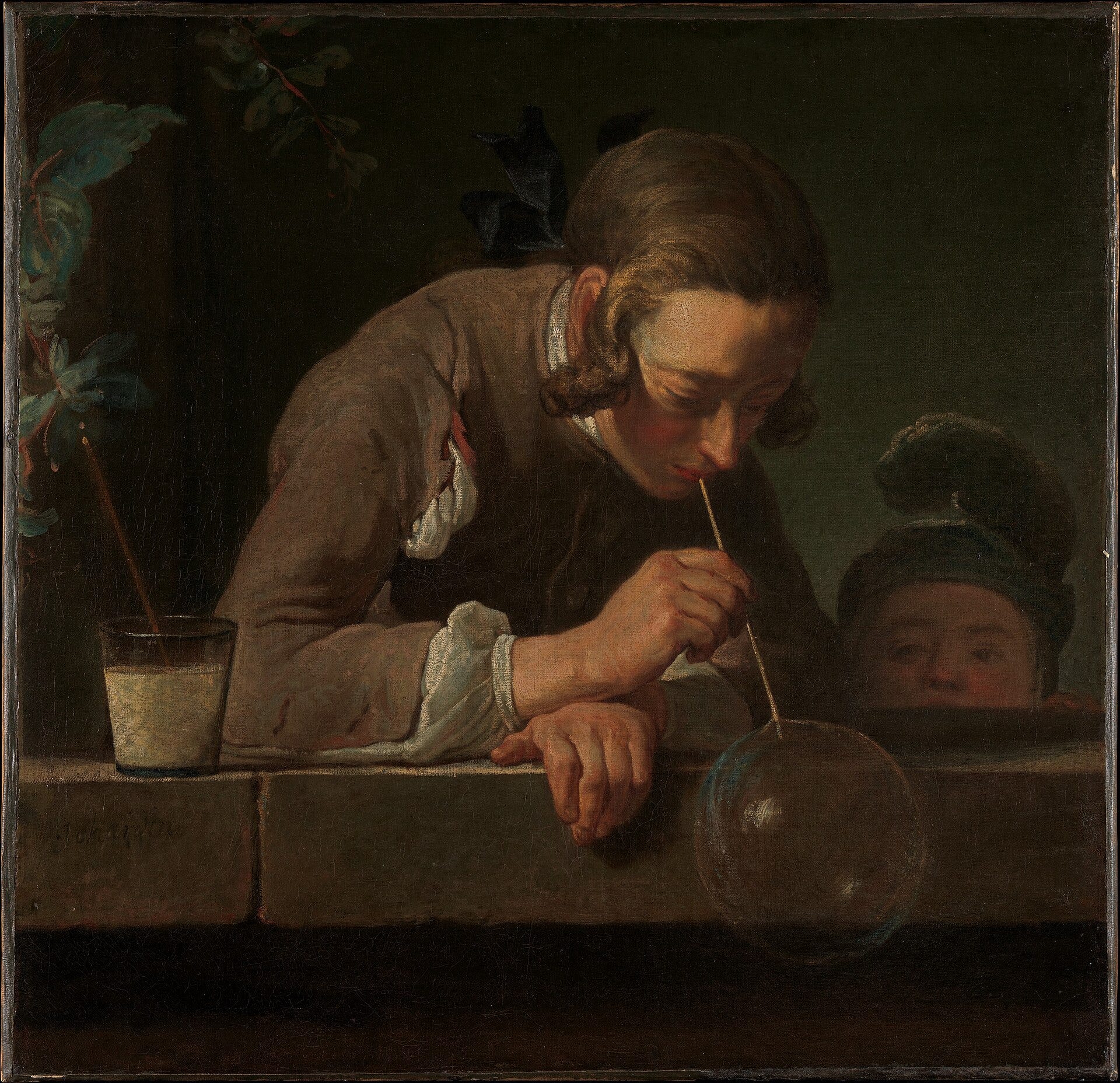
The Royal Academy took him in at 28 as a painter of animals and fruit, the lowest rank it had to offer, and he is remembered today as the master of the quiet still life. His best known picture, Soap Bubbles, shows a young man blowing a bubble out of a glass.
The picture shows almost nothing happening. A young man leans on a ledge with a glass of soapy water, a child leans over the ledge beside him, and the whole canvas waits for the bubble to drop or burst.
It was painted around 1733 by a man whose life was just as plain from the outside. He never lived anywhere but Paris, he was the son of a maker of billiard tables, and he died in rooms the king had given him in the Louvre.
Cool Stories About Art is a newsletter to learn art the fun way.
Join 200,000+ readers and get:
10 new art stories / month
The entire archive of content (140+ articles)
Comment, ask questions, and chat with other readers
Yet the Academy that admitted him ranked such pictures at the bottom. In September 1728 he was received on the strength of The Ray, a canvas almost a meter and a half wide in which a gutted fish hangs in a kitchen while a cat stalks it.
The Academy ranked a picture by its subject, and a gutted fish stood far below a king or a saint. The novelist Marcel Proust, writing about the picture as a young man, saw "red blood, blue nerves and white muscle" in the open flesh.
Then, at the Salon of 1763, the writer and critic Denis Diderot stood in front of Chardin's canvases and admitted defeat. "We understand nothing of this magic," he wrote. "Come closer, and everything blurs, flattens out and vanishes. Step back, and everything creates itself again." The most celebrated critic in France could not say how a still life had been made.
Chardin himself left no treatise on his method. One remark is attributed to him, "I make use of colors but I paint with sentiment," and it explains very little. His career ended in a medium he had never tried before his seventies, and the cause may have been in his own paint box.
What You'll Discover
What the Academy saw in a dead fish.
What a soap bubble meant before him.
What Diderot could not explain.
What became of his son in Italy.
Why he gave up oil late in life.
Where his best pictures hang today.