Joan Miro: The Complete Story
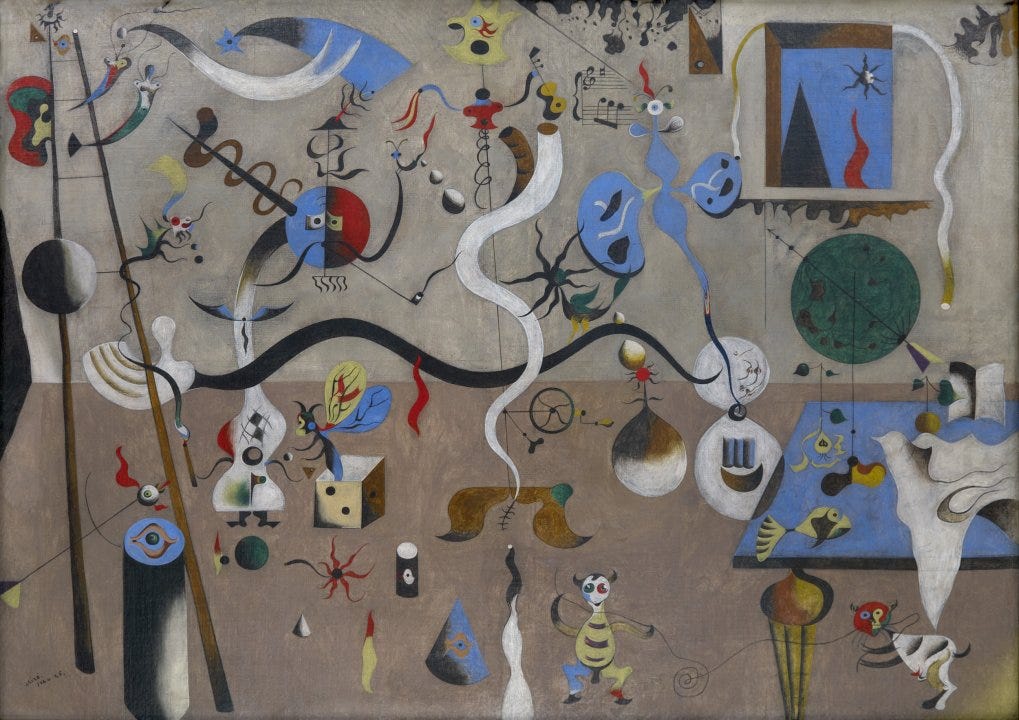
Joan Miro was the Catalan artist who filled his canvases with floating shapes, stars, eyes, birds and squiggles in pure red, blue, yellow and black.
They look like a child's dream, but they came from a serious mind that wanted to blow up traditional painting and rebuild it as a free, playful language of signs.
People file him under Surrealism, and he belongs there, but he never quite fit any group. He invented a private alphabet of forms and spent sixty years expanding it.
Born: Barcelona, 1893
Known for: biomorphic shapes, a personal language of signs, Surrealism
Died: Palma, Mallorca, 1983
If the list was not enough
If this is the kind of art history you want more of:
Ten women artists you need to know, the names the textbooks skipped
Was Monet really the first Impressionist, the painting that may have got there first
The secret behind Monet Magpie, one bird in the snow, and why it matters
Assassinate painting
As a young man Miro declared he wanted to assassinate painting, meaning the stale, respectable easel art of the past. He wanted to tear it down and start again from instinct, dreams and the unconscious.
Out of that came his signature world, flat colored grounds scattered with curling black lines and small shapes, half creature and half symbol, that he treated like words in a language only he fully knew.
From the farm to the dream
His early masterpiece, The Farm, is a precise, almost magical picture of his family's land in Catalonia. Ernest Hemingway bought it and treasured it for life, saying it held everything you feel about Spain.
Soon after, his work loosened and floated free of reality. The detailed farm gave way to the open, starry dream spaces that made him famous.
Painting through war
During the upheavals of the late 1930s and the Second World War, Miro made a series of small, dense works called Constellations, full of stars, moons and birds. They were an escape into the night sky while Europe burned.
He stayed deeply tied to Catalonia and its culture, even under Franco's dictatorship, and became a symbol of Catalan identity.
More than paint
Miro never stopped experimenting. He made ceramics, huge public sculptures, murals, tapestries and prints, scattering his shapes across plazas and walls around the world.
His simple, joyful star and sun logo for a Spanish bank and his tourism designs put his language in front of millions who never set foot in a museum.
Quick answers about Joan Miro
What is Joan Miro famous for?
A playful personal language of floating shapes and primary colors, within Surrealism. See what is surrealism.
Was he a Surrealist?
Yes, broadly, though he kept his independence. See also what is abstract art.
Where was he from?
Barcelona, in Catalonia, a region he stayed loyal to all his life.
Why he still matters
Miro proved that art could be radical and joyful at once, and built a visual language so friendly that children love it and scholars study it. Few artists are both that accessible and that deep.
One last fact. He helped found a huge foundation in Barcelona to support young experimental artists, making sure the man who wanted to assassinate old painting kept funding new painting after his death.