
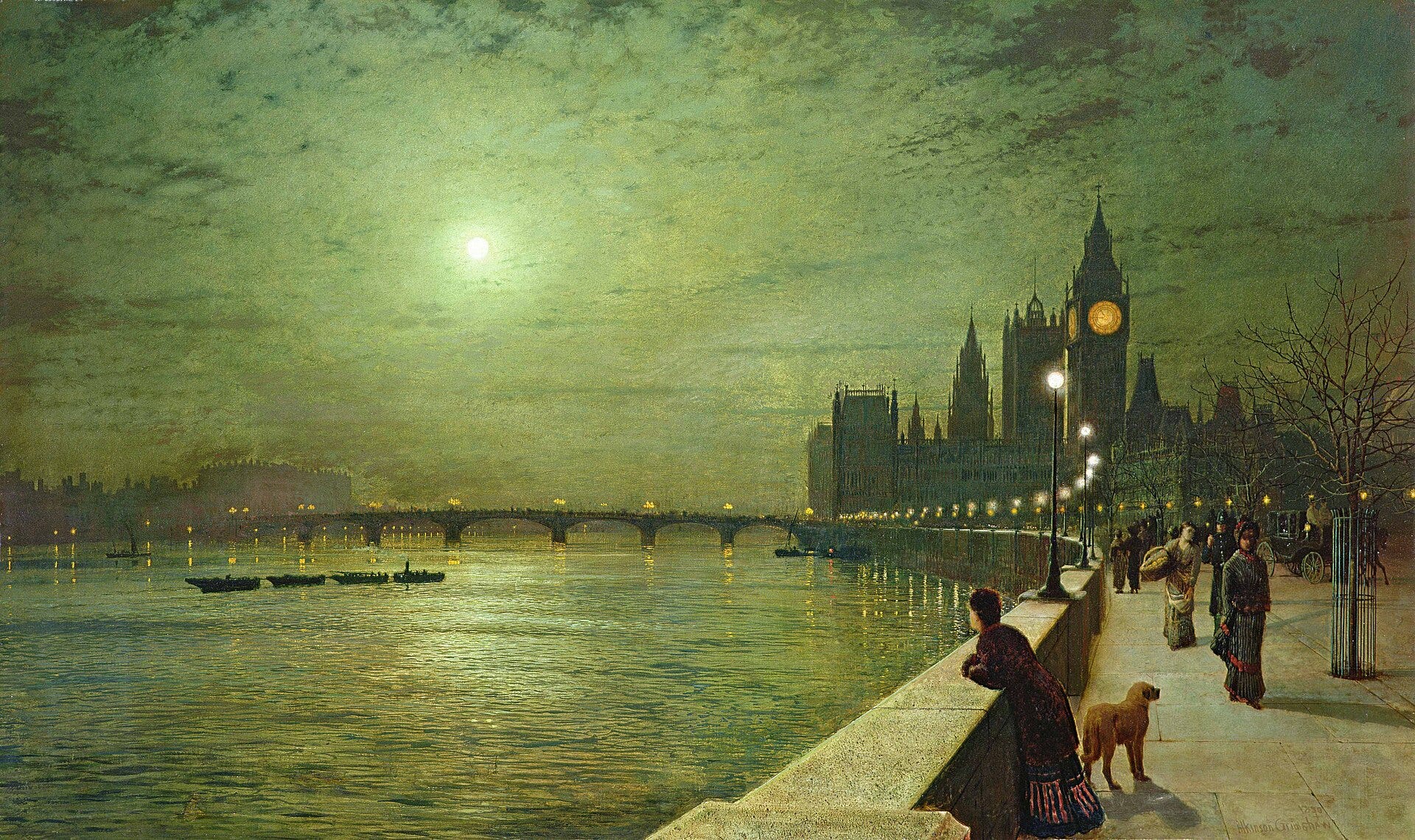
John Atkinson Grimshaw (1836 to 1893) was an English painter from Leeds, a big factory city in the north of England. He painted cities and ports at night: wet streets, docks and the masts of ships under the moon and the gas lamps, in detail as sharp as a photograph.
His night views, among them Reflections on the Thames, Westminster and Liverpool Quay by Moonlight, sold well in the reign of Queen Victoria, who ruled Britain from 1837 to 1901. He died at his home near Leeds in 1893.
Yet Grimshaw never had a painting teacher. He worked in a railway office until he was twenty-four, and his parents did not want a painter in the family.
Cool Stories About Art is a newsletter to learn art the fun way.
Join 200,000+ readers and get:
10 new art stories / month
The entire archive of content (140+ articles)
Comment, ask questions, and chat with other readers
John Atkinson Grimshaw grew up in Leeds in a back-to-back house, a small workers' house that shared its rear wall with the house behind it. His father, David Grimshaw, was a policeman.
Both parents were strict Baptists, members of a Protestant church with severe rules of life. To them, painting was a waste of time. Their son painted anyway.
Grimshaw left no letters and no diary, so the story of his youth comes from the memories of his children and grandchildren. In the family's memory, his mother threw his paints on the fire.
In the evenings, his mother also turned off the gas that fed the lamps of the house, so that her son had no light to paint by.
Then the parents found their son a steady job. Grimshaw became a clerk, an office worker who keeps the record books, at the Great Northern Railway, one of the companies that ran trains between London and the north of England.
While he worked for the railway, Grimshaw married his cousin, Frances Theodosia Hubbard, known as Fanny. Unlike his parents, Fanny encouraged him to paint.
In 1861, against his parents' wishes, Grimshaw left the railway office to live from his painting. He had a wife to support, and nobody had ever shown him how to draw a street or a ship.
How did a railway clerk who had never taken a painting lesson come to paint whole cities at night, as sharp as photographs?
In the rest of the story, you'll find out:
what a famous critic's book told young painters like Grimshaw to do
what a friend's unpaid debt cost Grimshaw in 1879
what tool Grimshaw most likely used to make his streets as sharp as photographs
why other painters doubted that Grimshaw's pictures were paintings at all