
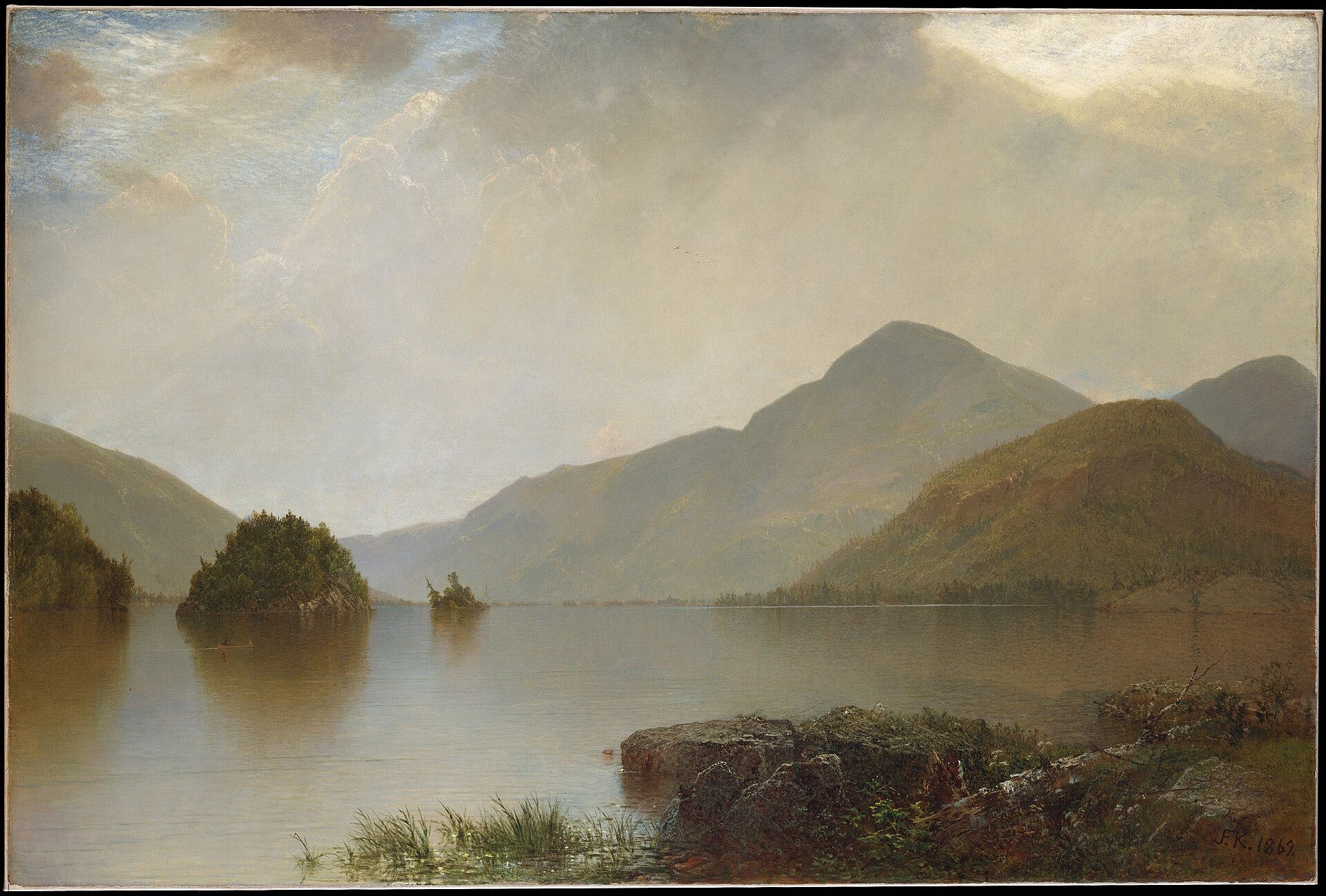
John Frederick Kensett (1816 to 1872) was an American painter of the Hudson River School, a group of landscape painters of the 1800s. He became famous for calm, light-filled lakes and shores, like Lake George, now at the Metropolitan Museum of Art in New York.
Cool Stories About Art is a newsletter to learn art the fun way.
Join 200,000+ readers and get:
10 new art stories / month
The entire archive of content (140+ articles)
Comment, ask questions, and chat with other readers
In Kensett's lifetime, the most celebrated American landscapes were enormous. Frederic Church and Albert Bierstadt drew crowds with giant canvases of volcanoes and mountain ranges.
Kensett sold calm water, a strip of shore and a great deal of sky, and he was one of the leading painters in New York. By 1869, hotels and steamboat landings lined Lake George, a summer resort in New York State. In Lake George, the painting above, Kensett left out almost every sign of the summer crowds.
John Frederick Kensett was born in 1816 in Cheshire, a small town in Connecticut, into a family of engravers. Engravers cut fine lines into metal plates to print pictures, and by twelve, John was cutting them in his father's shop in nearby New Haven.
After his father died in 1829, John engraved banknotes with an uncle. Banks then printed their own paper money, and tiny engraved pictures called vignettes made the notes hard to copy.
As a teenager in New York, Kensett had met Asher B. Durand, an engraver who had turned to painting landscapes. In June 1840, at twenty-four, Kensett sailed for Europe with Durand to become a painter too.
Kensett stayed seven years, copying the old masters, the great painters of the past, in London and Paris. In Rome, in 1845, he fell ill, and a young American painter, Thomas Hicks, nursed him and became his friend for life.
In Italy, Kensett would spend a whole day studying and painting a single mullein, a tall roadside weed with a fuzzy stem.
Kensett came home to New York in November 1847. The next spring, he showed two paintings at the National Academy of Design, the society of New York painters.
Kensett wrote to Hicks: "My two pictures in the academy are sold to a gentleman in Providence." He added: "Hurra!" In the years ahead, he would give his buyers less and less to look at.
How far could Kensett go in leaving things out of his pictures before his buyers lost interest?
In the rest of the story
What Kensett did to the islands of Lake George in his painting.
How a landscape painter became one of the first trustees of the Metropolitan Museum.
Who Kensett went into the water for, in the fall of 1872.
What became of the paintings on Kensett's studio walls when he died.